Gravestone Doji: Meaning & How to Trade It

A gravestone doji is one of the easier bearish candlestick patterns to recognize: open, low, and close cluster near the bottom of the range, while a long upper wick stretches well above them. It shows up most often at the top of an uptrend, right where buyers start running out of room to push price higher. This guide covers how the pattern forms, what it tells you about buyer and seller behavior, and how to trade it without getting faked out by a candle that looks more ominous than it is.
Key Takeaways
- A gravestone doji forms when buyers push price sharply higher intraday, but sellers absorb that pressure and drag it back down to the open, leaving a long upper shadow and almost no real body.
- It’s a potential bearish reversal signal at the top of an uptrend, but it needs a confirmation candle, and ideally above-average volume, before you treat it as a real signal rather than noise.
- It’s the mirror image of a dragonfly doji, and on its own it’s a low-frequency, moderate-reliability pattern best combined with resistance levels or another indicator, not traded in isolation.
Financial Tech Wiz Trading Journal
Spotting a gravestone doji is only half the job. The other half is knowing whether it actually worked the last five times you traded one.
The Financial Tech Wiz Trading Journal tracks every trade off a pattern like this: win rate, P&L, and hold duration by symbol, so you can see whether gravestone doji reversals actually pay, or just look good on a chart.
Start Tracking Your Trades$19/month, or $9.91/month billed annually.
What Is a Gravestone Doji Candlestick?
A doji forms any time a candle’s open and close land at nearly the same price, so the “body” is essentially a flat line. A gravestone doji is a doji where that flat line sits at the very bottom of the range: price opens, rallies hard, then gives it all back down to the open by the close, leaving a long upper shadow, little to no lower shadow, and a shape like an inverted “T,” or a headstone standing upright, which is where the name comes from.
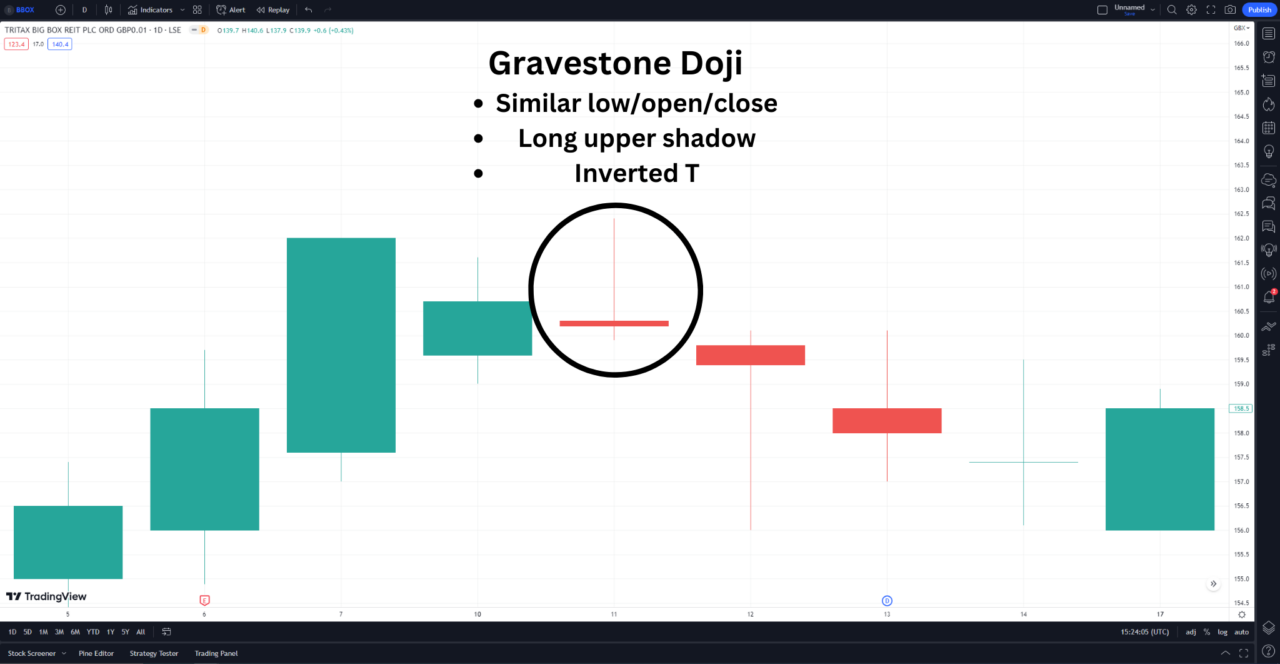
There’s no strict rule for wick length relative to body, but the more the pattern looks like a straight vertical line with almost no body, the more textbook it is. When a gravestone forms as the middle candle of a three-candle top, it can be part of an evening doji star, a stronger bearish signal built from three sessions instead of one.
How a Gravestone Doji Forms: The Psychology Behind It
Candlestick patterns are a shorthand for order flow. Buyers push price up hard early in the session, sometimes to a fresh high, and for a while the uptrend looks intact. Then sellers step in, in size, and drag price back down to the open by the close. That round trip matters more than the shape itself: buyers had control for most of the session and lost it entirely by the close. Over my years of trading, the gravestone dojis that led somewhere were almost always printed on above-average volume, where real size was clearly changing hands, not a quiet, low-volume session with an odd shape.
Bullish or Bearish? Context Decides
A gravestone doji has no fixed direction on its own. It’s a reversal candidate, and what it’s warning about depends entirely on where it shows up.
Gravestone Doji at the Top of an Uptrend (The Classic Signal)
This is the setup traders actually care about. After a sustained move higher, a gravestone doji suggests buyers pushed price to a new high and couldn’t hold it there. If the next candle confirms by closing lower, it’s an early sign buying pressure has exhausted itself. Two gravestone dojis printing back to back at the top of an uptrend escalates into a double doji at the top, a stronger bearish signal because sellers defended the high across two sessions instead of one.
Gravestone Doji in a Downtrend (What It Actually Means)
The same shape can print mid-downtrend, and traders searching for what that means are usually hoping it signals a bottom. It doesn’t, on its own. A gravestone doji in a downtrend means buyers tried to rally price intraday and got rejected, a continuation signal, not a reversal one: sellers are still in control. The pattern only earns its reversal reputation after a sustained uptrend.
Does the Color of a Gravestone Doji Matter?
You’ll see gravestone dojis printed as both red and green candles, and the color tells you almost nothing extra. Since the open and close are nearly identical by definition, a “green” gravestone doji simply closed a fraction above its open, and a “red” one closed a fraction below it. Neither version is meaningfully more bearish than the other. What matters is the shape, where it appears in the trend, and whether volume and the next candle confirm it. Treat color as cosmetic on this pattern.
How Reliable Is the Gravestone Doji?
A clean gravestone doji, tiny body and genuinely long upper wick, is rare next to patterns like engulfing candles or inside bars. Rarity isn’t the same as reliability, though. Published pattern-reliability research on single-candle reversal setups generally puts the raw follow-through rate only marginally above a coin flip when traded in isolation, no resistance level, no volume confirmation, no follow-through candle, which is why every trader who uses it leans on confirmation rather than the shape alone. Stack a well-tested resistance level, above-average volume, and a bearish confirmation candle on top, and the odds improve.
How to Spot a Gravestone Doji on a Chart
In practice, you’re scanning for three things: a small or nonexistent body, an upper wick two to three times the length of that body, and a location at the top of a visible uptrend. A charting platform with clean candlestick rendering and volume overlays makes this faster than counting wicks by hand.
TradingView
TradingView’s charting tools make it easy to scan for gravestone dojis in real time, layer in volume and resistance levels, and set alerts so you’re not refreshing charts by hand.
Try TradingView FreeOnce you can spot the shape, pair it with technical indicators for confirmation on whether momentum is actually rolling over, not just one candle’s worth.
How to Confirm a Gravestone Doji (and Avoid False Signals)
The single most common mistake is acting on it the moment it closes. A gravestone doji signals a reversal might be starting, not proof that it has. A few checks before you size up a trade:
- Location matters more than shape. A gravestone doji at a prior resistance level or round number carries more weight than the same shape mid-range.
- Volume should confirm the reversal. Above-average volume on the doji or the confirmation candle after it tells you real participants are behind the move.
- Watch for a false signal in a strong uptrend. Sellers can absorb one session’s buying and still get run over the next day.
Best Timeframes for Trading the Gravestone Doji
The pattern shows up on every timeframe, but it doesn’t carry equal weight on all of them. On a 1-minute or 5-minute chart, gravestone dojis are common and mostly noise. On daily and weekly charts, where far more volume and time went into building that upper wick, the same pattern tends to mean more. Swing traders get the most reliable use out of it on daily charts; day traders using it intraday should lean harder on volume confirmation.
Gravestone Doji vs Dragonfly Doji vs Inverted Hammer
These patterns get confused constantly: a long wick on one side, a small or nonexistent body, and a location at the end of a trend.
Gravestone Doji vs Dragonfly Doji
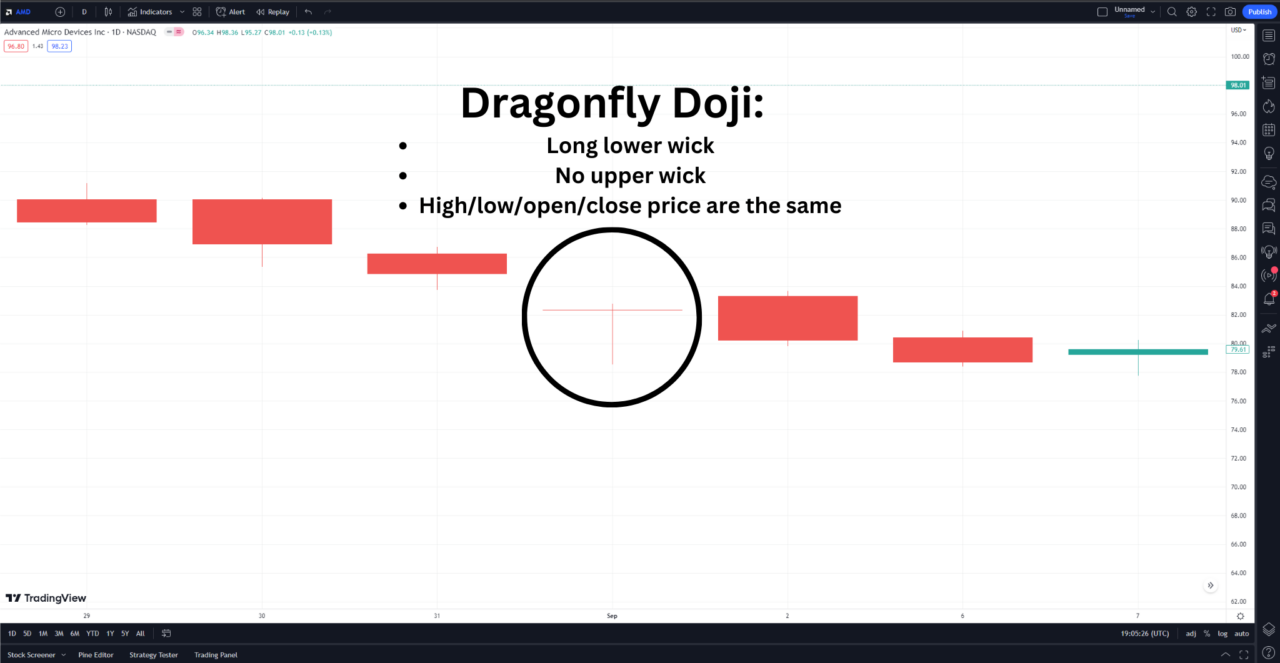
The dragonfly doji is the gravestone’s mirror image: a long lower shadow, little to no upper shadow, and the open, high, and close clustered near the top of the range. Where a gravestone doji at the top of an uptrend is bearish, a dragonfly doji at the bottom of a downtrend is bullish. Traders occasionally call this the “inverted dragonfly doji,” which is really just another name for the gravestone rather than a distinct third pattern.
Gravestone Doji vs Inverted Hammer
An inverted hammer has the same long-upper-wick silhouette as a gravestone doji, one of the most commonly misread candles. The difference is context and body size: an inverted hammer has a small visible body and shows up at the bottom of a downtrend as bullish, while a gravestone doji has essentially no body and shows up at the top of an uptrend as bearish. Same silhouette, opposite location, opposite meaning.
How to Trade the Gravestone Doji: Entries, Stops, and Risk Management
Once you have a confirmed gravestone doji at a level you’re willing to trade, the mechanics are straightforward:
- Entry: Enter on the close of the confirmation candle, not the doji itself, to avoid a pattern that fails to follow through.
- Stop-loss: Place your stop above the high of the doji or the confirmation candle, whichever is higher. That high is the level sellers defended.
- Position size: Size the trade to the distance between entry and stop, not to how confident you feel about the pattern.
- Exit: Decide your profit target or trailing-stop plan before you enter: the next support level, a fixed risk/reward ratio, or a trailing stop above each new lower high.
No candlestick pattern guarantees a reversal. Use the gravestone doji as one tool in a broader plan, not a signal you trade in isolation. If you’re not ready to pay for a full trading journal yet, FTW’s free trading journal template is a solid place to start logging setups like this one by hand.
Gravestone Doji: Bottom Line
A gravestone doji is a useful, easy-to-spot signal that buyers lost control after pushing price to a new high, most meaningful at the top of an uptrend and paired with confirmation, volume, and a real resistance level. It’s not a standalone sell signal, and color doesn’t change what it means. It’s one entry in a much larger toolkit; see FTW’s chart patterns guide for the rest of them. Treat it the same way as every other pattern: as evidence to weigh, not an answer on its own.
FAQ
What does a gravestone doji indicate?
A gravestone doji indicates buyers pushed price to a new high but lost control entirely by the close, settling back near the open. At the top of an uptrend, it’s an early sign momentum has been exhausted, though it needs a confirmation candle before you act.
What is the difference between a dragonfly doji and a gravestone doji?
A dragonfly doji has a long lower shadow, little to no upper shadow, and open, high, and close clustered near the top of the range. A gravestone doji is the opposite: long upper shadow, open, low, and close clustered near the bottom. The dragonfly is bullish at the bottom of a downtrend; the gravestone is bearish at the top of an uptrend.
What does a green gravestone doji mean?
A green gravestone doji simply closed a fraction above its open instead of below it. Because open and close are nearly identical by definition, color carries almost no extra meaning. What matters is the shape, the trend context, the volume, and whether the next candle confirms the move.
What is the difference between a shooting star and a gravestone doji?
A shooting star shares the gravestone doji’s long upper shadow and top-of-trend location, but has a small visible body instead of none. Both indicate buyers failed to sustain the move and sellers took control by the close.
What does a gravestone doji mean in a downtrend?
A gravestone doji mid-downtrend isn’t the reversal signal traders often hope for. It shows buyers tried to rally price intraday and were rejected, a continuation signal, not a reversal one. Save the bearish reversal reading for one that prints after a sustained uptrend.
This article contains affiliate links I may be compensated for if you click them.
Get Your Free Trading Resources
Grab the free trading journal template plus the same tools we use to stay organized, consistent, and objective.
- Free trading journal template
- Custom indicators, watchlists, and scanners
- Access our free trading community
Enter your email below to get instant access.
No spam. Unsubscribe anytime.