Charles Schwab vs E*TRADE (2026): Fees, Platforms, Winner

E*TRADE and Charles Schwab are two of the most recognized names in retail brokerage, and since 2020 both have sat inside much larger parents: E*TRADE under Morgan Stanley and Schwab after its TD Ameritrade acquisition. That second deal matters more than most comparisons admit, because it is the reason thinkorswim now lives at Schwab. This breakdown compares the two on platforms, fees, options pricing, banking, and research, then tells you which one fits the way you actually trade.
Both brokers earn a place in our broader roundup. For the full field organized by trading style, see our guide to the best trading platforms for 2026.
If you are cross-shopping Fidelity at the same time, the E*TRADE vs. Fidelity breakdown covers the other traditional-broker comparison.
Key Takeaways
- Schwab is the stronger all-around pick for most traders thanks to thinkorswim, deep research, and integrated banking; E*TRADE leans toward a clean options workflow and active-trader options pricing.
- Core costs are nearly identical: both charge $0 on stocks and ETFs and $0.65 per options contract, so the decision comes down to platform, banking, and research, not headline commissions.
- Whichever broker you pick, your broker dashboard will not show win rate, expectancy, or performance by symbol; track those in a dedicated trading journal.
Recommended Tool
Financial Tech Wiz Trading Journal
Both brokers give you the order ticket. Neither gives you post-trade analytics. The Financial Tech Wiz Trading Journal pulls your E*TRADE or Schwab account via SnapTrade and breaks down win rate by setup, equity curve vs. the S&P 500, and per-symbol P&L for every closed trade. Starting at $9.91/month billed annually.
Try It FreeAre E*TRADE and Schwab the Same Company?
No. E*TRADE and Charles Schwab are two completely separate companies with different parent owners. Morgan Stanley closed its acquisition of E*TRADE in October 2020, and the brand now operates as “E*TRADE from Morgan Stanley” with its own platforms, fees, and account experience. Charles Schwab acquired TD Ameritrade in 2020 and finished the TDA-to-Schwab account migration in 2023, which is when thinkorswim formally moved under the Schwab umbrella. That leaves E*TRADE owned by Morgan Stanley and Schwab running thinkorswim as its active-trader platform. If you want the deeper look at how thinkorswim works inside Schwab, read the Schwab vs. thinkorswim comparison.
| Year | E*TRADE | Charles Schwab |
|---|---|---|
| 2020 | Acquired by Morgan Stanley (closed October). | Announced TD Ameritrade acquisition. |
| 2021-2022 | Operates as E*TRADE from Morgan Stanley; platforms unchanged. | TDA client integration begins in waves. |
| 2023 | Account platforms migrate to Morgan Stanley infrastructure. | TDA-to-Schwab migration completes; thinkorswim formally part of Schwab. |
| 2024-2026 | E*TRADE brand and platforms continue under Morgan Stanley. | thinkorswim, StreetSmart Edge, and Schwab web coexist; Schwab begins sunsetting StreetSmart Edge in late 2025. |
E*TRADE at a Glance
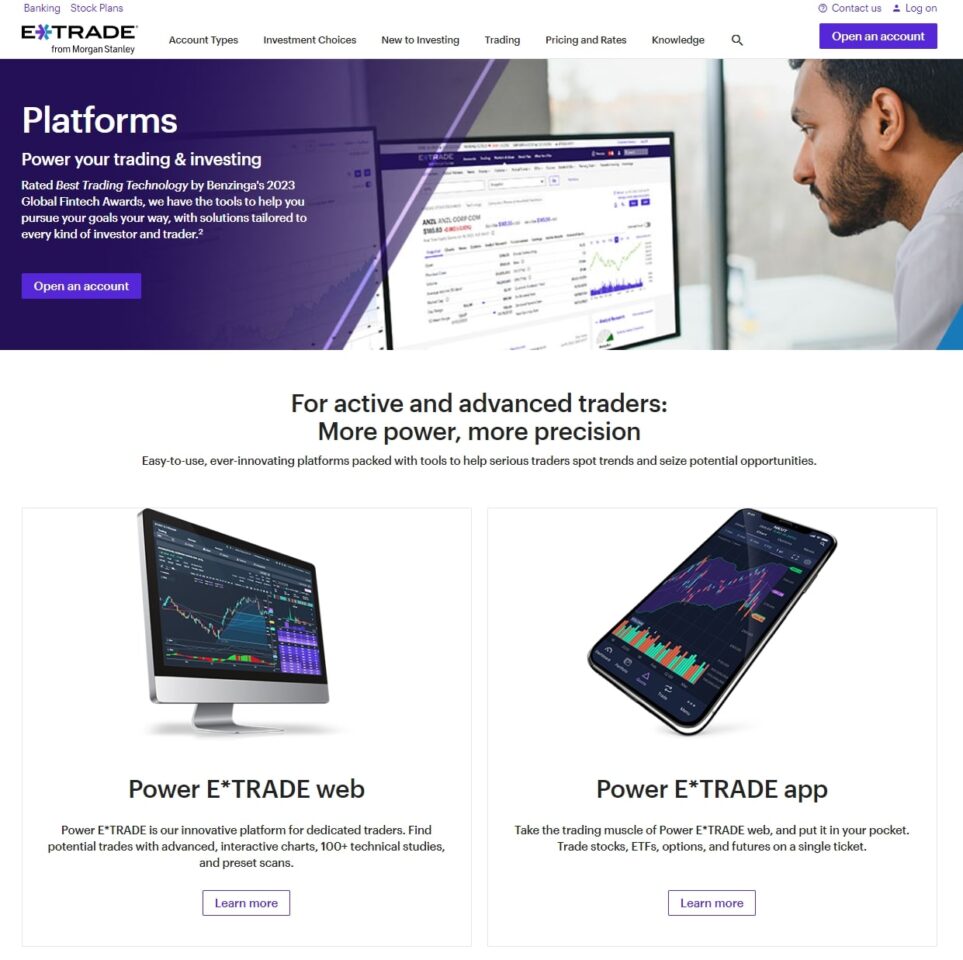
E*TRADE is one of the original online discount brokers, founded in 1982 and now owned by Morgan Stanley. It supports stocks, ETFs, mutual funds, bonds, options, futures, and futures options, with a smaller crypto surface than a dedicated crypto-first broker. Its flagship active-trader platform is Power E*TRADE, which is designed around options workflows (risk slide, strategy scanner, heat map) and runs in the browser and on mobile. The standard E*TRADE experience is friendlier to beginners and casual investors than Schwab’s thinkorswim.
Charles Schwab at a Glance
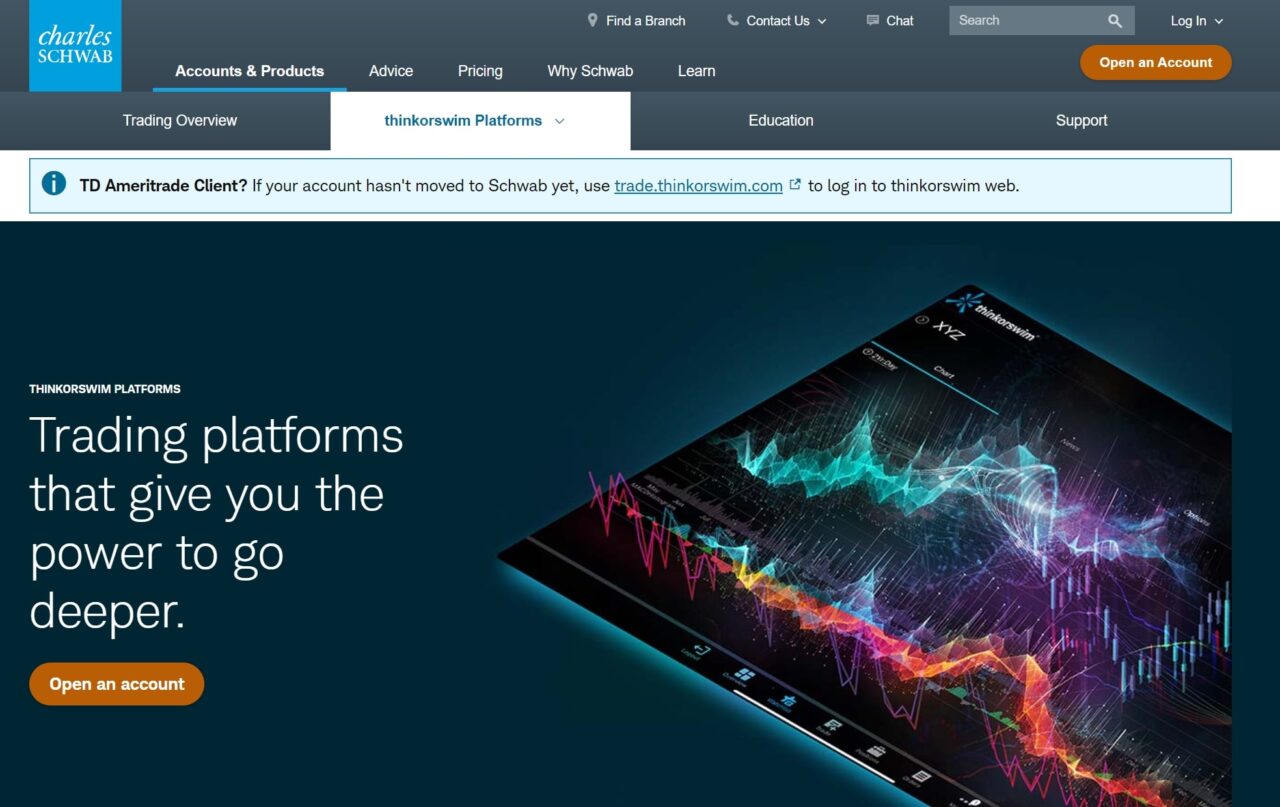
Charles Schwab was founded in 1971 and is now one of the largest brokerages in the world, with more than $9 trillion in client assets. It supports stocks, ETFs, mutual funds, bonds, options, futures, futures options, and index options, and it offers fractional share investing through Schwab Stock Slices. Schwab operates three trading interfaces: the standard Schwab web and mobile experience for long-term investors, StreetSmart Edge for active equity traders, and thinkorswim (desktop, web, and mobile) for active options and derivatives traders. It also maintains a physical branch network, which E*TRADE does not.
Side-by-Side Comparison Table
| Feature | E*TRADE | Charles Schwab |
|---|---|---|
| Parent company | Morgan Stanley (since 2020) | Independent; acquired TD Ameritrade in 2020 |
| Account minimum | $0 | $0 |
| Stock and ETF commission | $0 | $0 |
| Options (baseline) | $0.65 per contract | $0.65 per contract |
| Options (active trader) | $0.50 per contract at 30 or more trades per quarter | No discount tier |
| Futures | $1.50 per contract, per side | $2.25 per contract, per side |
| Active-trader platform | Power E*TRADE (web and mobile) | thinkorswim (desktop, web, mobile) + StreetSmart Edge |
| Fractional shares | Yes (select ETFs and stocks) | Yes (Schwab Stock Slices, S&P 500) |
| Crypto | Limited (ETFs and futures, no direct spot) | Limited (ETFs and futures, no direct spot) |
| Forex | No | Yes (via thinkorswim, forex.com pass-through) |
| Margin rate (under $25k) | ~12.95% | ~12.58% |
| Outgoing account transfer (ACATS) | $75 | $50 |
| Physical branches | Limited Morgan Stanley locations | 300+ nationwide |
| SIPC insurance | Yes (up to $500K; $250K cash) | Yes (up to $500K; $250K cash) |
Trading Platforms Compared
Power E*TRADE vs. thinkorswim
Power E*TRADE is browser-based and optimized for options. It includes a live risk slide, strategy scanner, custom options chain layout, and a spectral chart for volatility skew. It is easier to learn than thinkorswim and works well for traders who live in the options chain but do not want to set up a full desktop charting rig. thinkorswim is a heavier tool: a downloadable desktop application with custom thinkScript studies, tick-level charting, paperMoney simulation, OnDemand replay, and deep futures support. If you want the most customizable environment in retail brokerage, thinkorswim wins. If you want a fast options-centric workflow without the learning curve, Power E*TRADE wins. For a full breakdown of Power E*TRADE and thinkorswim head-to-head, see the E*TRADE vs. thinkorswim breakdown.
Web and Browser Platforms
Schwab runs two browser experiences: the standard Schwab.com portal for long-term investors and the thinkorswim web app for active traders who want a lighter-weight version of the desktop tool without losing the custom studies. E*TRADE offers the main etrade.com interface for everyday account activity plus the Power E*TRADE browser platform for active trading. Schwab’s browser stack is deeper; E*TRADE’s browser stack is simpler.
Mobile Apps
Schwab runs three mobile apps: Schwab Mobile, thinkorswim Mobile, and the StreetSmart Mobile legacy app. Active traders typically live in thinkorswim Mobile, which carries over most of the desktop charting and options workflows. E*TRADE runs two mobile apps: the main E*TRADE app for account management and the Power E*TRADE app for traders. Reviews typically rate thinkorswim Mobile as the more powerful active-trading mobile app; Power E*TRADE is cleaner for options-focused mobile order entry.
Fees and Commissions
Stocks and ETFs trade at $0 at both brokers. Options are $0.65 per contract at both brokers with one key exception: E*TRADE drops to $0.50 per contract for traders placing 30 or more trades per quarter. If you are an active options trader, that $0.15 per contract discount compounds quickly. Futures cost $1.50 per contract per side at E*TRADE and $2.25 per contract per side at Schwab through thinkorswim. Margin rates favor Schwab at every balance tier (under $25k, Schwab is roughly 12.58% vs. E*TRADE’s 12.95%, and the gap widens at higher balances). Outgoing ACATS transfers cost $75 at E*TRADE and $50 at Schwab, so switching brokers is slightly cheaper coming from Schwab. Neither broker charges inactivity or annual account fees.
Investment Options and Asset Classes
Both brokers cover the core asset classes: stocks, ETFs, mutual funds, bonds, options, futures, and futures options. Schwab adds index options (SPX, NDX, RUT) and forex trading through thinkorswim. Neither broker supports direct spot crypto ownership, though both offer crypto ETF access and crypto futures through CME. Schwab has a larger mutual fund selection and a proprietary suite of low-expense Schwab index funds; E*TRADE relies more heavily on Morgan Stanley research and managed portfolios for fund investors. Fractional shares are supported at both brokers, though Schwab Stock Slices is limited to S&P 500 names while E*TRADE supports a broader list of select ETFs and stocks.
Banking and Cash Management
Schwab is the clear differentiator here. A Schwab brokerage account pairs naturally with Schwab Bank, which offers a checking account with unlimited ATM-fee rebates worldwide and no foreign transaction fees, plus a tightly integrated transfer experience between banking and brokerage. For traders who want one login for cash, debit, and investing, that integration is a real day-to-day convenience.
E*TRADE offers banking through Morgan Stanley Private Bank, including checking and savings products and a debit card, but the experience is less central to the trading workflow than Schwab’s. Both brokers sweep uninvested cash, though default sweep yields are typically modest at both; traders holding meaningful idle cash should compare the current sweep rate and the money-market alternatives at each broker rather than assume the default is competitive.
If banking integration is a priority, Schwab wins this category. If you keep banking and brokerage separate, it is close to a non-factor.
Research and Education
Schwab’s research stack is one of the deepest in retail brokerage: proprietary Schwab Equity Ratings, third-party reports from Morningstar, Argus, CFRA, and Market Edge, plus the thinkorswim screener and scanner tools for technical traders. Schwab consistently ranks top three among major brokers for research depth. E*TRADE offers solid third-party research (Morgan Stanley, Morningstar, TipRanks) and strong screeners inside Power E*TRADE, but the overall research depth is a step behind Schwab. Both brokers run extensive free education libraries, with Schwab’s content leaning broader (personal finance, retirement, investing basics) and E*TRADE’s leaning more active-trader focused.
Customer Support and Branches
Schwab runs 24/7 phone support and operates more than 300 physical branches nationwide, which is a meaningful advantage for clients who want in-person help with retirement rollovers, estate planning, or complex account issues. E*TRADE offers phone and chat support during extended hours and has limited physical presence through Morgan Stanley wealth locations, which are oriented toward advisor clients rather than walk-in retail. If branch access matters, Schwab is the clear winner.
Who Should Choose E*TRADE?
- Active options traders placing 30 or more trades per quarter who benefit from the $0.50 per contract active-trader tier.
- Traders who want a powerful options platform without the thinkorswim learning curve (Power E*TRADE).
- Morgan Stanley wealth management clients who want their brokerage tied to their advisor relationship.
- Futures traders who want the lower $1.50 per contract per side commission.
- Beginners who want a cleaner, simpler interface for stocks and ETFs.
Who Should Choose Charles Schwab?
- Active traders who want the full thinkorswim platform, including custom thinkScript studies, OnDemand replay, and paperMoney simulation.
- Research-heavy investors who want proprietary Schwab Equity Ratings plus Morningstar, Argus, CFRA, and Market Edge coverage in one account.
- Investors who want access to physical branches for retirement planning, rollovers, or advice.
- Margin users who want consistently lower margin rates at every balance tier.
- Long-term investors who prefer Schwab’s low-cost index fund lineup and Stock Slices fractional investing.
Account Promotions and Transfer Offers
Both brokers periodically run cash bonuses for new accounts and for ACATS transfers that move an existing portfolio over from another broker, with the bonus usually scaling to the size of the deposit or transfer. These offers change often, so rather than quote a figure that will be stale by the time you read it, check each broker’s current new-account and transfer-offer page before you open or move an account.
One practical note: an ACATS transfer moves your positions in kind, but it does not bring your trade history or your performance records with it. If you are switching from E*TRADE to Schwab or vice versa, export or record your closed-trade history first, or start logging in a journal at the new broker from day one, so your performance data survives the move.
Get Your Free Trading Resources
Grab the free trading journal template plus the same tools we use to stay organized, consistent, and objective.
- Free trading journal template
- Custom indicators, watchlists, and scanners
- Access our free trading community
Enter your email below to get instant access.
No spam. Unsubscribe anytime.
How to Track Your Trades at E*TRADE or Schwab
Neither E*TRADE nor Schwab will tell you your real win rate, your expectancy, or which setups actually make you money. Start free: grab the free trading journal template (a Google Sheets journal you can use today) and log your first trades. When you want automatic import and AI-driven analytics across your positions, the Financial Tech Wiz Trading Journal connects to 25+ brokers via SnapTrade and breaks down win rate and P&L by symbol and hold duration. See the step-by-step E*TRADE trading journal guide or the thinkorswim trading journal workflow for the full import process.
Frequently Asked Questions
Is E*TRADE now owned by Schwab?
No. E*TRADE is owned by Morgan Stanley, which closed its acquisition in October 2020. Charles Schwab is a separate company; Schwab acquired TD Ameritrade (not E*TRADE) and finished that integration in 2023. E*TRADE now operates as “E*TRADE from Morgan Stanley” but keeps its own platforms, account interfaces, and pricing.
Is thinkorswim still available after the Schwab and TD Ameritrade merger?
Yes. thinkorswim was part of the TD Ameritrade acquisition, and Schwab kept the full platform intact across desktop, web, and mobile. Existing thinkorswim users were migrated to Schwab accounts in 2023 but continue to log into the same thinkorswim application. New Schwab clients can enable thinkorswim on any standard Schwab brokerage account at no extra cost.
Which has lower fees, E*TRADE or Schwab?
Fees are nearly identical on the surface: $0 stock and ETF commissions, $0.65 per options contract at both brokers, $0 account minimums. Where they differ: E*TRADE drops to $0.50 per options contract at 30 or more trades per quarter, and E*TRADE charges lower futures commissions ($1.50 vs. $2.25 per side). Schwab wins on margin rates at every balance tier and charges a lower $50 outgoing transfer fee vs. E*TRADE’s $75.
Which is better for options trading, E*TRADE or Schwab?
Both brokers are strong options brokers. E*TRADE through Power E*TRADE is easier to learn, has a cleaner strategy scanner, and is cheaper at 30 or more trades per quarter ($0.50 vs. $0.65). Schwab through thinkorswim is more customizable, supports index options (SPX, NDX, RUT) natively, and gives you thinkScript for custom studies and scans. Heavy, customization-focused options traders usually prefer thinkorswim; traders who want speed and simplicity usually prefer Power E*TRADE.
Can I transfer my account from E*TRADE to Schwab?
Yes. Both brokers accept incoming ACATS transfers for free. E*TRADE charges a $75 outgoing ACATS transfer fee if you move from E*TRADE to Schwab; Schwab charges $50 if you move the other direction. The transfer itself typically takes 5 to 7 business days and preserves your cost basis history. Many brokers will reimburse your transfer fee if you are opening a new account with a qualifying balance, so ask before you initiate.
Does Schwab or E*TRADE offer fractional shares?
Both brokers offer fractional shares. Schwab Stock Slices lets you buy fractional positions in any S&P 500 company for as little as $5. E*TRADE supports fractional investing on a broader list that includes select ETFs and dividend reinvestment for most stocks. For an investor buying individual S&P 500 names, Schwab has the simpler interface; for a broader fractional list, E*TRADE has slightly more coverage.
Is Schwab or E*TRADE better for beginners?
Both brokers work well for beginners, and either is a safe choice. E*TRADE’s standard interface and Power E*TRADE tend to feel slightly more approachable and less cluttered out of the box. Schwab offers deeper research and an extensive education library, plus in-person branch support if you want to talk to someone. A beginner who wants a clean interface and cheap options leans E*TRADE; a beginner who values research depth and branch access leans Schwab.
How does E*TRADE compare to Schwab and TD Ameritrade?
TD Ameritrade no longer exists as a separate broker. Schwab completed the TDA account migration in 2023, and all former TDA clients are now Schwab clients with continued access to thinkorswim. So the modern comparison is really E*TRADE vs. Schwab (with thinkorswim inside it). E*TRADE stayed independent of this consolidation under Morgan Stanley, while Schwab absorbed TDA’s client base and active-trader platform. For a direct look at thinkorswim as it lives inside Schwab today, see the Schwab vs. thinkorswim comparison.
Is Schwab or E*TRADE better for long-term investing?
For buy-and-hold investing both are strong and cost the same on stocks and ETFs, but Schwab edges ahead for long-term investors thanks to a broader fund lineup, integrated banking, and deeper research and planning tools. E*TRADE is fully capable for long-term portfolios and is a fine choice if you prefer its interface.
Related Broker Comparisons
- Schwab vs. thinkorswim
- E*TRADE vs. thinkorswim
- Schwab vs. tastytrade
- Interactive Brokers vs. thinkorswim
- Webull vs. thinkorswim
- thinkorswim Alternatives
- Best Trading Journals in 2026
- Supported Brokers for the Trading Journal
Get Your Free Trading Resources
Grab the free trading journal template plus the same tools we use to stay organized, consistent, and objective.
- Free trading journal template
- Custom indicators, watchlists, and scanners
- Access our free trading community
Enter your email below to get instant access.
No spam. Unsubscribe anytime.