Heikin Ashi Candles: How to Read and Trade Them (2026)

Heikin Ashi candles average out price data to filter market noise, which makes trends easier to see and easier to hold. The tradeoff is that they hide the exact prices you would trade at. This guide covers the formula, how to read the signals, and when a standard candlestick chart is still the better tool.
Key Takeaways
- Heikin Ashi candles are calculated from averaged price data, so they smooth out noise and make trends easier to follow than standard candlesticks.
- Long runs of same-colored candles with no opposing wick signal strong trends; small bodies with wicks on both sides warn of stalls and reversals.
- Because Heikin Ashi values are averages, the chart does not show real entry or exit prices; most traders pair it with a standard chart before placing orders.
Test It, Then Track It
Financial Tech Wiz Trading Journal
Switching to Heikin Ashi charts changes when you enter and exit. Tag every Heikin Ashi setup as you log it, pull those trades up in the Trades tab, and review your win rate and P&L broken down by symbol and hold duration to see whether the smoother chart is actually improving your results.
Try the Trading JournalWhat Are Heikin Ashi Candles?
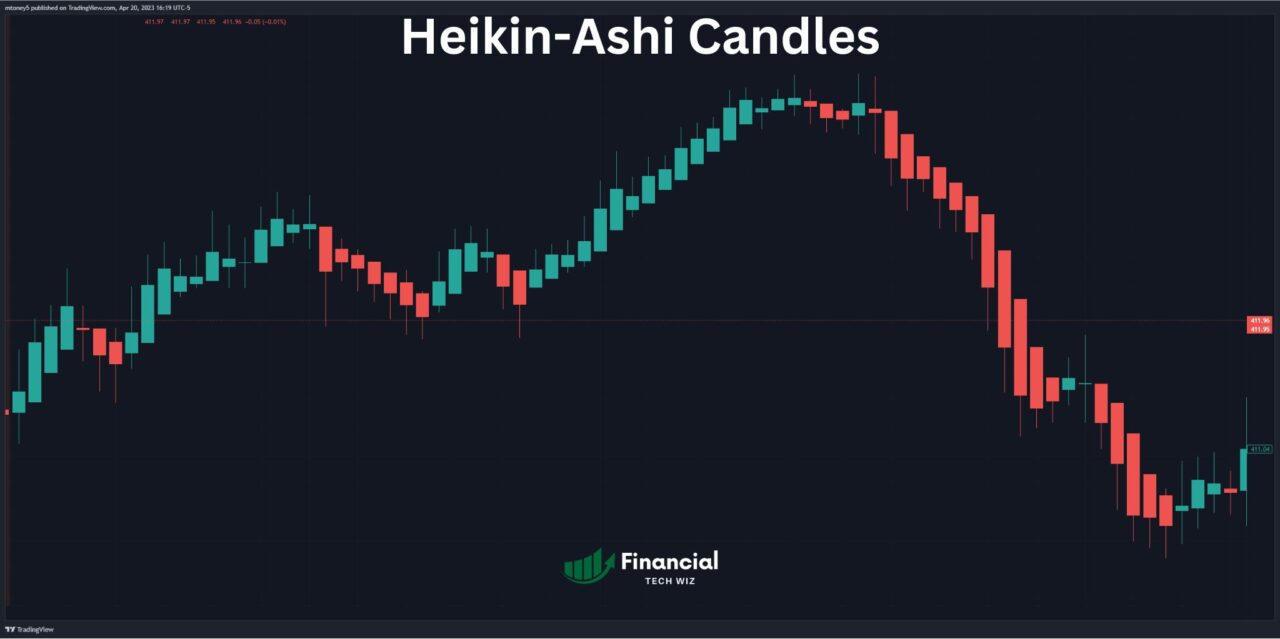
Heikin Ashi means “average bar” in Japanese, and that is exactly what these candles are. Instead of plotting each period’s actual open, high, low, and close the way a standard candlestick does, a Heikin Ashi candle blends the current period’s price data with the prior candle’s values. The result is a chart that looks like a candlestick chart but moves more smoothly, with fewer color flips and less noise inside a trend.
Traders use Heikin Ashi charts for one main job: staying in trends longer. On a standard chart, a strong uptrend still prints occasional red candles that shake out nervous traders. On a Heikin Ashi chart, those counter-trend blips often get averaged away, so the trend reads as an unbroken run of green. The technique comes from the same Japanese charting tradition as the patterns covered in our chart patterns guide.
The Heikin Ashi Formula
Each Heikin Ashi candle is built from four calculated values:
- HA Close = (Open + High + Low + Close) / 4, the average of the current period’s real prices
- HA Open = (prior HA Open + prior HA Close) / 2, the midpoint of the previous Heikin Ashi candle
- HA High = the highest of the period’s real High, the HA Open, or the HA Close
- HA Low = the lowest of the period’s real Low, the HA Open, or the HA Close
Here is a worked example. Say the prior Heikin Ashi candle had an HA Open of 100 and an HA Close of 104. The current period’s real prices are Open 104, High 108, Low 103, Close 107. The new HA Close is (104 + 108 + 103 + 107) / 4 = 105.50. The new HA Open is (100 + 104) / 2 = 102. The HA High is 108 and the HA Low is 102 (the HA Open sits below the real low of 103). Notice the printed candle opens at 102 even though price never traded there in that period. That is the core tradeoff: smoother visuals, synthetic prices.
How to Read Heikin Ashi Candles
Three signals cover most of what a Heikin Ashi chart tells you:
Strong trend candles
Long-bodied green candles with no lower wick signal strong buying pressure; long red candles with no upper wick signal strong selling. As long as candles keep printing one color with wicks only on the trend side, the trend is healthy and the chart is telling you to stay in the position.
Indecision candles
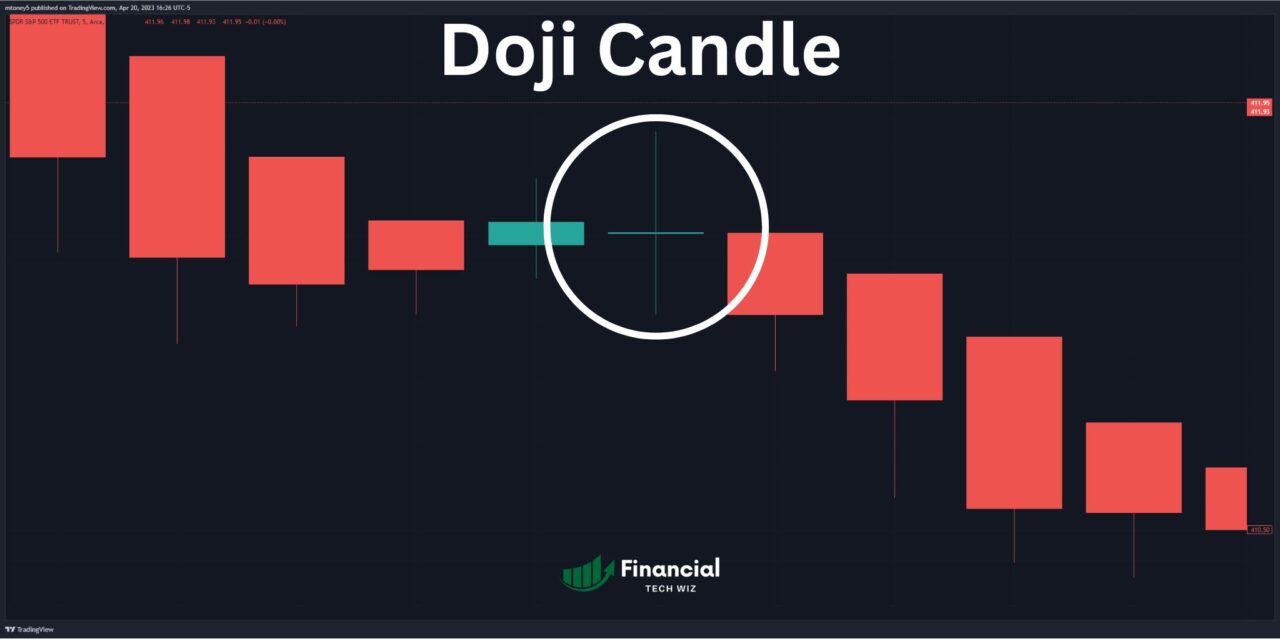
Small bodies with wicks on both sides are the Heikin Ashi version of a doji or spinning top. They mark hesitation and often appear before trend changes. If you trade doji setups on standard charts, our guide to doji candle types maps directly onto what these indecision candles mean here.
Color flips
Because the data is averaged, a color change on a Heikin Ashi chart is a slower, more deliberate signal than on a standard chart. A flip after a long one-color run carries real weight; a flip inside choppy sideways action carries almost none.
Heikin Ashi vs Traditional Candlesticks
| Feature | Heikin Ashi | Traditional candlesticks |
|---|---|---|
| Prices shown | Averaged, synthetic | Actual traded prices |
| Noise level | Low, smoothed | Full market noise |
| Trend readability | Excellent | Moderate |
| Entry/exit precision | Poor, prices lag | Exact |
| Gaps | Hidden by averaging | Visible |
| Best use | Trend following, holding winners | Timing entries, reading patterns |
Standard candlesticks remain the default for a reason: every classic reversal and continuation pattern is defined on real prices. Heikin Ashi is a lens you switch into when your question is “is this trend still intact?”, then switch back out of before you place an order. If you want a refresher on configuring standard candles first, see how to get candlesticks on TradingView.
Start Simple
Free Trading Journal Template
Not ready for a full journaling app? Log your Heikin Ashi trades in our free Google Sheets template. Note the chart type you used for each entry so you can compare results by hand before upgrading to automated tracking.
Get the Free TemplateHeikin Ashi Trading Strategies
Trend riding
The bread-and-butter strategy: enter when a color flip confirms a new trend after a pullback, then hold as long as candles stay one color with no opposing wick. Exit or tighten stops when indecision candles appear. This approach shines on daily and 4-hour charts where noise causes premature exits.
Reversal confirmation
Heikin Ashi indecision candles pair well with standard-chart reversal patterns. If a morning star pattern prints on the standard chart while the Heikin Ashi chart shows shrinking red bodies and two-sided wicks, the two charts are confirming each other and the reversal case is stronger.
Indicator pairing
Because Heikin Ashi already smooths price, it pairs best with indicators that measure something other than smoothed price: RSI for momentum divergence, volume for participation, and ATR for stop placement. Layering multiple moving averages on top of Heikin Ashi tends to double-smooth the signal. Our roundup of the best TradingView indicators covers settings for each of these.
Limitations of Heikin Ashi Candles
The averaging that creates the smoothness also creates every weakness the technique has. Printed prices are synthetic, so you cannot read exact support and resistance levels or fill prices off the chart. Signals lag by design, which costs you entry quality in fast markets and makes the technique poorly suited to scalping. Gaps disappear into the averaging even when they matter fundamentally. And in sideways, low-volume conditions the smoothing manufactures false mini-trends that lure trend followers into chop. Treat Heikin Ashi as a trend filter, not a complete charting system.
Do Professional Traders Use Heikin Ashi?
Yes, but almost never in isolation. Professional trend followers and swing traders use Heikin Ashi as a secondary lens to manage open positions and filter noise, while executing orders off standard charts or order-flow tools with real prices. The professional pattern is worth copying: analyze on Heikin Ashi, execute on standard candles, and journal the results so you know whether the switch actually helps your numbers. You can track that comparison in the Financial Tech Wiz Trading Journal by tagging each setup with the chart type that produced it.
How to Turn On Heikin Ashi Candles in TradingView
- Open any chart on TradingView.
- Click the candle icon in the top toolbar (next to the timeframe selector).
- Select Heikin Ashi from the chart-type dropdown.
- To switch back, open the same menu and choose Candles.
Heikin Ashi is available on every TradingView plan, including the free tier, and works on all timeframes. Most other platforms, including thinkorswim and NinjaTrader, include it as a standard chart type as well.
Chart It Yourself
TradingView
Heikin Ashi is a chart type, so the only way to learn it is to flip it on and watch a trend unfold in real time. TradingView gives you Heikin Ashi on the free tier across every timeframe and symbol, plus the RSI, volume, and ATR overlays that pair well with a smoothed chart. Open a chart, switch the candle type, and compare the same setup side by side against standard candles.
Open a Free TradingView ChartFAQ
What are Heikin Ashi candles?
Heikin Ashi candles are modified candlesticks calculated from averaged price data. Each candle blends the current period’s open, high, low, and close with the prior candle’s values, producing a smoother chart that makes trends easier to see than standard candlesticks.
Do professional traders use Heikin Ashi?
Many professional trend followers and swing traders use Heikin Ashi charts to manage positions and filter noise, but they typically execute trades on standard charts that show real prices. It is a supplementary tool, not a standalone system.
What are the disadvantages of Heikin Ashi candles?
The main disadvantages are lagging signals, synthetic prices that do not match real fill levels, hidden gaps, and false trend signals in sideways markets. The averaging that smooths the chart also delays and distorts the information it shows.
What is the difference between Heikin Ashi and regular candlesticks?
Regular candlesticks plot actual traded prices for each period. Heikin Ashi candles plot averaged values that incorporate the previous candle, so they show smoother trends but sacrifice price accuracy, gap visibility, and pattern precision.
Get Your Free Trading Resources
Grab the free trading journal template plus the same tools we use to stay organized, consistent, and objective.
- Free trading journal template
- Custom indicators, watchlists, and scanners
- Access our free trading community
Enter your email below to get instant access.
No spam. Unsubscribe anytime.