Iron Condor vs Iron Butterfly: Profit, Risk, When to Use

Iron condors and iron butterflies share the same four-leg structure: a short call spread paired with a short put spread, all expiring on the same date. The difference is where you place the short strikes, and that one design choice changes the profit zone, the max profit, and the volatility environment each strategy thrives in. This guide breaks down both, walks through a side-by-side example, and shows you when to pick each one. New to the strategy? Our full iron condor strategy guide covers the setup, math, and management in depth.
For the full picture of how this trade fits alongside other plays, see our options trading strategies guide.
For the full breakeven formula for iron condors and butterflies, see the options breakeven price guide.
Iron condors and butterflies are two of the most refined forms of premium-selling; for a broader look at which options strategies have the strongest long-term track record, see our most successful options strategies guide.
Both iron condors and iron butterflies are credit versions of a simpler structure. If you want the mechanics of the plain, non-iron version built from a single option type, see our guide to butterfly spread options.
Key Takeaways
- Iron condors sell out-of-the-money strikes for a wider profit zone, smaller credit, and a higher probability of profit.
- Iron butterflies sell at-the-money strikes for a narrower profit zone, a much larger credit, and a higher max profit if price pins near the strike.
- Use the iron condor in elevated IV when you expect a range; use the iron butterfly in high IV when you expect price to pin a specific level into expiration.
Recommended Tool
Financial Tech Wiz Trading Journal
Tag every iron condor and iron butterfly with entry IV, hold duration, and exit reason. See win rate and average P&L by structure so you know which one is actually working in your account. Starting at $9.91/month billed annually.
Try It FreeIron Condor vs Iron Butterfly: Side-by-Side Comparison
| Element | Iron Condor | Iron Butterfly |
|---|---|---|
| Short strikes | OTM call and OTM put (different strikes) | ATM call and ATM put (same strike) |
| Profit zone | Wide (between the two short strikes) | Narrow (centered on the shared short strike) |
| Max profit | Lower (smaller credit) | Higher (larger credit) |
| Max loss | Wing width minus credit | Wing width minus credit |
| Capital at risk | Defined | Defined |
| Ideal IV environment | Elevated IV, expecting range | High IV, expecting pin near the strike |
| Probability of profit | Higher | Lower |
| Best for | Range-bound, low directional conviction | Pin-the-strike conviction near a level |
What Are Iron Condors and Iron Butterflies?
Iron condors and iron butterflies are delta-neutral, defined-risk options strategies. Both are option selling strategies, meaning you are short volatility. The jade lizard strategy is a related premium-selling structure if you want a non-symmetric take on the same theme.
Because both structures are delta-neutral at entry, they generate a profit when the underlying does not move much in either direction. If implied volatility drops after you open the trade, options across the chain reprice lower and the trade gains value too.
Iron Condor vs Iron Butterfly: Structure
Both strategies use four legs. The difference shows up in where the short strikes sit relative to the current price.
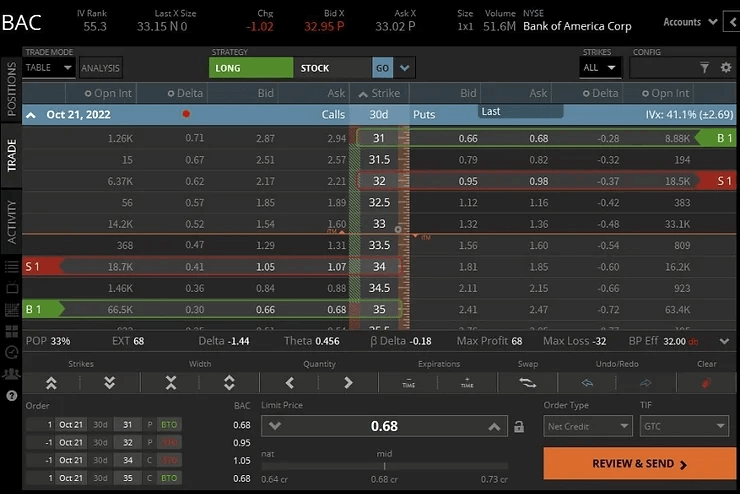
Iron Condor
- OTM short strikes
- Less extrinsic value collected from OTM strikes
- Collects less premium than the iron butterfly
- Wider profit range
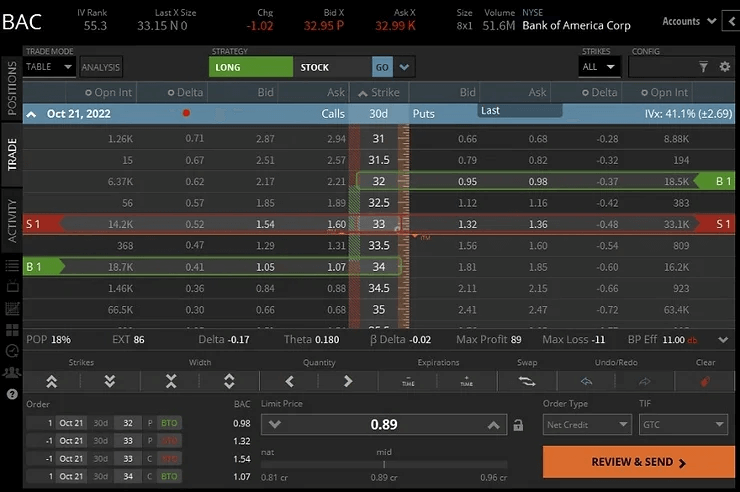
Iron Butterfly
- ATM short strikes
- Max extrinsic value is at the ATM strikes
- Collects more premium than an iron condor
- Narrower profit range
What Iron Butterflies and Iron Condors Have in Common
Aside from the four-leg short-volatility structure, the two strategies share a critical risk feature: both are defined-risk trades.
Both Strategies Are Defined Risk
Each strategy includes long protection legs that cap the worst-case loss at the wing width minus the credit collected. Without those long legs, an iron butterfly would be a short straddle and an iron condor would be a short strangle, both of which are naked structures with theoretically unlimited risk on the call side.

Some traders pair an iron condor or butterfly with a directional overlay. A jade lizard, for example, sells a naked put alongside a call credit spread to lean slightly bullish while keeping the call side defined.
How an Iron Butterfly Differs From an Iron Condor
The iron butterfly sells ATM short strikes. Because ATM options carry the most extrinsic value, you collect a larger credit than you would on an iron condor at the same expiration.
The trade-off is profit-zone width. The iron butterfly forces the underlying to stay close to the short strike for the full credit to be realized, while the iron condor leaves room for the underlying to drift across a much larger range.
The iron condor is the slightly more conservative structure because you are selling strikes further away from spot.
How the Greeks Behave in Each Strategy
Both strategies are short-volatility, short-gamma, long-theta, and roughly delta-neutral at entry. The differences sharpen on Vega and Gamma, and they are large enough to change how each trade behaves day to day.
Delta
Both structures open close to delta-neutral. The condor stays neutral across a wider range because its short strikes sit further from spot. The butterfly drifts off neutral faster as price moves away from the shared ATM strike, which can force defensive adjustments sooner.
Theta
The butterfly collects more theta per day at entry because the short ATM contracts hold the most extrinsic value. That decay only realizes if price stays close to the strike, so the higher theta number on day one does not always translate into a higher actual P&L by expiration.
Vega
The iron butterfly carries higher absolute Vega because the short ATM straddle component is more sensitive to a vol crush. The butterfly can pay faster on a volatility drop, but it also bleeds faster on a vol spike. The condor smooths Vega across two short OTM strikes, so vol moves hit the position less violently in either direction.
Gamma
The butterfly is more reactive to a single-direction move once the underlying drifts off the short strike: small moves cost a lot more, fast. The condor stays calm until price approaches one of the short strikes. If you are running both strategies side by side, track every iron condor and iron butterfly in the Financial Tech Wiz Trading Journal: tag entry IV regime, hold duration, and exit reason so you can see which structure your edge actually shows up in.
Worked Example: Same Underlying, Same Expiration
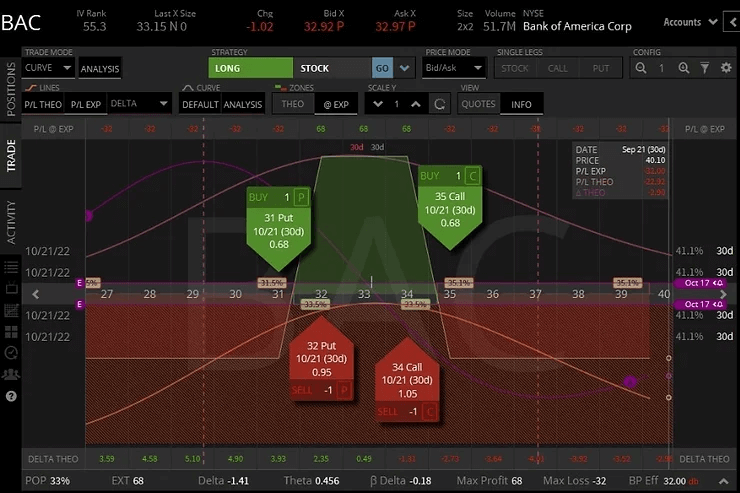
Same underlying at $400, 30 days to expiration, IV elevated. The iron condor sells the 415 call and the 385 put, then buys the 420 call and the 380 put as protection (5-wide wings, 30-point profit zone). Net credit collected: $1.50. Max profit: $150. Max loss: ($5.00 wing minus $1.50 credit) x 100 = $350. Breakevens: 386.50 and 416.50.
The iron butterfly on the same underlying sells the 400 call and the 400 put, then buys the 405 call and the 395 put. Net credit: $4.00. Max profit: $400. Max loss: ($5.00 wing minus $4.00 credit) x 100 = $100. Breakevens: 396 and 404.
Same capital framework, very different risk geometry: the condor hands you a 30-point cushion for $150 max, the butterfly hands you a 4-point cushion for $400 max. Pick based on conviction about where price closes, not just whether you think it stays range-bound. Drop the strikes from this example into our options profit calculator to see the exact P&L curve at expiration.
When to Use Iron Condor vs Iron Butterfly
Pick the iron condor when implied volatility is elevated and you expect the underlying to drift inside a wide range without a strong opinion on where it will close. The wide profit zone gives you room to be wrong on direction and still collect.
Pick the iron butterfly when IV is high AND you have a thesis that the underlying will pin near a specific level into expiration: a magnet strike, an ATM gamma cluster, a reversion spot after an earnings reaction. The butterfly gives you a much larger credit but penalizes you the moment price drifts off the strike.
Both of these are advanced, four-leg trades. If you want a simpler way to earn option income on shares you already hold, a covered call involves selling just a single call and is where most income traders start before moving on to multi-leg structures like these.
As a rule of thumb in the options-selling community, iron condors win on probability of profit and lose on average payoff, while butterflies win on average payoff and lose on probability of profit. Either can be backtested before you commit capital: see our walkthrough of the best options backtesting software for how to pressure-test condors and butterflies across past IV regimes before you put one on live. Tag every iron condor and butterfly trade in your journal with the entry IV regime so you can see which environment your edge actually shows up in.
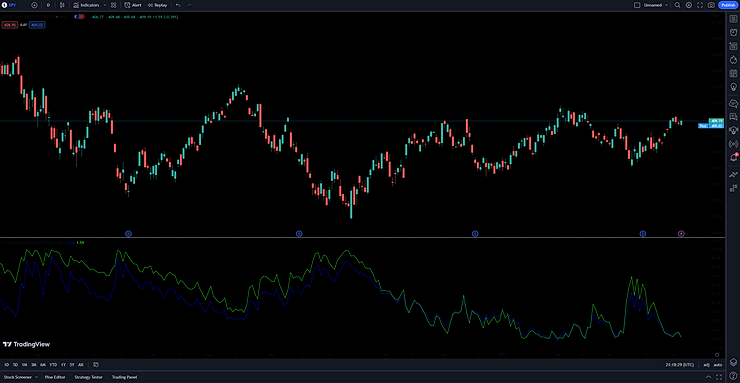
Some traders use additional tactics to determine when to use one strategy over the other, including technical analysis on TradingView and implied volatility rank (IVR) readings on thinkorswim. The structure you choose should match your trading style and your read on the underlying.
Iron Condor vs Iron Butterfly FAQ
What is the main difference between an iron condor and an iron butterfly?
The iron condor sells out-of-the-money calls and puts at different strikes, creating a wide profit zone. The iron butterfly sells the call and the put at the same at-the-money strike, creating a narrow profit zone with a much larger credit. Same four-leg structure, different short-strike placement.
Is an iron butterfly the same as a butterfly spread?
No. A standard butterfly spread is a debit position built from three strikes of the same option type (all calls or all puts). An iron butterfly is a credit position built from four legs: a short ATM call spread plus a short ATM put spread. Different cost basis, different P&L geometry.
Which strategy has a higher probability of profit?
The iron condor. Because the profit zone is wider, a larger range of closing prices keeps the trade in the money. The trade-off is a smaller credit and a smaller max profit per trade.
Which strategy has higher max profit?
The iron butterfly. Selling the at-the-money strike on both sides collects the largest available credit because at-the-money options carry the most extrinsic value. The trade-off is that the underlying has to close very close to the short strike for the full credit to be realized.
When should I use an iron butterfly instead of an iron condor?
Use an iron butterfly when you have conviction that the underlying will pin near a specific level into expiration: a chart magnet, an ATM gamma cluster, a post-earnings reversion target. Use an iron condor when implied volatility is elevated, you expect the underlying to stay inside a range, and you do not have a strong opinion on where exactly it will close. If you are not ready for the paid app, the free trading journal template for Google Sheets has a strategy column where you can tag each trade as iron condor, iron butterfly, or any other structure and slice your stats by tag.
Do iron condors and iron butterflies have the same risk profile?
Both are defined-risk, defined-reward credit spreads. Max loss equals the wing width minus the net credit (per spread). The geometry differs: the condor has two zones of loss separated by a flat profit shelf, while the butterfly has a tent-shaped P&L peaking at the short strike with loss zones on either side.
Get Your Free Trading Resources
Grab the free trading journal template plus the same tools we use to stay organized, consistent, and objective.
- Free trading journal template
- Custom indicators, watchlists, and scanners
- Access our free trading community
Enter your email below to get instant access.
No spam. Unsubscribe anytime.