Cash Secured Put: How It Works, When to Sell One, and What Happens After Assignment

A cash secured put is one of the few options trades where getting stuck with the stock is often the plan. You sell a put on a stock you would be happy to own, set aside the cash to buy it, and collect a premium for the promise. If you can buy 100 shares, you already understand most of this trade.
Key Takeaways
- Selling a cash secured put means holding enough cash to buy 100 shares at the strike, so assignment is never a margin call.
- Your maximum profit is the premium. Your real risk is the stock falling well below the strike while you are obligated to buy at it.
- Only sell puts on stocks you actually want to own, at strikes you would genuinely pay. The premium is never the reason.
Track Your Put Selling
Financial Tech Wiz Trading Journal
Put selling produces a long string of small wins and the occasional large assignment. One trade tells you nothing. The journal shows your win rate and P&L across your options positions, broken down by symbol and hold duration, so you can see whether the premium is actually paying you.
Start Journaling Your Options TradesWhat Is a Cash Secured Put?
A cash secured put is an options strategy where you sell (write) a put option and set aside enough cash to buy 100 shares at the strike price. Because the purchase is fully funded, assignment never forces you to liquidate something else to pay for the shares. In exchange for accepting the obligation to buy, you collect a premium up front, and it is yours to keep whether or not you are ever assigned.
Traders sell them for two overlapping reasons: earning income on idle cash, and entering a position they already want at a better price. It is one of two strategies most brokers approve at the lowest options permission level (the other is the covered call), because the worst case is owning fully paid-for stock rather than an open-ended loss.
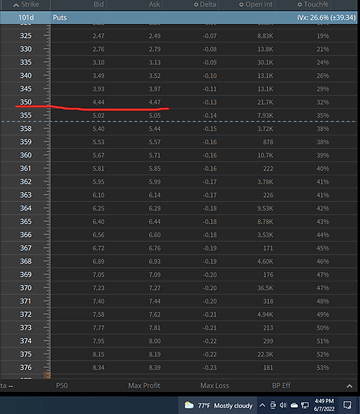
Read the chain above as a menu of promises. Each strike is a price you could commit to buy at, and the bid beside it is what the market pays you for the commitment. Promise to buy SPY at 350 and you collect 4.45 per share, or $445 for one contract. That is the trade we will carry through the rest of this article.
How a Cash Secured Put Works, Step by Step
- Pick the underlying and strike. You want SPY exposure and would own it happily at 350. Pick a strike you would actually pay, not the one with the fattest premium.
- Confirm the cash. One contract covers 100 shares, so $35,000 sits untouched in the account for the life of the trade. That is what makes it cash secured rather than naked.
- Sell to open the put. The 350 put is bid at 4.45, so you collect $445 the moment the order fills. If the order language still trips you up, see buy to open vs buy to close.
- Wait, manage, or close early. Hold to expiration, buy the put back to lock in a partial win, or roll it out. Most of the time decay that works in your favor arrives in the final two weeks.
- Expiration resolves it. Above 350, the put expires worthless, your cash unlocks, and you keep the $445. Below 350, you are assigned and buy 100 shares at 350.
Notice the effective purchase price on assignment. You paid 350 but collected 4.45, so your real cost basis is 345.55: below the strike you named.
The Math: Max Profit, Max Loss, and Breakeven
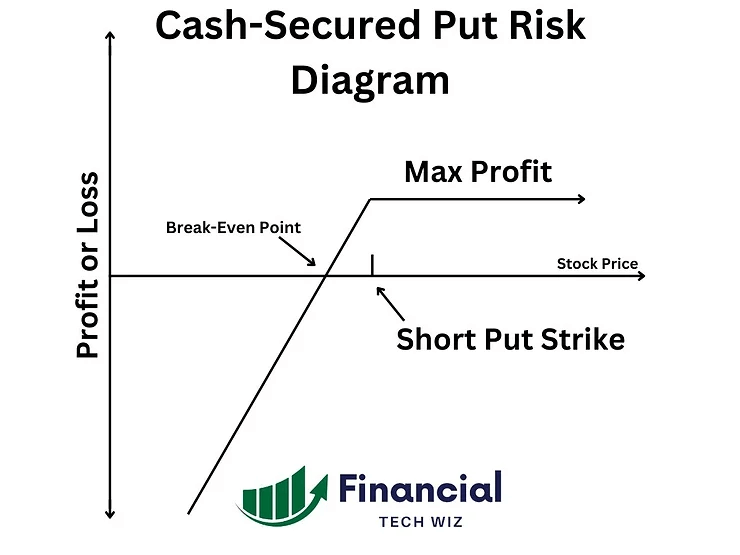
Maximum profit
The premium, full stop. Here that is $445 on $35,000 of reserved cash, roughly 1.3% if the put expires worthless. You cannot make a dollar more no matter how far SPY rallies. That flat ceiling is what you accept for getting paid whether the stock rises, stalls, or drifts lower.
Maximum loss
Substantial but defined: strike minus premium, times 100. If SPY went to zero you would hold shares bought at 350 with $445 of cushion, a loss of $34,555. That is not the scenario to plan around. The realistic one is assignment in a sharp drawdown: SPY falls to 300, you buy at 350, and you are down $4,555 net of premium. If setting aside that much collateral is the obstacle, a put credit spread expresses the same bullish-to-neutral view for a few hundred dollars of buying power, at the cost of never owning the shares.
Breakeven
Strike minus premium: 345.55. Above that at expiration you are profitable; below it you are underwater on paper. Model any strike with our free options profit calculator, or see how to calculate the breakeven point of your options trade for the arithmetic.
Cash Secured Put vs Naked Put: The Only Difference Is Collateral
This trips up more new options traders than anything else on this page. A cash secured put, a naked put, an uncovered put, and a short put are all the same options position: short one put contract. The obligation is identical. What differs is what backs it.
- Cash secured put: the full strike value sits in cash. Assignment is a purchase you already funded.
- Naked put (also called an uncovered put or short put): the position is backed by margin. You post a fraction of the strike value and your broker lends you the rest if you are assigned.
Same payoff diagram, very different consequences. Margin lets you sell four or five contracts where cash allows one, and a fast decline turns that leverage into a margin call. The strategy did not become riskier; your sizing did.
One more term to untangle: a covered put is not a cash secured put. It pairs a short put with short stock and is bearish, as is the put-side mirror of the poor man’s covered call. Neither sets cash aside to buy shares.
When Should You Sell Cash Secured Puts?
Three things need to line up. First, you want the underlying anyway, at that strike, in the size the contract implies. If you would not buy 100 shares at 350 with your own cash today, do not sell the 350 put. Second, implied volatility is elevated, because premium is the only thing you are paid. Earnings season and market pullbacks pay put sellers best, and they are also when assignment is most likely. Third, you decided what you will do in both outcomes before you entered.
Most put sellers work the 30 to 45 day window, where time decay accelerates but the premium still justifies the capital lockup. Selling weekly cash secured puts generates more activity, but each premium is small and one bad week can hand back months of income. Selling on a broad ETF rather than a single name spreads assignment risk across a basket, which is why beginners often start there. For how this fits a broader approach, see our guide to options trading for income.
Cash Secured Put vs Covered Call vs Buying a Call
A cash secured put and a covered call at the same strike have nearly identical payoff shapes; they solve different problems depending on whether you hold cash or shares. Buying a call looks similar and behaves nothing alike.
| Cash Secured Put | Covered Call | Long Call | |
|---|---|---|---|
| You start with | Cash | 100 shares | Cash (much less) |
| You are paid to | Agree to buy at the strike | Agree to sell at the strike | Nothing, you pay |
| Max profit | The premium | Premium plus gains to the strike | Unlimited |
| Max loss | Strike minus premium | Cost basis minus premium | The entire premium paid |
| Time decay | Works for you | Works for you | Works against you |
| Worst case | You own the stock too high | Shares called away below the rally | Expires worthless at zero |
The decision rule: sell puts to enter a position, sell calls to manage one you hold. The critical difference against a long call option is that shares do not expire. If the stock stalls, the call buyer loses everything and the put seller keeps the premium. If it rips, the call buyer is the only one who captured it. Our roundup of the most successful options strategies puts premium selling in context.
What Happens at Expiration (and the Morning After Assignment)
If SPY closes above 350, the put expires worthless. Your cash unlocks and you keep the $445.
If SPY closes below 350, assignment is automatic in almost every case and processes over the weekend. Monday morning you own 100 shares at 350 and $445 in premium. This is where most articles stop, and where the decision actually starts. You have three moves.
- Hold the shares. You bought something you wanted at a cost basis of 345.55. If the thesis is intact, this is the plan working, not failing. You can hold a share forever; an option expires.
- Sell covered calls against the shares. Puts until assignment, then calls until the shares are called away, collecting premium in both directions. That loop is the wheel strategy, and a cash secured put is its first step.
- Exit. If the stock broke your strike because the story changed, not because the market wobbled, sell and take the defined loss. Collecting pennies of call premium against a broken position is how a small loss becomes permanent.
You rarely have to wait for expiration at all. If the put has bled most of its value early (SPY rallied and your 4.45 put now trades at 0.60), buying it back locks in the profit and frees the $35,000 weeks early. Plenty of put sellers close mechanically at 50% to 80% of max profit and redeploy.
Selling Your First Put?
Free Trading Journal Template
Start simple. Log every contract, the premium, the strike, and how it resolved in our free Google Sheets journal. Within a few months you will know whether put selling is actually paying you or just keeping you busy.
Get the Free TemplateRisks and Common Mistakes
- Selling puts on stocks you do not want. Premium is rich for a reason. High implied volatility is the market telling you assignment is a live possibility, not handing you free money.
- Sizing by premium instead of obligation. A $445 credit feels small. It comes attached to a $35,000 commitment. Sell four and you have quietly committed $140,000.
- Anchoring to the strike after the thesis breaks. Your obligation is contractual. Your opinion of the company is not, and should be allowed to change.
- Ignoring opportunity cost. In a bull market, put sellers collect 1% to 2% a month while the stock they wanted runs 30% without them. Not a loss on the statement, but the honest price of the strategy.
Selling a cash secured put is not riskier than buying 100 shares outright. It is slightly less risky, because the premium widens your cushion. It becomes risky the moment you drop the cash and use margin instead.
Tracking Your Cash Secured Put Trades
Put selling is uniquely easy to fool yourself about. A 90% win rate feels excellent right up until one assignment in a drawdown hands back a year of premium. Over my years of trading, the people who do well with it can tell you, without guessing, how many puts they sold last quarter, how many were assigned, and what happened to the shares. That takes a record, not a memory.
The Financial Tech Wiz Trading Journal imports your trades automatically from 25+ brokers and shows your win rate and P&L across your options positions, broken down by symbol and hold duration, alongside an equity curve for the whole account. For the broader playbook, start with our complete guide to options trading strategies, or read up on the protective put to see what buying a put looks like from the other side of the contract.
FAQ
What is a cash secured put?
A cash secured put is an options strategy where you sell a put option while setting aside enough cash to buy 100 shares at the strike price. You collect a premium up front, and if the option is exercised, the reserved cash pays for the shares in full, with no margin involved.
How risky are cash secured puts?
The risk is the same as buying 100 shares, minus the premium you collected. Maximum loss is the strike minus the premium, times 100, and that only happens if the stock goes to zero. It becomes genuinely risky when the puts are not cash secured, because margin lets you take on more obligation than you can fund.
What is the difference between a cash secured put and a naked put?
None, as far as the contract is concerned. Both are a short put with the same obligation to buy 100 shares at the strike. The difference is collateral: a cash secured put is backed by the full strike value in cash, a naked put (also called an uncovered put or short put) by margin.
Is a covered put the same as a cash secured put?
No. A covered put is a bearish strategy pairing a short put with short stock. A cash secured put is neutral to bullish, backed by cash, and its worst case is owning the shares. The names look similar; the trades have almost nothing in common.
Is it better to buy a put or sell a put?
Different tools. Buying a put is a bearish bet or a hedge: you pay premium for the right to sell at the strike, and your loss is capped at what you paid. Selling a cash secured put is a neutral-to-bullish income trade. Sell puts to own the stock cheaper; buy puts for protection or downside exposure.
Is it better to sell cash secured puts or covered calls?
It depends what you are holding. Holding cash and wanting in, sell the put. Holding 100 shares and willing to part with them higher, sell the call. Run in sequence they become the wheel strategy, so many income traders never choose at all.
What happens when a cash secured put expires?
If the stock closes above the strike, the put expires worthless, your cash is released, and you keep the full premium. If it closes below, you are assigned: you buy 100 shares per contract at the strike, and the premium reduces your effective cost basis.
Get Your Free Trading Resources
Grab the free trading journal template plus the same tools we use to stay organized, consistent, and objective.
- Free trading journal template
- Custom indicators, watchlists, and scanners
- Access our free trading community
Enter your email below to get instant access.
No spam. Unsubscribe anytime.