Best Trading Journals of 2026: Top 6 Ranked and Compared

Not every trading journal is worth your money. Some charge $50 a month for features most traders never use. Others are so thin they barely beat a spreadsheet. I’ve tested the serious options available in 2026, compared pricing, looked at what actually moves the needle on performance, and ranked the six I’d recommend to any trader who wants a real edge from their data.
Key Takeaways
- The Financial Tech Wiz Trading Journal is the best value overall: AI insights, benchmark tracking, and SnapTrade auto-import across 36 brokers at $9.91 per month billed annually.
- For traders not ready to pay, the Financial Tech Wiz Free Trading Journal Template for Google Sheets is the strongest free starting point.
- The right journal depends on your style: Edgewonk for psychology, TraderSync for simulation, TradesViz for raw analytical depth, Tradervue for community, Tradezella for presentation.
Thinking about switching away from Tradervue? See our full tradervue alternative comparison for a side-by-side breakdown of cost, features, and who each tool fits.
Recommended Tool
Financial Tech Wiz Trading Journal
AI-generated performance insights, equity curve tracking, benchmark comparison against SPY, QQQ, and IWM, and SnapTrade auto-import across 36 brokers. Starting at $9.91/month billed annually.
Try It FreeQuick Comparison: Best Trading Journals
| Journal | Best For | Free Option | Price |
|---|---|---|---|
| Top PickFinancial Tech Wiz Trading JournalTry It Free | Analytics, AI insights, and value | Free template available | $19/mo or $9.91/mo annually |
| TradezellaVisit Site | Strategy and playbook tracking | No | From $24/mo annually |
| TraderSyncVisit Site | AI coaching and market replay | 7-day free trial | From $29.95/mo |
| EdgewonkVisit Site | Trading psychology and habits | 14-day refund policy | $197/yr or $297/2yr |
| TradervueVisit Site | Analytics and community feedback | Yes (30 trades/mo) | From $29.95/mo |
| TradesVizVisit Site | Most features and statistics | Yes (3,000 executions/mo) | $19/mo or $179/yr |
How I Evaluated These Trading Journals
A trading journal is only useful if it gets used. That means the value of each option comes down to five practical factors. First, import breadth: how many brokers it connects to directly and whether you can bring in a full history or only what you log going forward. Second, analytics depth: does it surface patterns you would not spot on your own, or does it just display what you already know. Third, price relative to feature set: what you get per dollar, and how fast the app pays for itself in improved decisions. Fourth, learning curve: how quickly a new user can import data and act on it without watching an hour of setup tutorials. Fifth, AI and automation: whether the tool actively points at weaknesses in your trading or whether it waits for you to do the work.
Every journal below was scored against those five factors. I weighted depth and value most heavily because those are the factors that separate journals that traders keep using after three months from journals that get abandoned.
The 6 Best Trading Journals in 2026
1. Financial Tech Wiz Trading Journal (Best Overall Value)
Price
$9.91/mo
Billed annually, or $19 monthly
Free option
Yes (free Google Sheets template)
Best for
Analytics, AI insights, and value
The Financial Tech Wiz Trading Journal is the journal I built after years of using every competitor on this list and finding each one either too expensive, too shallow, or too complicated for what serious traders actually need. It costs $9.91 per month billed annually, or $19 month to month, which puts it below every feature-comparable paid option. The AI insights tab generates a daily performance summary and improvement suggestions from your closed trades. The Trading Coach assistant has full access to your data, so you can ask it questions like “what is my win rate on options held over five days” and get an answer pulled directly from your history. Our full Financial Tech Wiz Trading Journal guide walks through setup and every tab.
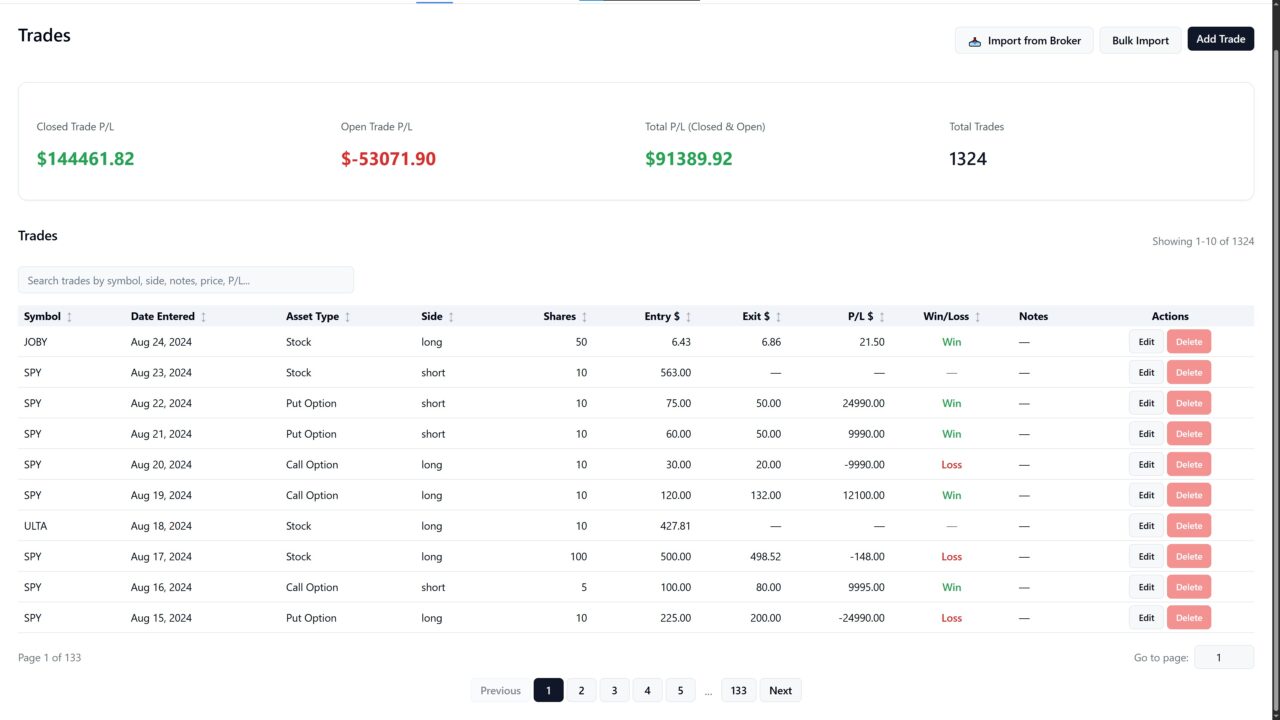
Imports work through SnapTrade across 36 supported brokers, covering a full historical trade pull rather than a going-forward feed. Broker-specific setup guides cover the process step by step, like our Webull trading journal walkthrough. CSV import is available for brokers where bulk history matters. The Portfolio Performance tab plots your net liquidity against SPY, QQQ, or IWM so you can see whether your actual trading is beating a passive index. The Drawdown Tracker shows max drawdown versus the same benchmarks, which is the single most overlooked metric in discretionary trading. Multi-account support lets you keep separate strategies, sizes, or accounts tracked independently.
Popular options-focused brokers like tastytrade connect via SnapTrade. For setup instructions and a breakdown of what you can track, see the tastytrade trading journal guide.
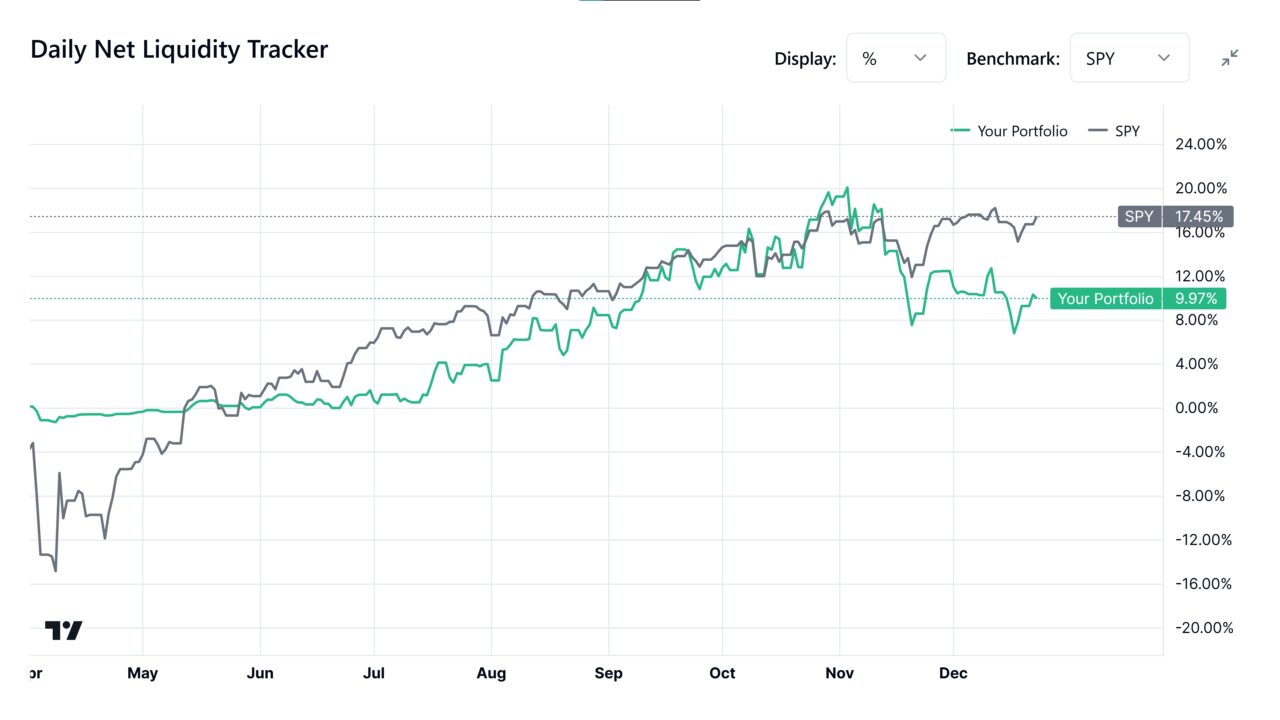
If you are not ready to pay, the Financial Tech Wiz Free Trading Journal Template for Google Sheets is the free starting point inside the same ecosystem. It includes automated performance charting and benchmark tracking out of the box, and when you outgrow it, your data maps cleanly into the paid app via CSV import.
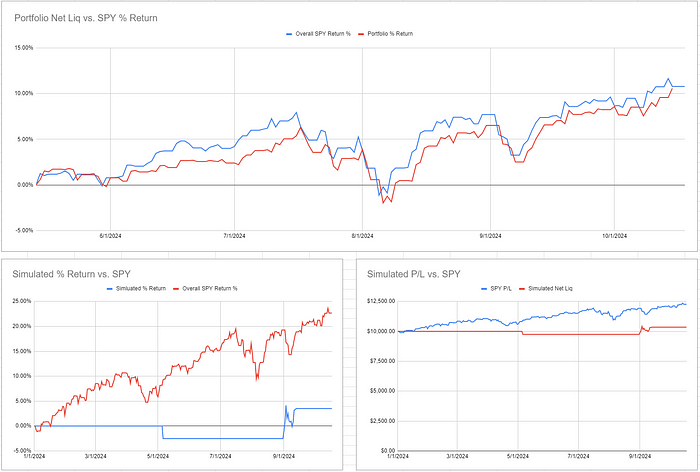

Best for: Serious traders who want structured performance analytics, AI insights, and benchmark comparison without paying $30 to $80 a month.
Not ideal for: Traders who specifically want tick-precision market replay or a 600-statistic analytics firehose.
Get Your Free Trading Resources
Grab the free trading journal template plus the same tools we use to stay organized, consistent, and objective.
- Free trading journal template
- Custom indicators, watchlists, and scanners
- Access our free trading community
Enter your email below to get instant access.
No spam. Unsubscribe anytime.
2. Tradezella

Price
From $24/mo
Billed annually, or $29 monthly
Free option
No
Best for
Equity day traders who want UI polish
Tradezella is a polished, modern journal that presents trading data better than most competitors. The dashboards are clean, the mistake tagging is well thought out, and the playbook feature encourages traders to define setups and track performance against those specific patterns. It starts at $24 per month billed annually ($29 month to month), with higher tiers unlocking automated broker imports and advanced replay.
The honest read on Tradezella: it is strong for equity day traders who want their journal to feel like a product rather than a spreadsheet, and weaker for options-focused traders where the depth drops off. There is no free tier, so you commit on day one. For deeper breakdown, see our full Tradezella review. If Tradezella is not for you, compare the best Tradezella alternative options.
Best for: Equity day traders who value UI polish and playbook-style setup tracking.
Not ideal for: Options traders or anyone who wants a free tier to try before paying.
3. TraderSync

Price
From $29.95/mo
Elite tier $79.95/mo
Free option
7-day free trial
Best for
AI coaching and market replay
TraderSync is the growth-platform option on this list. Three tiers run from Pro at $29.95 to Elite at $79.95 per month. The differentiators are Cypher, an AI assistant that can query and coach against your trading data, and Market Replay with configurable tick precision down to 250 milliseconds on Elite. Strategy Checker validates setups before a trade is taken, which is useful discipline for traders prone to impulse entries.
The honest read: TraderSync’s most compelling features sit behind the top tiers. Cypher Coach and automated backtesting only exist on Elite, which makes the platform expensive relative to the competitive set. The 7-day free trial is long enough to judge whether the simulation and AI layers justify the price. If you are primarily a journaler rather than a backtester, you are paying for features you will not use.
For the full breakdown of pricing tiers, Cypher AI message caps, and where TraderSync frustrates users, see the TraderSync review.
Best for: Active traders who want market replay, backtesting, and AI coaching in one subscription.
Not ideal for: Traders who want core journaling and analytics without paying for simulation.
4. Edgewonk

Price
$197 for 12 months
Or $297 for 24 months
Free option
14-day refund policy
Best for
Trading psychology and habits
Edgewonk has been around for over a decade and is the most established name in the psychology-focused end of the journal market. The headline features are the Tiltmeter, which tracks rule-breaks and emotional discipline across sessions, and the Edge Finder, a weekly automated scan that surfaces the specific patterns dragging your performance down. Pricing is one plan at two billing durations: $197 for 12 months or $297 for 24 months.
The honest read: the psychology and habit-tracking work in Edgewonk is unmatched, but the pricing model is the friction. There is no monthly plan, no free tier, and the 14-day refund policy is the only safety net. For a new or part-time trader, committing $197 upfront is a real barrier. For a serious trader focused on mental edge and willing to invest in a year of structured review, Edgewonk earns its price.
If the pricing model is the dealbreaker, our best Edgewonk alternative comparison breaks down the free and auto-import options side by side.
Best for: Serious traders working on psychology, discipline, and rule adherence who will commit to a full year of tracking.
Not ideal for: Beginners, part-time traders, or anyone testing the waters on paid journaling.
5. Tradervue

Price
From $29.95/mo
Gold tier $49.95/mo
Free option
Yes (30 trades/mo)
Best for
Analytics and community feedback
Tradervue is the oldest journal on this list by a wide margin, with 207,000-plus users and a decade-plus of refinement. The analytical depth is considerable: over 100 report types, MFE and MAE statistics, and detailed risk tracking on the Gold tier. Where Tradervue stands alone is the community layer: you can share trades with other traders, mentor or be mentored, and get feedback that no AI assistant can replicate. There is a free tier capped at 30 trades per month, a Silver plan at $29.95, and Gold at $49.95.
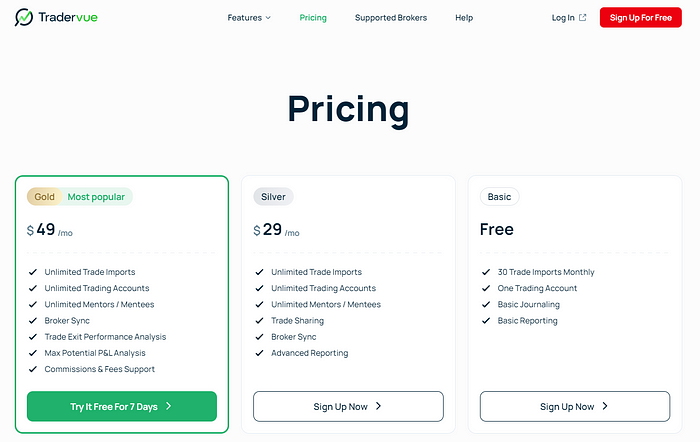
The honest read: Silver strips out exit analysis and max potential P&L, which are core to a review workflow, so most serious users end up on Gold at $49.95 per month. The interface is dated compared to newer competitors. Full breakdown in our Tradervue review.
Best for: Traders who want deep reporting plus a community to share and review trades with.
Not ideal for: Traders who want AI insights or a modern interface.
6. TradesViz

Price
Pro $19/mo
Platinum $29/mo, or $179/yr
Free option
Yes (3,000 executions/mo)
Best for
Most features and statistics
TradesViz is the most feature-rich option on the market and is a multi-time Benzinga FinTech Award winner for trading analysis. The platform advertises over 600 statistics, an all-asset simulator, 70-plus indicator backtesting, options flow analysis, and AI Q&A that lets you query your data in plain English. Pricing starts with a genuinely usable free tier (3,000 executions per month), Pro at $19 per month, and Platinum at $29 per month.
The honest read: 600-plus stats is either a feature or a bug depending on who you are. Analytical power users love it. Average traders get lost. The learning curve is the steepest on this list and several features overlap in ways that take time to sort out. For traders willing to invest in learning the platform, you are paying $19 to $29 for a feature set that genuinely rivals enterprise-level tools.
Best for: Analytical power users who want the deepest feature set and will spend time learning the interface.
Not ideal for: Traders who want a clean dashboard and actionable summaries over raw data volume.
What Is a Trading Journal
A trading journal is a structured record of every trade you take, combined with analytics that turn that record into feedback. At the simplest level it captures entry price, exit price, position size, and profit or loss. A real journal goes further: it tags the setup or strategy, records your rationale, notes what went wrong or right in execution, and rolls everything up into performance charts, win rates by pattern, and drawdown curves you can actually learn from.
The format does not matter on its own. Traders have used paper notebooks, Excel files, Google Sheets, and purpose-built apps. What matters is consistency and depth. A journal you fill in for three weeks and abandon is worse than no journal at all because it gives you a misleading sample size. The paid apps on this list survive because they lower the friction of consistent logging enough that traders keep using them after the novelty wears off.
Why You Need a Trading Journal
Most retail traders lose money for the same reason: they cannot honestly describe their own edge. They remember their wins, forget their losses, tell themselves a story about their strategy that does not match what they actually do, and keep trading the same way. A journal takes that story and replaces it with evidence. When you can see that 70 percent of your losses come from trades you took on Mondays before 10 a.m., or that your win rate on options held over three days is double your same-day win rate, you can adapt.
The second reason is accountability. Logging a trade forces you to articulate why you took it, which filters out impulse entries at the margin. The third reason is benchmarking. If your account is up 12 percent for the year but the S&P 500 is up 20 percent, you are underperforming a passive index that costs nothing, and you need to see that number to act on it. A good journal makes that comparison automatic.
What to Track in a Trading Journal
The minimum viable set of fields is small: entry price, exit price, position size, asset, date and time in, date and time out, and P&L in dollars and percent. Everything beyond that is optimization and is where a purpose-built journal pulls ahead of a spreadsheet. Setup or strategy tag lets you segment performance by pattern. Planned stop loss and target let you calculate reward-to-risk. Max favorable excursion (MFE) and max adverse excursion (MAE) show whether you tend to take profit too early or let losers run. Mistake tags isolate the execution errors you repeat.
Above that, a few advanced fields separate the serious log from the hobby log. Emotional state at entry. Market conditions (trending, chop, high IV). Note or screenshot of the chart at the moment of entry. Time held in minutes or days. Whether the trade followed your written plan. For options specifically: strategy type, days to expiration, and individual entry and exit fees. The free trading journal template gives you a working starting point for most of these fields without any setup.
How to Choose the Right Trading Journal for You
Start with budget. If you want to pay nothing, use the Financial Tech Wiz Free Trading Journal Template. If you can spend under $15 a month, the Financial Tech Wiz Trading Journal at $9.91 per month annual is the strongest pick. If you need simulation and market replay, TraderSync is the choice even at $49.95 to $79.95. If you need the deepest analytics in the market and can absorb the learning curve, TradesViz Platinum at $29 per month is the answer.
Then filter on style. Psychology-first traders belong on Edgewonk. Traders who want a community for feedback belong on Tradervue. Day traders who prize visual polish belong on Tradezella. If you are primarily charting in TradingView, your journal should pair cleanly with that workflow. See our guide on TradingView pricing to understand where your charting spend fits alongside your journaling spend.
Finally, filter on your broker. If you trade on one platform, a broker-specific setup guide saves time: our Robinhood trading journal guide, for example, walks through importing that account automatically through SnapTrade.
Recommended Tool
Financial Tech Wiz Trading Journal
AI insights, benchmark tracking, drawdown analysis, and SnapTrade auto-import across 36 brokers. Starting at $9.91/month billed annually.
Try It FreeFrequently Asked Questions
What is the best trading journal overall?
The Financial Tech Wiz Trading Journal is the best all-round option for most traders in 2026. It combines AI-generated insights, benchmark tracking against SPY, QQQ, and IWM, drawdown analytics, and SnapTrade auto-import across 36 brokers at $9.91 per month billed annually. That price point is meaningfully below every feature-comparable competitor, which is why it wins on value.
What is the best trading journal for day traders?
Day traders have two strong options. The Financial Tech Wiz Trading Journal handles the intraday P&L, session reports, and performance-by-time-of-day analysis that day traders care about, at the lowest price. Tradezella is the alternative if visual polish and playbook-style setup tracking matter more than price. For day traders who specifically need tick-precision market replay, TraderSync Elite is the only option that offers it.
What is the best free trading journal?
The Financial Tech Wiz Free Trading Journal Template for Google Sheets is the strongest free option because it includes automated charting and benchmark tracking rather than just a blank trade log. TradesViz has a functional free tier capped at 3,000 executions per month, which is enough for most part-time traders. Tradervue has a free plan too but it caps at 30 trades per month, which runs out fast for active traders.
What is the best trading journal for options traders?
The Financial Tech Wiz Trading Journal handles options across equities, futures, and crypto and breaks down performance by symbol, time of day, asset type, and hold duration. Multi-leg options imported through SnapTrade come in as individual contracts, and the workaround for tracking spreads as single structures is to log the trade manually using total credit or debit and tag it. TradesViz Platinum has the deepest options-specific layer, including options flow analysis and payoff charts, if that depth justifies the price for you.
Which trading journal has the best AI features?
TradesViz has the broadest AI surface area with plain-English Q&A against your trade data. TraderSync Elite includes Cypher Coach, a personalized AI coach that costs $79.95 per month. The Financial Tech Wiz Trading Journal includes daily AI-generated performance insights and a Trading Coach assistant with full access to your data at $9.91 per month. Edgewonk’s Edge Finder runs a weekly automated scan that surfaces the specific patterns hurting your performance.
Does TradingView or my broker have a built-in journal?
Not really. TradingView has a trade log inside its paper trading feature and basic P&L tracking, but nothing that rises to journal-level analytics. Most brokers show closed P&L and recent activity but do not tag setups, calculate reward-to-risk, compare performance to benchmarks, or surface patterns. A dedicated journal is the tool that turns broker execution data into decisions you can act on.
How much does trading journal software cost?
Paid trading journals range from $9.91 to $79.95 per month. The Financial Tech Wiz Trading Journal is the most affordable at $9.91 per month billed annually. TradesViz Pro is $19 and Platinum is $29. Tradezella starts at $24 annually. Tradervue and TraderSync both start at $29.95. Edgewonk is $197 for 12 months or $297 for 24. Free options exist: the Financial Tech Wiz template, TradesViz free tier, and Tradervue free tier.
How often should I review my trading journal?
Short answer: weekly and monthly. A weekly review lets you catch execution problems while the trades are still fresh, and a monthly review is where pattern-level learning happens because the sample size is large enough to see real trends. Daily review can turn into noise-chasing. Quarterly review is where you make bigger changes: strategy pivots, position-size adjustments, or cutting setups that underperform against your benchmark.
Want to keep learning beyond your journal? See our roundup of the best options trading blogs for traders who want actionable strategy and real trade examples.
Get Your Free Trading Resources
Grab the free trading journal template plus the same tools we use to stay organized, consistent, and objective.
- Free trading journal template
- Custom indicators, watchlists, and scanners
- Access our free trading community
Enter your email below to get instant access.
No spam. Unsubscribe anytime.