Cerebras IPO: OpenAI’s Quiet $5 Billion Day (CBRS)

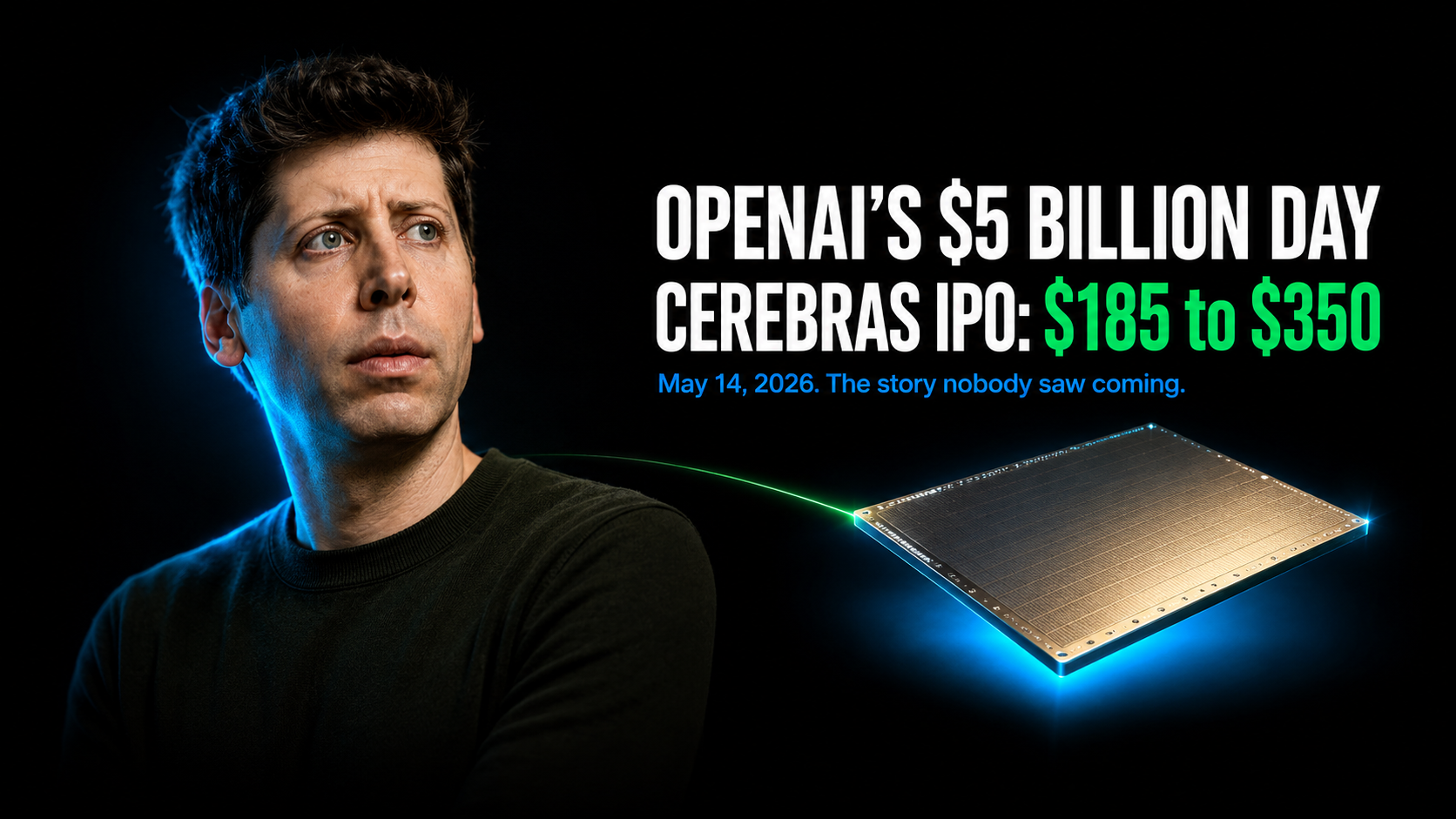
OpenAI didn’t just build ChatGPT. They invested early in Cerebras Systems, the AI chip company that priced its Nasdaq IPO at $185 today and opened at $350. OpenAI’s roughly 11% stake is now worth more than $5 billion on paper. The picks-and-shovels story of the AI cycle just got its loudest number yet.
What Happened
Cerebras Systems (CBRS) debuted on the Nasdaq on May 14, 2026 at an IPO price of $185, raising about $5.55 billion in what is now the largest Nasdaq debut of the year so far. The deal was reportedly 20x oversubscribed, with the price range walked up from $115 to $125 to $185 before pricing. The stock opened at $350, hit an intraday high of $385, and was last trading around $331 on more than 18 million shares.
Key Takeaways
- Cerebras priced at $185 and opened at $350, a +89% day-one pop on a deal that was already 20x oversubscribed.
- OpenAI holds roughly an 11% stake in Cerebras, putting its on-paper value above $5 billion at current prices.
- This is a brand-new ticker. No insider data, no congressional disclosures, no options chain yet. Day-one volatility is the whole tape.
Financial Tech Wiz Trading Journal
IPO day-one trades deserve a real journal entry.
Tag your CBRS trades, log your entry thesis, and let the analytics tab show you whether IPO momentum plays are actually a profitable setup for you, not just an exciting one.
Start Tracking Your TradesWhat It Means for Traders
The headline number is OpenAI’s $5 billion paper gain, but the trader takeaway is simpler. The market is paying a premium for anything that looks like the infrastructure layer of AI, not just the application layer. Nvidia has been the obvious expression of that trade for two years. Cerebras is the market saying it wants a second name in the picks-and-shovels bucket, and it wants exposure badly enough to push a $115 to $125 range up to $185 and still oversubscribe it twenty times.
That kind of demand creates a specific tape. The float is small on day one, the lockups are intact, retail is chasing, and institutions that didn’t get allocation are forced to buy in the open market if they want exposure. That mix produces the $185 to $350 to $385 path we just watched. It also produces the $385 to $331 fade, because anyone who got an allocation at $185 is sitting on a near double in a single session and the temptation to ring the register is real.
For active traders, the playbook on day-two-and-beyond IPOs like this is less about predicting direction and more about respecting structure. Watch the open versus the prior day’s close. Watch the VWAP. Watch where the first reactive low gets bought or lost. The skeptic angle that surfaced in print right before the IPO, calling it a late-cycle, speculative signal, is not wrong as a description of sentiment. It just does not tell you what the next 10 sessions look like.
The longer-term debate is whether Cerebras is the next Nvidia or a high-beta proxy for AI hype. CEO Andrew Feldman has said publicly that US chip manufacturing is roughly 15 years behind where it needs to be. That is a long-tail tailwind for any US-based AI silicon company that can ship at scale. It is also a long-tail risk if execution slips.
How to Track a New IPO in Your Journal
For brand-new tickers, the trade is almost never about fundamentals on day one. It is about your own behavior under volatility. Three things worth logging on a CBRS trade:
- Your entry thesis in one sentence. Are you trading the gap fill, the momentum continuation, or the OpenAI-association narrative?
- Your max-loss number before you click buy. Day-one IPO ranges of $185 to $385 do not respect ordinary stops.
- A note on your emotional state. New-ticker FOMO is the most expensive feeling in trading, and the only way to see it in your numbers is to write it down at the moment.
If you are not journaling trades yet, the gap between “I think I am good at IPOs” and “the data says I am good at IPOs” is the whole game. A structured journal closes it. So does our list of the best trading journals if you want to compare options before committing to one.
Free Tool
Not ready for a paid journal? Start with the free template.
Our free Google Sheets trading journal template lets you log CBRS and every other trade with one click. No paywall on the data, just an email to grab it.
Get the Free TemplateFAQ
What is Cerebras Systems and what does CBRS make?
Cerebras Systems is a US-based AI chip designer. Their flagship product, the Wafer-Scale Engine (WSE), is reportedly the largest chip ever built and is engineered specifically to accelerate AI training and inference. They also sell access to that hardware as a cloud AI compute service, so the revenue model is hardware sales plus subscriptions. The company positions itself as a direct alternative to Nvidia for AI workloads.
How big is OpenAI’s stake in Cerebras and why does it matter?
OpenAI holds an approximately 11% equity stake in Cerebras. At the IPO opening price of $350, that stake is worth more than $5 billion on paper. It matters because it tells you the most prominent AI company in the world chose to invest in chip infrastructure, not just in its own models. That signal is part of why this IPO was 20x oversubscribed.
Is Cerebras the next Nvidia?
It is far too early to make that call. Cerebras is one ticker, one day old, on a tape that hit $385 and faded to the low $330s in a single session. Nvidia’s lead in AI silicon is built on years of CUDA software lock-in and a much broader product line. The honest answer is that Cerebras is positioned as a credible US-based challenger in AI compute, and the market is willing to pay up for that positioning. Whether the company executes on it is the next several years of story, not the next several sessions.
Get Your Free Trading Resources
Grab the free trading journal template plus the same tools we use to stay organized, consistent, and objective.
- Free trading journal template
- Custom indicators, watchlists, and scanners
- Access our free trading community
Enter your email below to get instant access.
No spam. Unsubscribe anytime.