NinjaTrader vs TradeStation (2026): Which Platform Fits Serious Traders?

NinjaTrader and TradeStation are both built for serious active traders, but they serve fundamentally different traders. NinjaTrader is a precision tool for futures execution and order flow analysis. TradeStation is a full-service brokerage with multi-asset trading, deep backtesting, and algorithmic strategy tools. If you are deciding between the two, the answer depends almost entirely on what you trade and how technically driven your strategy is.
Key Takeaways
- NinjaTrader is purpose-built for futures traders who want professional order flow tools and low-cost execution on micro and standard contracts.
- TradeStation supports stocks, options, futures, and crypto from a single platform with a powerful strategy backtesting engine (EasyLanguage).
- Neither platform has a built-in trading journal; TradeStation traders can automatically import full trade history into the Financial Tech Wiz Trading Journal via SnapTrade.
TRADING JOURNAL
Financial Tech Wiz Trading Journal
Track win rate, P&L by symbol, and equity curve for your futures trades. TradeStation connects automatically via SnapTrade; import your full trade history in minutes.
Try the Journal FreeNinjaTrader in 2026
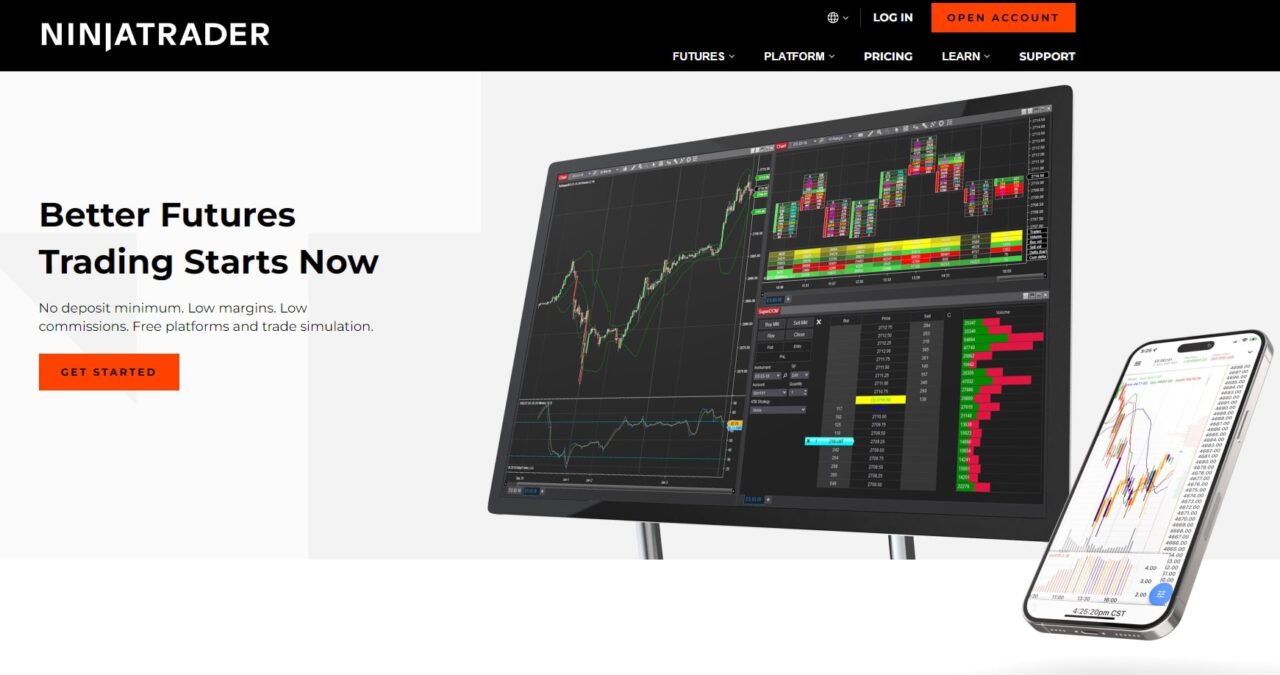
NinjaTrader has built its reputation as the go-to platform for dedicated futures traders. It is a trading platform and broker in one, offering real-time charting, order flow tools, and one of the lowest commission structures available for micro and standard futures contracts.
The platform is downloaded and installed on Windows (no web-based version for live trading), and it runs on a licensing model rather than a pure subscription. Traders can use NinjaTrader free for simulation and basic charting. To trade live, the options are: a monthly lease ($99/month), an annual lease ($972/year), or a lifetime license ($1,499 one-time). Traders who already have a brokerage account elsewhere can connect NinjaTrader as a front-end platform through supported adapters.
NinjaTrader’s biggest strengths are in futures execution. Footprint charts, volume profile, order book depth-of-market (DOM), and market replay are built in or available as add-ons. For traders who want to analyze order flow at the micro level and execute with tight precision, NinjaTrader has no serious rival in the retail space. For a direct comparison with another leading futures platform, see our NinjaTrader vs Tradovate breakdown.
NinjaTrader is best for: Futures-only traders who want professional-grade execution, order flow analysis, and low-cost micro futures commissions. It is not suited for traders who want to trade stocks or options through the same platform.
TradeStation in 2026
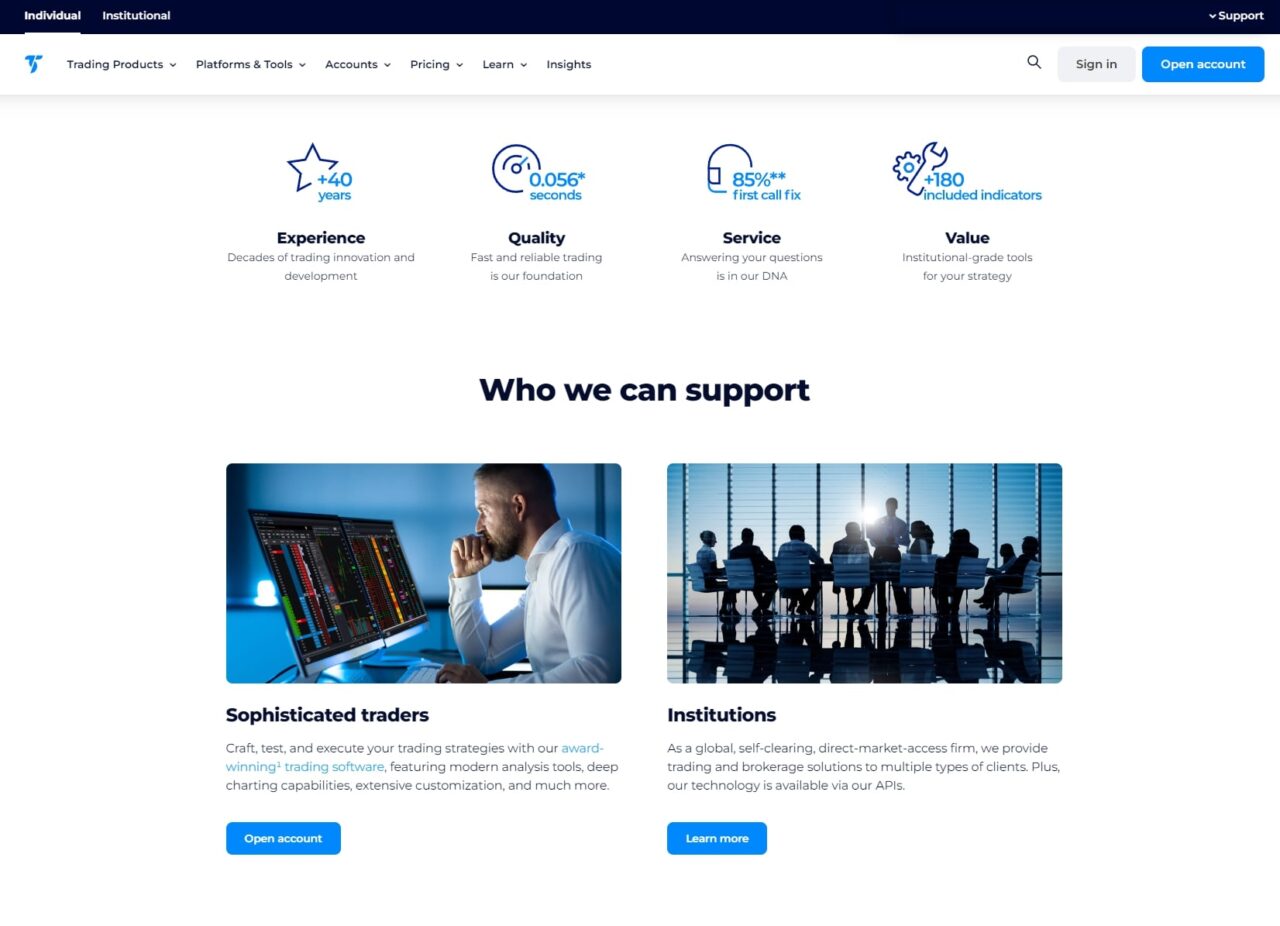
TradeStation is a long-standing brokerage and platform designed for traders who want one environment for multiple asset classes. It supports stocks, ETFs, options, futures, crypto, and forex, combined with a sophisticated backtesting and strategy development engine (EasyLanguage) that has been a staple of systematic traders for decades.
Unlike NinjaTrader, TradeStation is both the broker and the platform with no separation. Accounts are held at TradeStation Securities. The platform is available as a desktop application and a web-based version, and the mobile app covers order management and basic charting.
TradeStation’s EasyLanguage scripting environment lets traders build, backtest, and automate strategies across historical data. The Strategy Network gives access to third-party strategies and signals. For algorithmic and rule-based traders who want to go beyond manual execution, TradeStation’s backtesting infrastructure is one of the most complete available in the retail space. If you are interested in how TradeStation performs against a competing futures broker, see TradeStation vs Tradovate.
On the downside, exercise fees at TradeStation ($14.95 per contract at expiration) are higher than average and can impact the economics of options strategies held to expiry. The platform has a steeper learning curve for new traders than more consumer-oriented brokers.
TradeStation is best for: Experienced traders who want to trade and analyze multiple asset classes, develop automated strategies, and work with detailed historical data. It is overkill for pure futures traders who only need execution.
Head-to-Head Comparison
Asset Coverage
| Platform | Asset Classes | Broker Type |
|---|---|---|
| NinjaTrader | Futures, futures options, forex | Futures-focused broker and platform |
| TradeStation | Stocks, ETFs, options, futures, crypto, forex | Full-service brokerage |
NinjaTrader’s asset focus is intentional. By specializing in futures, it can offer execution infrastructure and tools optimized for that market without compromise. TradeStation’s multi-asset coverage makes it the stronger choice for traders who move between stocks and futures or who run options strategies alongside futures positions.
Charting and Order Flow Tools
NinjaTrader excels in intraday order flow analysis. Footprint charts, volume-at-price ladders, and real-time DOM are native to the platform and among the most granular available in retail software. Traders running scalping or high-frequency futures strategies will find NinjaTrader’s execution layer hard to match. Traders comparing NinjaTrader against chart-centric platforms may also find our TradingView vs NinjaTrader comparison useful.
TradeStation’s charting is broad and feature-rich but more traditional in its approach. The platform emphasizes price action, technical indicators, and strategy overlays over pure order flow. Both platforms offer extensive indicator libraries and third-party add-on ecosystems.
Backtesting and Strategy Development
This is where TradeStation has a significant edge. EasyLanguage is a proprietary scripting language designed specifically for defining entry and exit rules, risk management logic, and order management in backtesting. Traders can test strategies against years of tick data, run portfolio-level backtests, and optimize variables across parameter ranges.
NinjaTrader offers its own Strategy Analyzer with NinjaScript (C# based), which is more flexible for developers but has a steeper learning curve. Its backtesting is solid for futures-specific strategies and supports optimization runs, but it does not have the decades of institutional track record that TradeStation’s backtesting engine carries.
Traders building rule-based or algorithmic systems should lean toward TradeStation. Traders who want to backtest a specific futures setup quickly and move to live execution will find NinjaTrader’s workflow more streamlined for that purpose.
Platform Access and Licensing
NinjaTrader’s licensing model is worth understanding before committing:
- Free tier: simulation trading, delayed data, limited live features
- Monthly lease: $99/month, full platform access, cancels anytime
- Annual lease: $972/year (equivalent to $81/month)
- Lifetime license: $1,499 one-time, full access permanently
The lifetime license pays for itself after roughly 18 months of monthly leasing, making it the most cost-effective option for long-term traders. The free simulation mode is genuinely useful for testing strategies before committing capital.
TradeStation has no separate platform fee for account holders. The platform is included when you open and fund a brokerage account. There is no lifetime purchase or license model; access is tied to your account status.
Commissions and Trading Costs
| Fee Type | NinjaTrader | TradeStation |
|---|---|---|
| Standard futures (per contract) | ~$1.19 | $1.50 |
| Micro futures (per contract) | ~$0.09 | $0.50 |
| Options on futures | Included | $1.50 per contract |
| Options exercise fee | None | $14.95 at expiration |
| Equity commissions | Not supported | $0 per trade |
| Platform fee | $0 to $1,499 (see licensing) | Included with account |
NinjaTrader’s micro futures pricing is a standout advantage for traders who want to size down without paying proportional commissions. Micro E-mini contracts at ~$0.09 per contract make position sizing far more granular than TradeStation’s $0.50.
Get Your Free Trading Resources
Grab the free trading journal template plus the same tools we use to stay organized, consistent, and objective.
- Free trading journal template
- Custom indicators, watchlists, and scanners
- Access our free trading community
Enter your email below to get instant access.
No spam. Unsubscribe anytime.
Automation and Algorithmic Trading
Both platforms support automated trading, but they approach it from different philosophies, and the gap matters if running a system is part of your plan.
NinjaTrader uses NinjaScript, a development framework built on C#. Because it sits on top of a full programming language, NinjaScript gives developers near-unlimited control: custom indicators, automated strategies, custom order types, and direct integration with external data or signals. The trade-off is the learning curve. If you are not comfortable with C# (or willing to learn it), you will lean on the visual strategy builder or third-party add-ons rather than writing your own logic. For traders who already code, NinjaScript is one of the most capable automation environments in the retail space, and it pairs naturally with NinjaTrader’s order flow tools for execution-sensitive futures strategies.
TradeStation’s EasyLanguage takes the opposite approach. It was designed to read like plain trading instructions, so a rule such as “buy when the 50-day average crosses above the 200-day average” looks close to how you would say it out loud. That readability is why EasyLanguage has stayed popular with systematic traders for decades, and why TradeStation’s Strategy Network has a deep library of pre-built, shareable strategies you can study or deploy. EasyLanguage is less flexible than raw C# at the edges, but for the large majority of rule-based stock, options, and futures systems, it gets you from idea to backtest to live automation faster.
The practical takeaway: choose NinjaScript if you want maximum control and already think like a developer; choose EasyLanguage if you want to express and test trading logic quickly without a software background.
Market Data and Order Execution
NinjaTrader is execution-first. It connects to multiple data feeds (including its own brokerage feed and supported third-party providers), and traders can choose a feed that matches the granularity their strategy needs. For order flow work, the depth-of-market ladder, one-click order entry, and bracket-order management are tuned for fast, precise futures execution. This is the part of the platform scalpers and intraday futures traders care about most, and it is where NinjaTrader’s specialization pays off.
TradeStation routes orders through its own brokerage infrastructure and supports advanced order types, conditional orders, and strategy-driven automated entries across every asset class it covers. Because it is broker and platform in one, real-time data for stocks, options, and futures comes from a single integrated source rather than a separate feed you configure yourself. That integration is convenient for multi-asset traders, though it gives you fewer feed choices than NinjaTrader’s modular setup.
Customer Support and Learning Resources
Both companies are established names with mature support operations. NinjaTrader leans heavily on its community: an active user forum, a large ecosystem of third-party developers and add-ons, and extensive documentation aimed at traders building or tuning NinjaScript tools. If you run into a problem, odds are another trader has already solved it and posted the answer.
TradeStation backs its platform with phone and ticket support plus a long catalog of educational material, webinars, and EasyLanguage tutorials reflecting its decades in the market. For a multi-asset platform with a steeper learning curve, that structured education library is genuinely useful when you are getting started.
Which Platform Should You Choose?
Choose NinjaTrader if:
- You trade futures exclusively and want the deepest order flow tools available at the retail level
- Micro futures commissions matter to your cost structure
- You plan to use NinjaTrader as a front-end platform over your existing brokerage account
- You are interested in futures prop trading (most prop firms are NinjaTrader-compatible; see our best futures prop firms guide for which firms work with each platform)
Choose TradeStation if:
- You trade a mix of stocks, options, and futures and want one platform and one broker
- You build algorithmic or rule-based strategies and need a robust backtesting environment
- You value EasyLanguage’s scripting depth and the Strategy Network ecosystem
- You want automatic trade history import into a third-party journal via SnapTrade
Both platforms are well-suited for experienced, technically driven traders. Neither is a beginner platform. If you are newer to active trading, a more streamlined broker may be a better starting point before moving to either of these.
FAQ
Is NinjaTrader better than TradeStation for futures?
For pure futures trading, NinjaTrader generally edges out TradeStation on execution tools, order flow analysis, and micro futures commissions. TradeStation is the stronger choice when you also need multi-asset coverage or a serious backtesting engine for algorithmic strategies.
Can you use NinjaTrader with any broker?
NinjaTrader supports a number of third-party broker connections, meaning you can use the NinjaTrader platform as a front-end while keeping your account at a supported brokerage. NinjaTrader also operates its own brokerage for traders who prefer to keep everything in one place.
Does TradeStation charge a platform fee?
There is no separate platform fee for active TradeStation account holders. The desktop platform and web platform are included with your brokerage account. However, exchange fees and clearing fees are added to commissions, so your total all-in cost per futures contract will be higher than the quoted commission rate alone.
Can I import TradeStation trades into a trading journal?
Yes. TradeStation is a supported broker on SnapTrade, which means you can connect your TradeStation account to the Financial Tech Wiz Trading Journal and automatically import your full trade history. From there you can track win rate, P&L by symbol, and equity curve alongside your other positions. Traders not yet ready for the paid journal can start with the free trading journal template to establish a baseline before automating.
Is NinjaTrader free to use?
NinjaTrader offers a free tier that includes simulation trading and delayed data. Live trading requires a license: monthly lease ($99/month), annual lease ($972/year), or a lifetime license ($1,499). The free simulation mode is useful for strategy testing before committing to a license.
Related Trading Platform Comparisons
- NinjaTrader vs Tradovate
- TradeStation vs Tradovate
- TradeStation vs Tradier
- NinjaTrader vs thinkorswim
- TradingView vs NinjaTrader
- TradeStation Trading Journal
Get Your Free Trading Resources
Grab the free trading journal template plus the same tools we use to stay organized, consistent, and objective.
- Free trading journal template
- Custom indicators, watchlists, and scanners
- Access our free trading community
Enter your email below to get instant access.
No spam. Unsubscribe anytime.