Palantir Blows Out Q2 as U.S. Commercial Revenue Jumps 149%

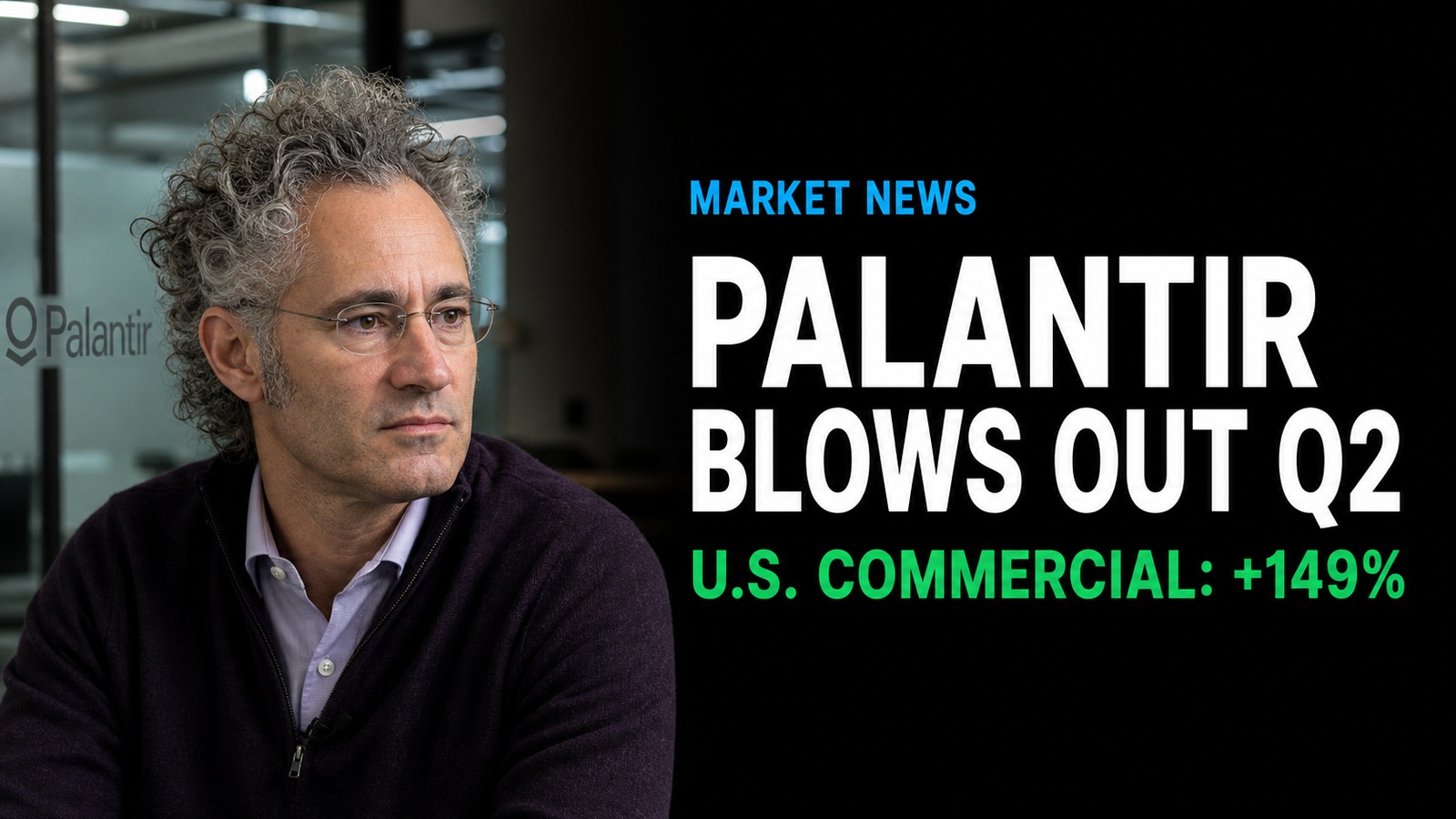
Palantir delivered the kind of quarter that forces investors to look past the headline number and into the engine underneath it. The company reported record second-quarter revenue of $1.9 billion, up 93% from a year earlier, while U.S. commercial revenue reached $764 million, up 149%. Management also raised its 2026 outlook for that U.S. commercial business to more than $3.42 billion.
Key Takeaways
- Palantir’s $1.9 billion in second-quarter revenue was 93% higher than the prior year.
- U.S. commercial revenue hit $764 million and grew 149%, making that segment the central operating story.
- The raised outlook gives investors a higher bar for the rest of 2026: can Palantir keep converting AI demand into durable commercial revenue?
What Happened
Palantir’s quarterly results showed rapid expansion across a business that has increasingly become a major AI software bellwether. Total revenue reached a record $1.9 billion. The standout figure was the company’s U.S. commercial segment, where revenue climbed to $764 million. That business includes companies using Palantir’s software platforms to put data, operations, and artificial intelligence models to work inside large organizations.
The scale of the year-over-year increase matters because it is arriving on a much larger revenue base than Palantir carried just a few years ago. Fast growth is easier to produce from a small starting point. Sustaining triple-digit growth as commercial revenue approaches a billion dollars per quarter is a different test entirely.
Management raised its 2026 U.S. commercial revenue outlook above $3.42 billion. That is not a guarantee of future results, but it is a signal that the company sees its commercial demand continuing to build rather than flattening after a single strong period.
Why It Matters
For the market, Palantir has become one of the clearest public tests of whether enterprise AI spending can turn into measurable revenue and operating leverage. Investors are not only watching product demonstrations or customer announcements. They are watching whether companies adopt AI software deeply enough to expand contracts, renew them, and make the tools part of day-to-day operations.
The U.S. commercial figure is especially important because it captures the part of Palantir’s business most directly tied to corporate adoption. Government work remains a meaningful part of the company, but commercial growth gives investors a view into how broadly the platform is spreading across the private sector.
That also explains the market’s reaction. A stock move after earnings often reflects the gap between expectations and the forward path, not simply whether a company beat a consensus estimate. Palantir’s raised outlook put more attention on the possibility that its commercial momentum can extend through the rest of the year.
There is a broader market read-through as well. Large organizations are still sorting out which AI projects are experiments and which become recurring operating tools. A company that can point to expanding customer spend and a higher revenue outlook gives the market evidence that some enterprise deployments are moving beyond the pilot stage. That does not make every AI-related stock comparable to Palantir, but it helps explain why investors watch its commercial results so closely.
Financial Tech Wiz Trading Journal helps you log entries, exits, thesis notes, and performance so you can review how earnings reactions actually fit your process.
Explore the Trading JournalWhat Traders Should Watch Next
The next question is whether Palantir can maintain its commercial growth rate as comparisons become more difficult. Investors will be watching new customer activity, contract expansion, guidance updates, and whether revenue growth continues to translate into profitability and cash generation.
For traders, the practical point is to separate the news catalyst from the trading plan. Earnings momentum can create large moves in either direction, especially in heavily watched AI names. Defining the level that invalidates a setup, the time horizon, and the reason for holding a position is more useful than reacting to a single headline after the move is already underway.
Palantir’s report offered a powerful operating data point: commercial demand accelerated sharply and management lifted its outlook. The next few quarters will show whether that pace is becoming the company’s new baseline.
Sources
This remains a developing earnings story, and future guidance or customer disclosures can change the market’s interpretation quickly. Investors should review the original company materials alongside any position plan.
Get Your Free Trading Resources
Grab the free trading journal template plus the same tools we use to stay organized, consistent, and objective.
- Free trading journal template
- Custom indicators, watchlists, and scanners
- Access our free trading community
Enter your email below to get instant access.
No spam. Unsubscribe anytime.