What Is OpEx in Stocks? 2026 Options Expiration Dates

OpEx in stocks is short for options expiration: the third Friday of every month, when monthly options contracts settle, expire worthless, or convert into stock positions. Four times a year that Friday becomes triple witching, when stock options, index options, and index futures all expire together. Below you will find every OpEx date for 2026 and 2027, plus what actually happens to price during expiration week and how to trade it.
Key Takeaways
- OpEx is the third Friday of every month, the day monthly equity and index options stop trading and settle. The four quarterly ones (March, June, September, December) are triple witching.
- Open interest concentrated at round strikes pulls price toward those strikes into Friday close, then releases the Monday after when dealer hedges unwind.
- The next OpEx dates are August 21, 2026, September 18, 2026 (triple witching), October 16, 2026, November 20, 2026, and December 18, 2026 (triple witching).
Recommended Tool
Financial Tech Wiz Trading Journal
Log every options trade with its expiration, strike, and entry IV, then tag the ones you opened during OpEx week so you can pull them back up any time. Analytics break down your win rate and P&L by symbol, time of day, and hold duration, and AI insights surface the patterns you would miss in a spreadsheet. Starting at $9.91/month billed annually.
Try It FreeHow Options Expiration Works
Every listed option contract has a fixed expiration date. Standard monthly options expire on the third Friday of each month. On expiration day, holders can exercise the contract (turn calls into long stock or puts into short stock), close the position before the bell, or let it expire worthless if it is out of the money. American-style options on individual stocks can be exercised any time before expiration; European-style index options like SPX settle only at expiration.
Beyond the monthly cycle there are weekly options that expire every Friday and 0DTE options that expire the same day they trade, but the term OpEx still typically refers to the monthly third-Friday event because that is when the largest open interest rolls off. Twelve of the 251 trading days in the year carry a monthly expiration, and those twelve do not behave like the other 239. The weekly and 0DTE cycles add liquidity but do not produce the same end-of-month gamma cliff that monthly OpEx does.
Knowing your contract’s expiration cycle, settlement style, and exercise rules matters more than memorizing the calendar. Use a trading journal to log the expiration on every options trade so you can spot patterns in how your positions perform near expiration.
OpEx Dates 2026 and 2027: Every Third-Friday Expiration
Monthly equity and index options expire on the third Friday of each month. Not the third week, not the Friday closest to the middle: the third Friday on the calendar. If a market holiday falls on that Friday, expiration moves back to the preceding Thursday. That exception bites in June of both years: Juneteenth falls on Friday, June 19, 2026, and is observed on Friday, June 18, 2027, and the NYSE is closed on both, so each of those June expirations shifts to the Thursday before. Every other date below is a standard third Friday.
| Month | 2026 OpEx date | 2027 OpEx date | Type |
|---|---|---|---|
| January | January 16, 2026 | January 15, 2027 | Monthly |
| February | February 20, 2026 | February 19, 2027 | Monthly |
| March | March 20, 2026 | March 19, 2027 | Triple witching |
| April | April 17, 2026 | April 16, 2027 | Monthly |
| May | May 15, 2026 | May 21, 2027 | Monthly |
| June | June 18, 2026 (Thursday) | June 17, 2027 (Thursday) | Triple witching, holiday-shifted |
| July | July 17, 2026 | July 16, 2027 | Monthly |
| August | August 21, 2026 | August 20, 2027 | Monthly |
| September | September 18, 2026 | September 17, 2027 | Triple witching |
| October | October 16, 2026 | October 15, 2027 | Monthly |
| November | November 20, 2026 | November 19, 2027 | Monthly |
| December | December 18, 2026 | December 17, 2027 | Triple witching |
Weekly options expire every Friday and, on the most liquid index products, on Monday and Wednesday as well. Those weeklies are not what traders mean by OpEx. When somebody says “OpEx week” they mean the week containing one of the twelve dates above, because that is the week where the largest block of open interest is rolling off at once.
Quarterly OpEx carries more weight than the other eight. Index futures, index options, and single-stock options all settle in the same session, which is why March, June, September, and December expirations print outsized volume in the final hour. If you want to see the effect on a chart, pull up SPY or SPX on a daily and mark the third Friday of each quarter; the volume spike is usually visible without any indicator at all. Our breakdown of SPX vs SPY covers why the two products settle differently on those days.
When Is the Next OpEx? How to Work Out Any Month in Ten Seconds
You do not need a calendar app for this. Find the first Friday of the month, add fourteen days, and that is OpEx. A month that starts on a Friday has its third Friday on the 15th; a month that starts on a Saturday pushes it out to the 21st. So the third Friday always lands somewhere between the 15th and the 21st, and the only thing that moves it is a market holiday on that Friday, which pulls expiration back one day to the Thursday.
Two quick sanity checks traders use. First, if today is a Friday and the date is between the 15th and the 21st, today is OpEx. Second, if the date is between the 15th and the 21st but today is not Friday, OpEx is the Friday inside that same range, so it is either a few days ahead or a few days behind. The one thing that breaks the shortcut is a holiday closure on that Friday, so check the calendar in any month with one.
The reason this matters day to day is positioning. Options you sold with a monthly expiration have their gamma and assignment risk concentrated into that one session, and short-dated premium behaves very differently in the last five sessions before it. If you are running defined-risk spreads through expiration, the options profit calculator will show you where the position sits at expiry across a range of underlying prices, and our guide to calculating the breakeven point of your options trade covers the arithmetic behind the same picture.
Triple Witching: When Three Markets Expire Together
Triple witching happens four times a year, on the third Friday of March, June, September, and December. On those days stock index options, stock index futures, and stock options all expire in the same session. The market used to call this quadruple witching when single-stock futures were also part of the mix, but those products stopped trading in the United States in 2020.
Triple witching is the highest-volume options day of the quarter because index OpEx tends to concentrate the most open interest of any single expiration. A large share of total dealer gamma sits in those expiring contracts, which makes pre-OpEx pinning stronger and the post-OpEx regime shift sharper.
Mark these 2026 triple witching dates: March 20, June 18, September 18, and December 18. June is the odd one out because Juneteenth closes the market on the third Friday, pushing that expiration to the Thursday.
Why OpEx Moves Markets
OpEx weeks routinely produce trading volumes well above the monthly average, with sharp intraday moves driven by dealer hedging flows. That volume and volatility are not random; they come from a chain reaction in dealer hedging. Market makers sit on the other side of the options trades retail and institutional traders open. To stay neutral they hedge by buying or selling shares of the underlying. As expiration approaches, gamma (the rate at which delta changes) rises sharply for at-the-money options, which forces dealers to buy and sell more aggressively to stay hedged. That mechanical flow is what produces the volume spikes and the sharp final-hour moves that OpEx Fridays are known for.
The same dynamic creates pinning near large open-interest strikes. When a stock or index trades close to a strike with heavy open interest, dealer hedging tends to push price back toward that strike rather than away from it. Pinning is most visible on heavily traded indices like the SPX or SPY, where dealer flows are large enough to pull price toward the strike with the most open interest. Traders track this via the max pain price, which is the strike at which the most options contracts would expire worthless. Pinning is strongest into Friday’s close and tends to dissipate immediately after.
Watch implied volatility on the largest expiring strikes during OpEx week; a sharp IV crush into Friday close is one of the cleanest signs that the market is pinning.
The day after monthly OpEx, the gamma profile flips. With the largest expiring contracts gone, dealer hedging requirements drop, and the market often enters a different regime: less pinning, more directional movement, and frequently a spike in realized volatility in the week that follows quarterly OpEx. This “gamma cliff” is one reason the trading week after triple witching looks structurally different from the week before.
Does OpEx Week Actually Have an Edge? What the Research Says
The option-expiration week effect is one of the few calendar patterns in equities with a published academic paper behind it. Stivers and Sun documented higher average returns for large-cap stocks during expiration week, concentrated in names with heavy option activity, and quantitative research desks have been re-testing the finding on index data ever since. The mechanism proposed is straightforward: dealers who are short options need to hedge, and the direction of that hedging flow is predictable enough during the roll to leave a footprint.
Two honest caveats before you build anything on it. First, the effect is an average across decades, not a rule that holds in any given month, and the dispersion around that average is wide enough to blow up an undercapitalized account that sizes as if it were a rule. Second, the edge has been public for years, which is usually enough to compress it. Treat expiration-week seasonality as context for how you manage existing positions, not as a standalone entry signal.
What is far more reliable than the seasonal average is the mechanical stuff: open interest concentration, implied volatility crush into the event, and the unwind that follows. Over my years of trading, the tradeable part of expiration week has almost always been the volatility behavior rather than the direction. If you want to watch that setup rather than take it on faith, tracking IV rank in thinkorswim through the week gives you the crush and the reset in one number.
The only way to find out whether OpEx week is a real edge in your hands is to separate those trades from the rest of your record. Tag them, hold them apart, and look at the sample after twenty or thirty occurrences instead of after the two that stuck in your memory.
What OpEx Means for Active Traders
The behavior changes around OpEx are tradable, but only if you respect the gamma risk. A few rules that apply to most options traders during OpEx week:
- Avoid holding short at-the-money options into the final hour of triple witching Friday. Pin risk and assignment risk are real, and a winning position can flip into a loss in minutes if the underlying drifts through your strike.
- If you are long premium, weigh the value of holding into expiration against the gamma decay. Out-of-the-money options bleed value into the bell, and pinning often keeps them out of the money.
- Watch the strikes with the largest open interest in the week leading into OpEx. If price is grinding toward one of those strikes, expect dealer flow to reinforce the move, or stall it once price touches the strike.
- Plan for elevated realized volatility the week after quarterly OpEx, especially if the prior Friday saw a clean pin. The post-OpEx regime shift tends to release pent-up directional pressure.
Your options trading platform needs an option chain that surfaces open interest by strike so you can see where pinning risk is concentrated. Tag every position you open during OpEx week in the Financial Tech Wiz Trading Journal so you can pull that set of trades back up in the Trades tab and read the sample as a group rather than from memory.
If you are not ready for a paid app yet, the free trading journal template for options gives you the basic columns to log expiration, strike, IV at entry, and outcome so you can start tracking OpEx-week patterns yourself.
Your OpEx Week Checklist
- Monday: mark the week’s expiration date and note which of your open positions expire in it. Anything with monthly expiration is now a short-dated position whether you meant it to be or not.
- Tuesday and Wednesday: check where open interest is stacked on your underlyings. Large call or put walls at round strikes are the levels price tends to gravitate toward.
- Thursday: decide roll versus close versus assignment on every expiring leg. Deciding this on Friday afternoon is how traders end up assigned on positions they never intended to hold.
- Friday: expect thin, choppy price action into the close and wider spreads on anything short-dated. Size accordingly.
- The following Monday: watch for the unwind. Dealer hedges from the expired book come off, and the pin that held price all week frequently stops holding.
Strategy choice matters here too. Defined-risk structures behave predictably through expiration; undefined-risk short premium does not, and expiration week is where that difference gets expensive. Our breakdown of the most successful options strategy covers which structures hold up when volatility compresses and then releases.
Get Your Free Trading Resources
Grab the free trading journal template plus the same tools we use to stay organized, consistent, and objective.
- Free trading journal template
- Custom indicators, watchlists, and scanners
- Access our free trading community
Enter your email below to get instant access.
No spam. Unsubscribe anytime.
OpEx vs. CapEx in Corporate Finance
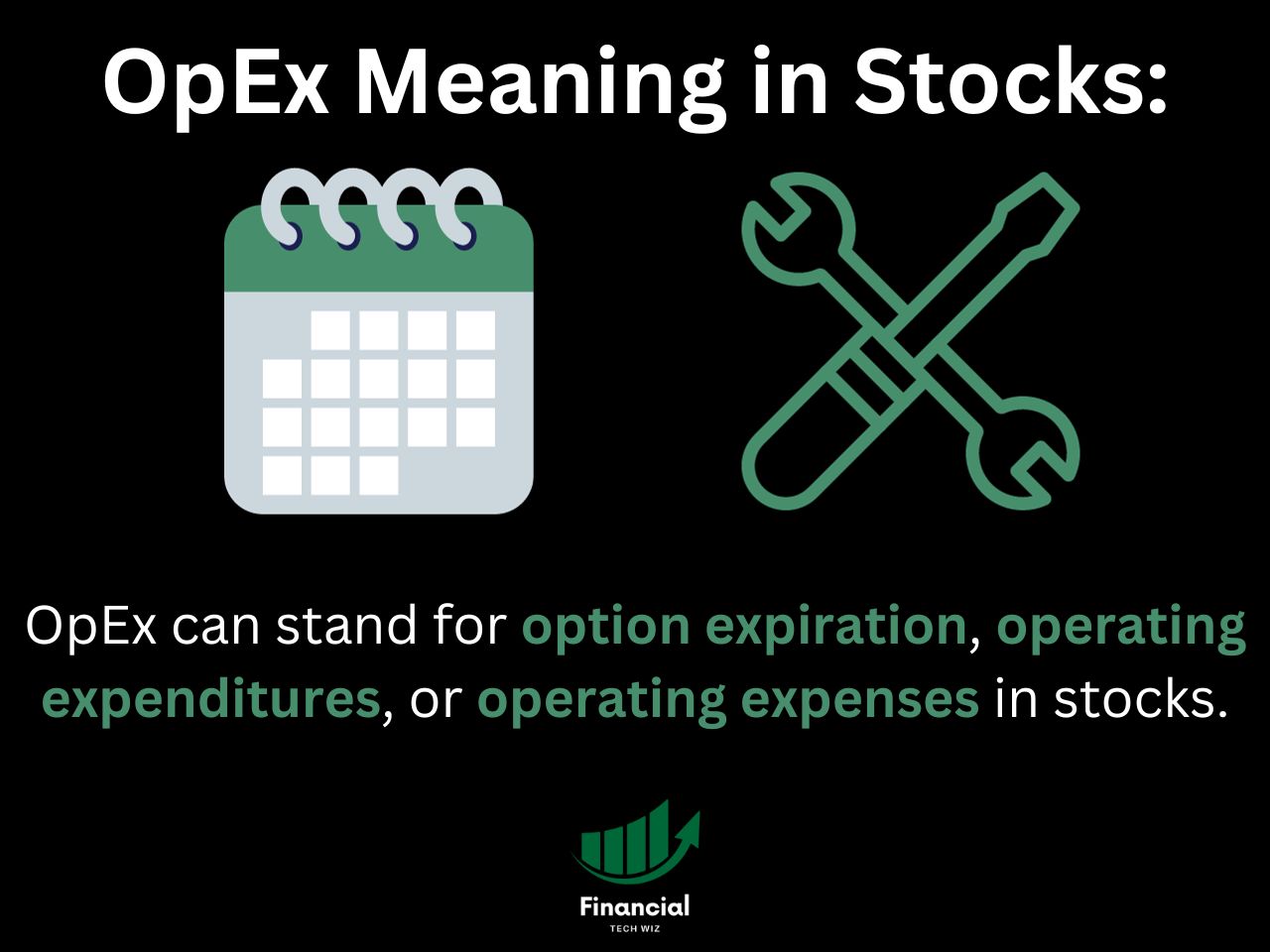
Outside trading, OpEx is also short for operating expenses or operating expenditures. In a corporate context, OpEx is the day-to-day cost of running a business: salaries, rent, utilities, marketing, software subscriptions, maintenance, and similar recurring expenses that flow through the income statement and reduce net income in the period they are incurred.
Capital expenditures (CapEx) are the counterpart. CapEx covers long-lived investments like property, plant, equipment, and major software, which sit on the balance sheet as assets and depreciate over multiple years. The shorthand: OpEx is consumed in the current period and hits the income statement; CapEx is capitalized and hits the balance sheet first. In real estate, OpEx specifically refers to the recurring cost of operating a property: taxes, insurance, repairs, utilities, and management fees.
If you landed here from a stock trading question, this is not the OpEx you are looking for. Skip back up to the options expiration section above.
Understanding OpEx | Bottom Line
OpEx is a term that has multiple definitions in stocks and finance. Depending on the context, it can mean options expiration, operating expenses, or operating expenditures. Each scenario has different implications for traders, investors, and businesses. For active options traders, the third-Friday cycle and the four 2026 triple witching dates are the calendar events that matter most.
If you trade options around expiration and want to see how your performance actually changes during OpEx week, log every trade in the Financial Tech Wiz Trading Journal and let the analytics tab break down your win rate and P&L by symbol, time of day, and hold duration. The trade tagging system lets you pull your OpEx-week trades back up in the Trades tab whenever you want to review that set on its own.
You can also chart the third-Friday cycle on TradingView, which runs on any device and carries the option-aware indicators and alerts that make open interest and IV behavior easy to watch through expiration week.
Featured Tool
Chart OpEx Week on TradingView
Watch open interest, implied volatility, and price action across the third-Friday cycle on a single chart. 100+ indicators, custom alerts, and option-aware tools that read the OpEx setup before it pins.
Start a TradingView Free TrialFrequently Asked Questions
What is OpEx?
OpEx is a term that has several different meanings in stocks and finance. It can refer to option expiration, operating expenses, or operating expenditures.
What is OpEx in stocks?
In stocks, OpEx stands for option expiration. It is the date when options contracts expire and cease to exist. There are monthly expiration dates and triple witching dates that occur four times a year.
What is OpEx and CapEx?
OpEx and CapEx are two types of costs that businesses incur. OpEx stands for operating expenses or operating expenditures, which are costs that have a short-term benefit. CapEx stands for capital expenditures, which are costs that have a long-term benefit.
What is OpEx in finance?
In finance, OpEx stands for operating expenses or operating expenditures. These are the costs that a business incurs while running its normal operations.
What is OpEx in real estate?
In real estate, OpEx refers to the expenses that owners or property managers incur while maintaining and operating a property. They include costs such as property taxes, insurance, repairs, utilities, etc.
What is OpEx week?
OpEx week is the week when monthly options contracts expire. It usually occurs on the third week of each month. Trading volume may increase during this week as traders adjust their positions before expiration.
What is OpEx day?
OpEx day is the day when monthly options contracts expire. It usually occurs on the third Friday of each month. Trading activity may be higher on this day as traders close or roll their positions before expiration.
What is OpEx options?
OpEx options are options contracts that expire on a monthly basis. They are also known as monthly options or standard options. They have more liquidity and volume than weekly or daily options.
What is OpEx in trading?
In trading, OpEx refers to option expiration. It is the date when options contracts expire and cease to exist. Traders need to be aware of OpEx dates because they can affect the price and volatility of the underlying assets.
When is the next OpEx date?
The remaining 2026 expirations are August 21, September 18, October 16, November 20, and December 18. September and December are triple witching. The full 2026 and 2027 calendar is in the table above.
Why does OpEx cause pinning?
Pinning happens because market makers hedge their options books by buying or selling the underlying. As price drifts toward a strike with heavy open interest, that hedging flow tends to push price back toward the strike rather than away from it. The pinning effect is strongest into Friday close on monthly OpEx and dissipates immediately after expiration.
How is 0DTE OpEx different from monthly OpEx?
0DTE means zero days to expiration, so technically every weekday is an expiration day for major index options. Monthly OpEx still matters more because the largest open interest concentrates in the monthly third-Friday cycle, which produces the gamma cliff that 0DTE expirations do not. 0DTE flows affect intraday behavior; monthly OpEx affects the multi-day regime.
What is the gamma cliff after OpEx?
The gamma cliff is the sharp drop in dealer gamma exposure that happens right after monthly or quarterly OpEx, when the largest expiring contracts roll off the books. With less gamma to hedge, dealer flows become smaller and the market often shifts to a more directional, more volatile regime in the days that follow.
Is today OpEx?
If today is a Friday and the date falls between the 15th and the 21st, today is monthly OpEx. Monthly expiration lands on the third Friday, which mathematically has to sit somewhere in that seven-day range, unless a market holiday closes that Friday and pushes expiration to the Thursday before. Any other Friday is a weekly expiration, which involves far less open interest.
Is OpEx day bullish or bearish for stocks?
Neither, reliably. Published research on the option-expiration week effect found a modest positive average return for large-cap stocks during that week, but the dispersion around the average is wide and the pattern has been public long enough to be partially arbitraged away. The more consistent behavior is mechanical rather than directional: price gravitates toward heavily traded strikes into Friday, then that pull releases the following week.
Get Your Free Trading Resources
Grab the free trading journal template plus the same tools we use to stay organized, consistent, and objective.
- Free trading journal template
- Custom indicators, watchlists, and scanners
- Access our free trading community
Enter your email below to get instant access.
No spam. Unsubscribe anytime.