Double Doji Candle Pattern: Strategy, Reliability, and Examples

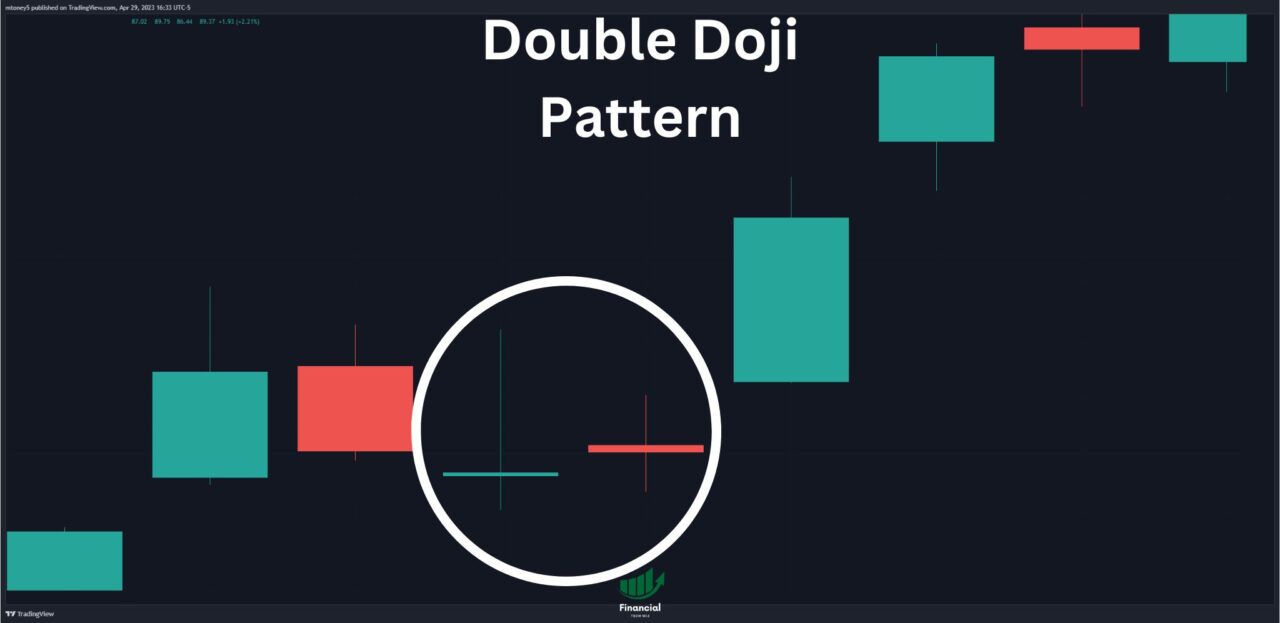
The double doji candle pattern shows up when the market posts two indecision candles back-to-back at the end of a clear trend. Standalone, a single doji is a soft pause. Paired, the second doji turns the pause into a reversal signal worth trading, provided you stack the right confirmation on top.
Key Takeaways
- The double doji is a stronger reversal signal than a single doji because two consecutive indecision candles confirm that one side of the order flow has stalled.
- The pattern works best at established support or resistance and after a clean directional move; in the middle of choppy range it produces false signals.
- Pair the setup with RSI divergence, a volume drop on the doji bars, or a moving-average confluence to lift the win rate before sizing in.
Track Your Reversal Setups
Financial Tech Wiz Trading Journal
Reversal trades live and die on the next two candles. Log every double doji entry with screenshots, confirmation notes, and exit reasoning, then let the analytics tab show you which setups actually compound over hundreds of trades.
Try the JournalTypes of Doji Inside a Double Doji
Not every double doji prints the same two candles. The first doji sets the indecision read; the second doji confirms which side of the order book is now in control. Understanding the type of each doji, especially the second candle, sharpens the reversal read significantly. Here are the four doji types that can form either half of the pattern, along with what each variation signals.
Doji
The standard Doji has a small body with the opening and closing prices nearly identical and shadows of varying lengths. It signals a market pause: neither buyers nor sellers controlled the session. When two standard dojis appear back-to-back, the read shifts from “one moment of indecision” to “the trend has genuinely lost momentum.” Two consecutive pauses are much harder for the dominant side to absorb. Learn more about the range of doji candle types and their individual characteristics.
Long-legged Doji
The Long-legged Doji features long upper and lower shadows, meaning the session saw wide-range action in both directions before closing near the open. As the second candle in a double doji pair, this variant signals aggressive back-and-forth price action with neither side winning, which is a strong exhaustion read at trend extremes.
Dragonfly Doji
The Dragonfly Doji appears with a long lower shadow and little to no upper shadow: price was pushed down during the session but buyers rejected those lower levels and closed near the open. As the second candle in a downtrend double doji, the Dragonfly is the most bullish variant of the pair because it directly confirms that selling pressure has been absorbed and rejected.
Gravestone Doji
The Gravestone Doji is the mirror image: a long upper shadow and little to no lower shadow, meaning buyers pushed price up but sellers pushed it back down to close near the open. As the second candle in an uptrend double doji, the Gravestone is the most bearish variant, confirming that buying pressure has stalled and sellers have stepped in at a level they are willing to defend.
Double Doji vs Single Doji
A single doji is a one-bar pause in an existing trend. Strong trends absorb single dojis constantly: the dominant side takes a breath and then resumes. A trader who fades every single doji in a directional market loses money over time because the trend usually overrides the one-bar hesitation. The single doji’s value is as a heads-up, not a signal.
A double doji is a different conversation. The dominant side had a second full session to reassert itself and failed again. That second failure is what converts indecision into a tradable exhaustion read. The pattern pairs naturally with other multi-candle reversal setups like the morning star pattern, where the doji component does the exhaustion work before the reversal candle prints. When choosing between a single doji and a double doji setup as an entry trigger, the double doji clears the bar substantially higher.
Confirmation Indicators That Lift the Win Rate
The double doji tells you the trend has paused twice. Confirmation indicators tell you whether that pause is a reversal in progress or a brief consolidation before continuation. Adding even one of the three below to a double doji setup meaningfully filters out the low-quality versions.
Volume Drop on the Doji Bars
Genuine reversals typically print with declining volume on the indecision bars followed by an expansion candle in the new direction. When you see a double doji form on shrinking volume at the end of a trend, that volume dry-up signals that the dominant side is pulling back before the counter-move. If the reversal candle after the second doji prints on higher volume than either of the doji bars, that is the confirmation. A volume profile on TradingView can help you spot the volume nodes at which price tends to stall, making it easier to identify where a double doji is most likely to resolve as a reversal rather than a continuation.
RSI Divergence
RSI divergence stacked on top of a double doji at support or resistance is a high-confidence combination. When price is making a new high or low but RSI on TradingView is making a lower high or higher low, momentum is already fading before the reversal candle prints. A double doji printing at that divergence point converts a soft reversal read into a scenario where both price structure and momentum are telling the same story. Most false double doji signals in trending markets fail exactly this test: RSI is trending with price, not diverging from it.
Moving Average Confluence
A double doji printing at a 20 or 50-period moving average carries a built-in stop-loss anchor. The moving average defines where price should not go if the reversal thesis is correct: a close through the MA invalidates the setup cleanly. Dojis at moving average levels are also easier to trade with a tight stop because the MA acts as the line in the sand, not an arbitrary dollar amount. Higher-timeframe MAs (the 50 daily, the 200 daily) are the highest-conviction anchors; the double doji just needs to print at or just beyond the level to qualify.
Double Doji Trading Strategy
The Double Doji pattern works as the basis for a rules-based trading strategy when combined with the context work above. Here is a clean six-step framework, followed by the trade management options that give the setup its risk-to-reward flexibility.
- Identify the Double Doji Pattern: look for two consecutive Doji candlesticks in a chart after a clear directional move of at least three bars.
- Confirm the Trend: the Double Doji must appear after a sustained up or downtrend. A double doji forming in choppy, sideways price action is much less reliable.
- Identify Support and Resistance Levels: determine key support and resistance levels. A double doji touching an established level raises the setup’s credibility. Coincidence with a moving average makes stop placement clean.
- Add Confirmation: check volume (declining on doji bars?), RSI (diverging from price?), and MA position (doji printing at the MA?). One confirmation is the minimum; two is a high-conviction setup.
- Place Pending Orders: once the setup qualifies, place two pending orders: one just above the high of the double doji range for a long entry and one just below the low for a short entry. Price will tell you which direction the reversal goes.
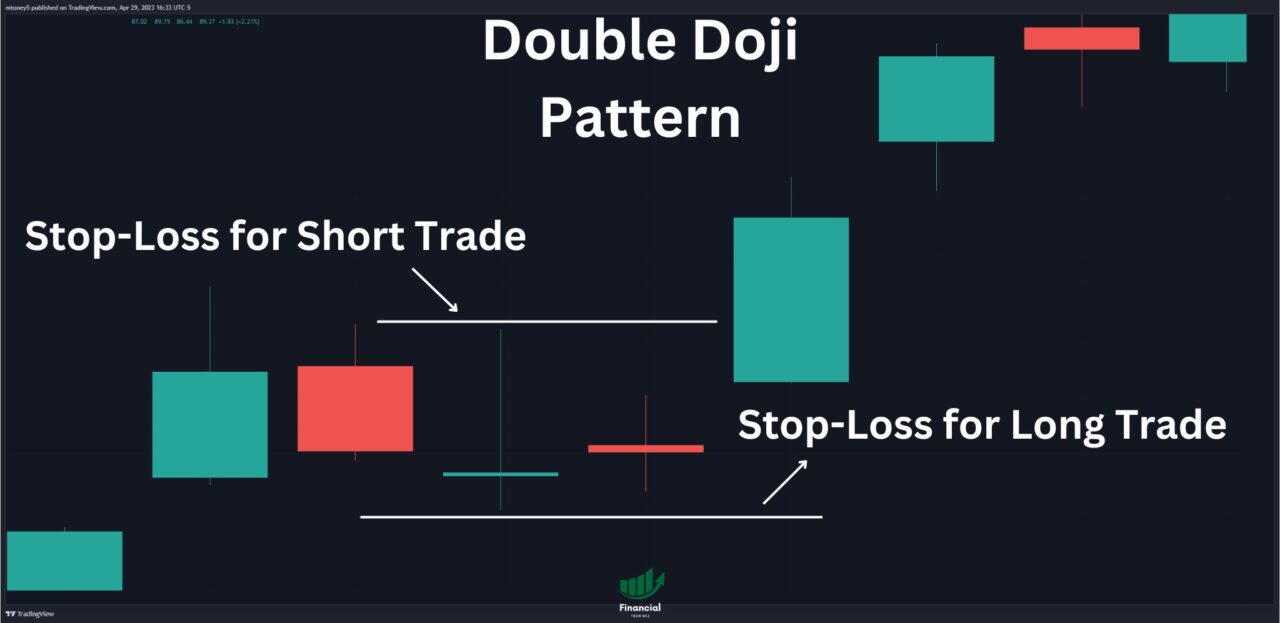
- Set Stop Loss: for a long trade, stop below the low of the two-candle range; for a short trade, stop above the high. Invalidation rule: if price closes back inside the doji range two candles after entry, exit at breakeven or the first profit target. Do not wait for the stop.
Trade management options once you are in position:
- Take Profit Method 1: set the take-profit level equal to the stop-loss distance. This gives a 1:1 risk-to-reward ratio and is the most conservative exit.
- Take Profit Method 2: open two identical trades. The first trade exits at 1R. The second trade targets 2R; once the first trade closes in profit, move the second stop to breakeven.
- Take Profit Method 3: open one trade, close 80% of the position at 0.5R, and let the remaining 20% run to 2R. This method locks in a partial win quickly while keeping a small position open for a larger move.
Reliability and Success Rate
The double doji is a discretionary pattern. No published win-rate study covers it across enough standardized samples to publish a hard percentage, and any site quoting a specific win rate for the double doji is working from a sample too small or too backfitted to generalize across markets and timeframes.
What is consistently observed among traders who track it: reliability improves materially when three conditions are met. First, the pattern prints at a confirmed support or resistance level that has held at least once before on a higher timeframe. Second, it appears after a clean directional move of three or more bars, not in sideways chop. Third, at least one confirmation indicator, volume drop, RSI divergence, or MA confluence, aligns with the setup before entry.
Without those conditions, a blind double-doji trade in mid-range price action loses money more often than it wins. That is not a flaw in the pattern; it is a feature. The setup is selective by design, and using it selectively is what makes the edge real.
The most useful win-rate number is your own. Traders who log every double doji entry in a free trading journal template and review their tagged results after 50 or 100 trades converge on a personal baseline that beats any generic stat. Your market, your timeframe, your confirmation stack: that combination has a real win rate, and a journal is the only tool that can calculate it for you.
Financial Tech Wiz / Free resources
Build a clearer picture of your trading.
Start with the free trading journal template. Keep your trades organized, review your results, and build a consistent review routine.
- Free Google Sheets and Excel trading journal template
- Indicators, watchlists, and scanners
- Access to the free trading community
Ready for automatic trade tracking? Explore the Financial Tech Wiz Trading Journal.
Free resources + trading emails. Unsubscribe anytime.
Double Doji Candlestick Pattern | Bottom Line
The Double Doji Candle pattern is a reliable reversal signal when used with discipline. Two consecutive indecision candles at the end of a clean trend confirm that one side of the market has stalled. Add confirmation from volume, RSI, or a moving average and the read sharpens considerably. The six-step strategy framework here keeps the setup rules-based rather than discretionary, and the flexible take-profit structure gives you options based on how much continuation you expect from the reversal move.
Charting tools like TradingView make spotting the pattern easier, but the real edge compounds over time through tracking. If you trade reversal patterns enough that the gut feel starts to matter, write every double doji entry down somewhere your future self can read it. That is the only way the pattern’s real win rate ever shows up for you.
For more insights into candlestick patterns and their applications in stock trading, explore these related articles:
FAQ
Is a double doji bullish or bearish?
A double doji is a neutral indecision read at the time of formation. The directional bias is set by what comes before it: an uptrend leans bearish, a downtrend leans bullish. The confirmation is set by the candle that prints after the second doji. The pattern itself does not have a fixed bullish or bearish tag.
How reliable is the double doji candle pattern?
Reliability swings hard with context. At a confirmed support or resistance level after a clean three-bar move, double doji setups confirmed by volume or RSI divergence work often enough to be worth trading with a tight invalidation. In choppy mid-range chart action, the pattern produces frequent false signals and is best ignored.
What is the difference between a double doji and a single doji?
A single doji is a one-bar pause that often gets absorbed by the prevailing trend. A double doji is two consecutive pauses, which raises the read from indecision to trend exhaustion candidate. The second candle is the confirmation that the first was not a one-bar fluke.
What is the best timeframe for trading the double doji pattern?
The pattern shows up on every timeframe, but the higher the timeframe, the more reliable the signal. Daily and 4-hour double dojis at major levels carry more weight than 5-minute setups. Lower timeframes work for entries once the higher-timeframe setup is already in place.
Should I use a stop-loss with the double doji strategy?
Always. Place the stop just outside the high or low of the two-candle range, depending on direction. Tight stops are part of the pattern’s edge; a wide stop turns a clean reversal trade into a guess.
Financial Tech Wiz / Free resources
Build a clearer picture of your trading.
Start with the free trading journal template. Keep your trades organized, review your results, and build a consistent review routine.
- Free Google Sheets and Excel trading journal template
- Indicators, watchlists, and scanners
- Access to the free trading community
Ready for automatic trade tracking? Explore the Financial Tech Wiz Trading Journal.
Free resources + trading emails. Unsubscribe anytime.