Tradezella vs Tradervue (2026): Pricing, Replay, Free Tier

Tradezella and Tradervue represent two philosophies: gamified visual learning versus quantitative data analysis. This comparison examines pricing, features, and technical differences to help you choose the right platform, or skip both for a free alternative.
Looking for options beyond TradeZella too? See the full tradervue alternative comparison, which covers five tools side by side including pricing, AI features, and broker support.
Key Takeaways
- Tradezella wins on trade replay, AI insights, and prop firm sync; Tradervue wins on the free tier, broker breadth, and shared-trades community.
- Neither offers a true free trial on paid plans, which makes a free Google Sheets journal the rational first step before paying $288 to $480 a year.
- For traders who already know they will log every trade, the Financial Tech Wiz Trading Journal at $9.91 per month billed annually delivers automated analytics and AI insights at a fraction of either competitor’s cost.
Recommended Tool
Financial Tech Wiz Trading Journal
If you have already validated the journaling habit and want automated analytics, AI insights, and equity curve tracking without paying $288 to $480 a year, the Financial Tech Wiz Trading Journal starts at $9.91/month billed annually. Imports from 25+ brokers via SnapTrade.
Try It FreeThe Core Difference
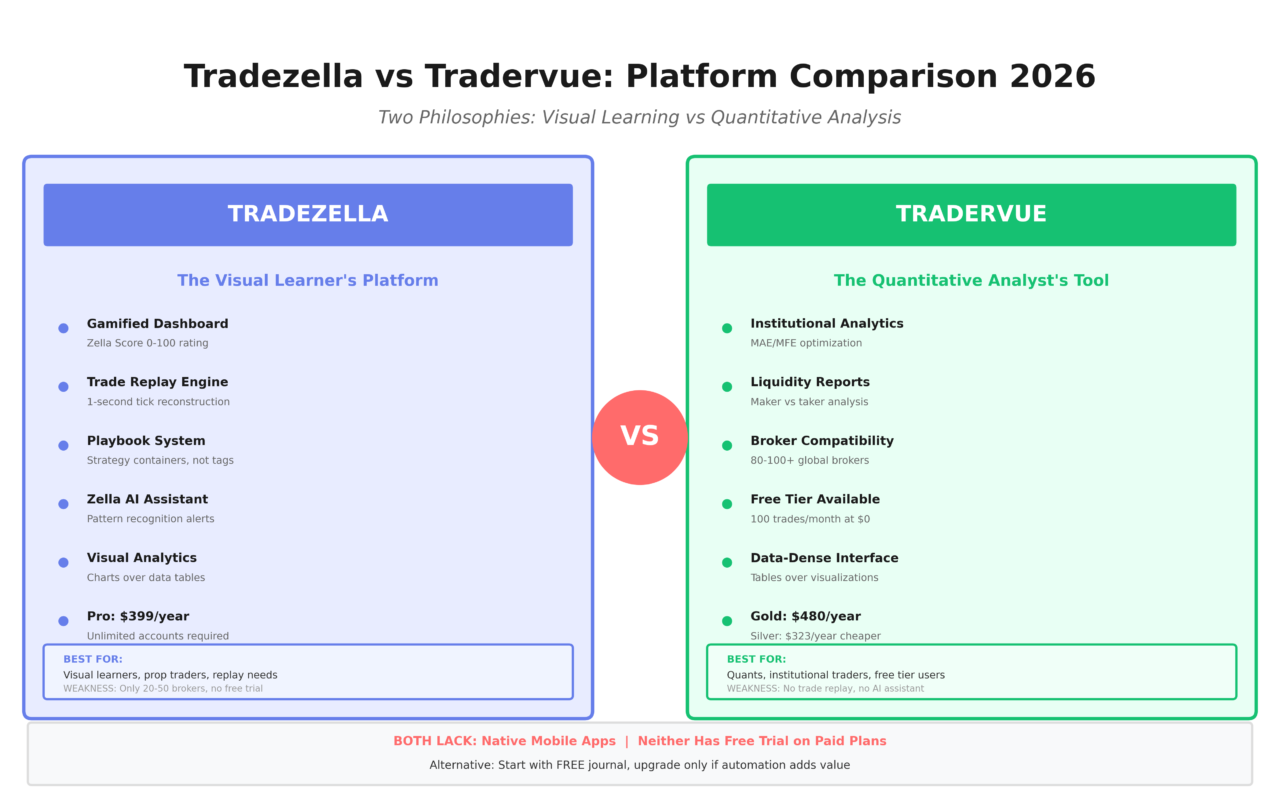
Tradezella = Modern “Trading Operating System” with trade replay, playbooks, and gamification. Built for visual learners and prop traders.
Tradervue = Quantitative workspace with institutional-grade analytics, liquidity reports, and dense data tables. Built for quants and professional desks.
Pricing Comparison 2026
| Feature | Tradezella Basic | Tradezella Pro | Tradervue Silver | Tradervue Gold |
|---|---|---|---|---|
| Monthly price | $29 | $49 | $29.95 | $49.95 |
| Annual price | $288 | $399 | $323 | $480 |
| Account limit | 1 account | Unlimited | Unlimited | Unlimited |
| Free tier | No | No | Yes (100 trades/mo) | Yes (100 trades/mo) |
| Trade replay | Yes | Yes (Sessions) | No | No |
| Playbooks | 3 | Unlimited | Tags only | Tags only |
| Broker support | 20-50 brokers | 20-50 brokers | 80-100+ brokers | 80-100+ brokers |
| Risk analytics (MAE/MFE) | Basic | Basic | Basic | Advanced |
| Liquidity reports | No | No | No | Yes |
| Mobile app | Web/PWA only | Web/PWA only | Web/PWA only | Web/PWA only |
Key pricing insights:
- Tradezella Pro ($399/yr) is 17% cheaper than Tradervue Gold ($480/yr)
- Tradervue Silver ($323/yr) offers unlimited accounts for less than Tradezella Pro ($399/yr)
- Tradervue has free tier (100 trades/month), Tradezella has no free option
Feature Breakdown
Tradezella Strengths
Trade Replay Engine. Tick-by-tick reconstruction of price action. Watch candles form exactly as they did live, with playback controls. Sessions replay shows entire trading days including missed opportunities.
Playbook System. Strategies are containers, not just tags. Separate win rates for “Gap and Go” vs “Afternoon Reversal” prevent data pollution. Track missed trades to quantify hesitation cost.
Zella Score. 0-100 gamified rating normalizing performance quality regardless of volume. Encourages improvement through positive reinforcement.
Visual Dashboard. Clean, modern interface. Heatmaps, P/L curves, and charts prioritized over tables. Reduces analysis paralysis for traders overwhelmed by spreadsheets.
Zella AI. Pattern recognition assistant flags behavioral deviations: “You lose 15% more often on trades within 5 minutes of market open.”
Unlimited Backtesting. Included even on Basic plan. Test strategies against historical data before risking capital.
Tradervue Strengths
Institutional Analytics. Maximum Adverse Excursion (MAE) and Maximum Favorable Excursion (MFE) analysis on Gold plan. Optimize stop placement based on actual price movement data.
Liquidity Reports (Gold Only). Visualize maker vs taker execution. Scatter plot shows correlation between passive entries (limit orders) and winning trades. Critical for optimizing spreads and rebates.
Broker Compatibility. 80-100+ brokers supported vs Tradezella’s 20-50. Includes institutional prime brokers (Sterling, Lightspeed), diverse forex/futures platforms, and robust API for custom pipelines.
Free Tier. 100 trades/month at $0 makes Tradervue viable for swing traders. Tradezella has no free option.
Shared Trades Ecosystem. Public trade sharing creates verifiable execution records used across Discord, Twitter, and mentorship programs. Can share technical details while masking financial data.
Data Density. Spreadsheet-style interface displays maximum information with minimum scrolling. Efficient for high-volume traders scanning hundreds of executions.
Where Both Fall Short
No Native Mobile Apps. Neither offers iOS/Android apps. Both rely on mobile web browsers. TraderSync’s native app provides superior mobile experience.
No Free Trial (Tradezella). Tradezella requires $288+ commitment without testing. Tradervue’s free tier allows evaluation before paying.
Limited AI (Tradervue). Tradervue lacks AI assistant. TraderSync’s Cypher AI performs counterfactual analysis: “If you moved profit target to 2R, P&L would increase $4,500.”
Replay Gap (Tradervue). No native trade replay. Users supplement with external tools (Sierra Chart, TradingView), creating disjointed workflow.
Free Tier Reality Check
The single most consequential difference between Tradezella and Tradervue for new traders is the free tier. Tradervue offers a permanent free plan capped at 100 trades per month: CSV import, basic per-trade statistics, win rate, profit factor, and tag-based filtering all work at $0. Liquidity reports, MAE/MFE analytics, shared-trades publishing, and the API are paywalled to Silver and Gold. Tradezella has no free tier and no free trial. Every Tradezella feature sits behind the $29 monthly Basic plan, with no way to evaluate the product against your own trade data first.
For a swing trader closing fewer than 100 positions a month, Tradervue’s free plan is a complete journaling solution and the obvious entry point. For a day trader running 200+ trades a month, the free tier expires almost immediately and the decision becomes Tradervue Silver versus Tradezella Basic on price-matched paid plans. The “no risk to try” angle disappears.
If a free tier is the deciding factor, Tradervue wins by default. If you want a free option that includes broker auto-sync, neither qualifies. A free Google Sheets trading journal template covers that gap, with full data ownership, performance benchmarking against the S&P 500, and zero subscription cost while you decide whether the journaling habit is going to stick.
Broker Integration Matrix
Both platforms publish high broker counts, but the practical question is whether your specific broker is supported and whether the import is API-driven or CSV-only. Direct API sync auto-pulls trades on a schedule. CSV import means you export from your broker and upload to the journal.
US equities and options. Both Tradezella and Tradervue cover the major retail brokers: Charles Schwab (and thinkorswim), Interactive Brokers, TradeStation, Fidelity, ETRADE, Webull, tastytrade, and Tradier. Tradervue typically supports more of these via direct API; Tradezella mixes API and CSV depending on the broker. For Robinhood specifically, Tradervue accepts CSV exports.
Prop firms and futures. This is Tradezella’s strongest broker territory. PropFirm Sync covers Apex Trader Funding, Topstep, Earn2Trade, MyFundedFutures, FTMO, and Take Profit Trader through direct integrations, plus Tradovate and NinjaTrader for retail futures. Tradervue covers NinjaTrader, Sierra Chart, and Rithmic-cleared futures platforms but its prop firm coverage is narrower.
Forex and crypto. Tradervue handles MT4, MT5, cTrader, Oanda, and FXCM via CSV, with broader institutional forex coverage. Both support Coinbase. Tradervue extends crypto coverage to Binance and Kraken via CSV; Tradezella’s crypto support is the thinnest dimension across both platforms.
The actionable test: pull a CSV from your primary broker and check whether both platforms can ingest it cleanly. If both can, broker support is a tie for your specific workflow. If only one can, that is your answer regardless of headline broker counts.
Which One Fits Your Trading Style
Generic “best for beginners” recommendations miss the point. The right platform depends on trade frequency, account count, and what you actually use a journal for. Five common profiles map cleanly to one of the two platforms.
Day traders running 5 to 50 trades a day
Tradezella, for the trade replay loop. Watching tick-by-tick playback of your own entries and exits is how high-frequency traders find the patterns that flat statistics miss: hesitation on the first pullback, premature exits at the 1R mark, late entries on the second test of support. Tradervue’s static charts cannot reproduce this. If you are leaning Tradezella mostly for replay, the Tradezella alternative comparison walks through cheaper paths to the same workflow.
Swing traders under 100 trades a month
Tradervue’s free tier handles the full workload at $0. Most swing traders never exceed the 100-trade threshold. The only reasons to upgrade are MAE/MFE analytics on Gold or shared-trades publishing for a coaching audience. If you have not validated that you will actually log every trade for six months, start with the free Google Sheets template instead and revisit this decision in 60 days.
Prop firm traders managing multiple funded accounts
Tradezella Pro for the unlimited accounts plus PropFirm Sync. Apex, Topstep, MyFundedFutures, and similar prop firms connect through direct integrations that auto-pull trades across all your funded accounts. Tradervue supports unlimited accounts on Silver at a lower price, but the prop firm direct sync coverage is thinner, so you end up doing more CSV uploads.
Quantitative traders who want MAE/MFE optimization
Tradervue Gold, for the liquidity reports and MAE/MFE analysis. This is the segment where Tradervue’s institutional roots show. Maker/taker scatter plots, adverse excursion distributions, and the API for piping data into custom notebooks are all native. Tradezella’s analytics are visual-first and stop short of this depth. If you are leaning Tradervue mostly for the free tier, the Tradervue alternative deep-dive covers what changes when you outgrow it.
Mentorship or coaching workflows
Tradervue, for the shared-trades ecosystem. Public trade-sharing with masked P&L is a Tradervue-native feature used across Discord communities and trading mentorships. Tradezella has no equivalent. If your journal also serves as a teaching artifact for students or accountability partners, this single feature outweighs everything else.
The Cost-Effective Multi-Account Strategy
Counterintuitive finding:
For traders managing multiple prop accounts who DON’T need trade replay, Tradervue Silver at $323/year beats Tradezella Pro at $399/year by $76 annually. Both offer unlimited accounts, but Tradervue is 19% cheaper.
However, if you need trade replay, Tradezella Pro’s $399 is justified since Tradervue lacks native replay entirely.
The Cost of Ownership Question
$288 to $480 per year is real money. The journaling ROI is also real: traders who log every trade and review weekly typically reduce repeated mistakes within three to six months. The catch is that the ROI only materializes if you stick with the habit. Most traders who pay for a journal stop logging within 60 days, which means the annual subscription quietly becomes a sunk cost.
The rational sequence is to validate the habit first, then upgrade to a paid app once automation is the bottleneck. The Financial Tech Wiz Trading Journal at $9.91 per month billed annually delivers automated analytics, AI insights, equity curve tracking, and benchmark comparison at roughly a third of Tradezella Basic’s price and a quarter of Tradervue Gold’s. It supports SnapTrade auto-import from 25+ brokers and CSV import for full historical data, which covers the import workflow most traders actually need without prop firm gamification or institutional-grade depth they will not use.
Lower-Cost Alternative
Financial Tech Wiz Trading Journal
All the analytics depth Tradezella and Tradervue advertise (equity curve, AI insights, broker auto-import, multi-account support, options analytics) at $9.91/month billed annually instead of $29 to $49 per month. Best fit for traders who want the analytics without the prop firm gamification or the institutional UI.
See Pricing and FeaturesBetter Alternative: Free First, Paid If Needed
Instead of committing $288-$480/year to either platform, start with the Financial Tech Wiz free trading journal:
Free Google Sheets journal:
- Performance charts vs S&P 500 benchmark
- Win rate, profit factor, holding period metrics
- Full data ownership and customization
- Zero financial risk to test if journaling improves results
Upgrade to AI-powered app when ready:
- AI trading coach trained on your trades
- Equity curve and P/L visualization
- Daily performance insights without manual calculations
- Multiple benchmark comparisons
Free Resource
Free Trading Journal Template for Google Sheets
Test the journaling habit before paying $288 to $480 a year for Tradezella or Tradervue. Win rate, profit factor, S&P 500 benchmark, full data ownership, no subscription.
Get the Free TemplateMigration and Data Export
Both platforms own your trade data on their servers. Tradezella supports CSV export of raw trades and basic metadata, but playbooks and tags do not move cleanly across platforms. Tradervue offers CSV export and an API on Silver and Gold, which makes scripted migration possible if you are technical. Notes and tags export but require remapping on the receiving side.
The practical implication: assume that switching journals later means losing some structural metadata (the tagging taxonomy, the playbook hierarchy, occasionally the trade screenshots). Pick the platform whose data model fits your trading style now rather than betting on a frictionless migration later. The free Google Sheets template you control entirely, since the data lives in your own Drive.
Technical Friction Points
Tradezella Limitations
1-Account Bottleneck on Basic: Modern traders juggle personal + multiple prop accounts. Basic plan’s single account limit forces $49/mo Pro upgrade.
Broker Sync Issues: Only 20-50 brokers supported. Weekly Schwab token re-authentication creates recurring friction.
Tradervue Limitations
No Visual Replay: Static charts generated at import. Cannot “re-live” trades to reconnect with execution emotions. Must supplement with external replay tools.
Complex Setup: Institutional-grade features require technical knowledge. IBKR Flex Query setup remains barrier for less tech-savvy traders.
The AI Gap
Tradezella’s Zella AI: Pattern recognition and behavioral alerts. Identifies when you deviate from historical baseline.
Tradervue’s AI: None. Relies on user-generated reports without AI assistance.
The bar in 2026: TraderSync’s Cypher AI performs counterfactual optimization, mathematically showing how parameter changes would have affected results. Both Tradezella and Tradervue lag behind this capability.
Final Verdict
Tradezella wins for:
- Trade replay quality
- Gamification and motivation
- Visual learners
- All-in-one ecosystem (journal + simulator)
Tradervue wins for:
- Broker compatibility (80-100+ vs 20-50)
- Institutional analytics (MAE/MFE, liquidity)
- Free tier existence
- Lower cost for multi-account without replay ($323 vs $399)
Neither platform is “best”, they serve different traders.
However, neither offers free trials, and both lack native mobile apps, creating unnecessary barriers.
Recommendation: Start Free
Most traders don’t know if journaling will actually improve their results. Risking $288-$480 before testing the habit makes no sense.
Start with a free journal, validate the process works for you, then upgrade only if automation adds measurable value.
For the wider field of journal apps beyond these two, see the broader best trading journals roundup.
If a one-time-purchase, manual-entry journal like Edgewonk is also on your shortlist, our Edgewonk alternative comparison covers the free and auto-import options.
Frequently Asked Questions
Is Tradezella or Tradervue better for beginners?
Tradervue is friendlier for beginners because of the free tier (100 trades per month at $0). Beginners can test the journaling habit without committing $288 to $480 a year. Tradezella’s gamified Zella Score and visual dashboards are easier to read once you are paying, but the no-trial paywall makes it a worse first journal for most new traders. The lowest-friction path is a free Google Sheets template for the first 30 to 60 days, then upgrade to a paid app once you know you will actually log every trade.
Does Tradezella or Tradervue have a free trial?
Neither has a true free trial. Tradervue offers a free tier (100 trades per month, basic analytics) that you can use indefinitely without paying. Tradezella has no free tier and no free trial. To evaluate a paid trading journal without paying first, you need either Tradervue’s free tier or a free third-party tool like the Financial Tech Wiz Google Sheets template.
Does Tradezella or Tradervue support trade replay?
Tradezella supports trade replay on the Premium plan ($49 per month), with playback at 1x, 2x, 10x, 20x, and 30x speeds and full session replay for entire trading days. Tradervue does not offer trade replay on any plan. If trade replay is a hard requirement, Tradezella Premium is the only option of the two.
Which has better broker support, Tradezella or Tradervue?
Tradervue advertises 80 to 100+ broker integrations including most major US equities, futures, and forex platforms via API or CSV. Tradezella advertises 500+ broker integrations through PropFirm Sync and direct broker connections, with stronger coverage of prop firm and futures platforms. For US retail equities and options, both cover the major brokers (Schwab, IBKR, Fidelity, ETRADE, tastytrade, Webull). For prop firm or futures-heavy workflows, Tradezella has more direct sync coverage; for institutional or forex workflows, Tradervue tends to cover more.
Is Tradezella or Tradervue worth the $300+ annual cost?
It depends on whether you log every trade for at least 6 months. The journaling ROI is real (most studies show traders who journal consistently reduce repeated mistakes within 3 to 6 months), but it only materializes if you stick with the habit. Most traders who pay for a journal stop logging within 60 days. The rational sequence is: start with a free journal to validate the habit, then upgrade to a paid app like the Financial Tech Wiz Trading Journal ($9.91 per month billed annually), Tradezella, or Tradervue once you know you will use it.
Get Your Free Trading Resources
Grab the free trading journal template plus the same tools we use to stay organized, consistent, and objective.
- Free trading journal template
- Custom indicators, watchlists, and scanners
- Access our free trading community
Enter your email below to get instant access.
No spam. Unsubscribe anytime.