The 12 Best Technical Analysis Books to Read in 2026

Technical analysis is a craft you build over years, not weeks, and the right books can shave a lot of trial-and-error off the curve. This list pulls together the 12 technical analysis books I keep coming back to, organized by where you are in your trading journey: foundational charting, strategy and psychology, and advanced price action. Read them in order, work the patterns on real charts, and the screen time will start paying you back.
Key Takeaways
- Start with John Murphy Technical Analysis of the Financial Markets to learn the language of charts before anything else.
- Trading in the Zone by Mark Douglas and Market Wizards by Jack Schwager matter as much as any pattern book; technical edge dies without psychology.
- Reading is half the work. The other half is logging trades, reviewing what worked, and turning theory into reps.
Financial Tech Wiz Trading Journal
Every book on this list says the same thing: review your trades. The journal does the heavy lifting: auto-imports from 25+ brokers, equity curve, P&L by symbol and hold duration, AI insights on your patterns. So you can spend the screen time studying setups, not building spreadsheets.
Try the JournalHow to Use This List
Read it in order. The Foundational tier teaches you the alphabet (charts, trends, classic patterns). The Strategic tier teaches you how to think (risk, psychology, finding your edge). The Advanced tier teaches you to read the tape bar by bar. Skipping the Foundational tier and jumping straight to Al Brooks is the trading-book equivalent of reading Shakespeare before learning to read; you will get nothing out of it.
If you only have time for three: Murphy, Mark Douglas, then Al Brooks. If you have time for one: Murphy. For a broader reading list beyond technical analysis, see our guide to the best day trading books.
The 12 Best Technical Analysis Books at a Glance
| # | Book | Author | Tier | Core Focus |
|---|---|---|---|---|
| 1 | Technical Analysis of the Financial Markets | John J. Murphy | Foundational | Charting, trends, intermarket analysis |
| 2 | Technical Analysis Explained | Martin Pring | Foundational | Indicators and oscillators |
| 3 | Technical Analysis of Stock Trends | Edwards & Magee | Foundational | Classic chart patterns (1948 original) |
| 4 | Technical Analysis For Dummies | Barbara Rockefeller | Foundational | Beginner-friendly overview |
| 5 | Getting Started in Technical Analysis | Jack Schwager | Foundational | Plain-English walkthrough |
| 6 | Japanese Candlestick Charting Techniques | Steve Nison | Foundational | Candlestick patterns |
| 7 | How to Make Money in Stocks | William O’Neil | Strategic | CAN SLIM growth-stock system |
| 8 | Encyclopedia of Chart Patterns | Thomas Bulkowski | Strategic | Pattern reliability statistics |
| 9 | Technical Analysis Using Multiple Timeframes | Brian Shannon | Strategic | Top-down multi-timeframe workflow |
| 10 | Trading in the Zone | Mark Douglas | Strategic | Trading psychology, probabilistic thinking |
| 11 | Market Wizards | Jack D. Schwager | Strategic | Interviews with top traders |
| 12 | Trading Price Action Trends | Al Brooks | Advanced | Bar-by-bar price action |
Foundational: Build the Charting Vocabulary First
Technical Analysis of the Financial Markets, by John J. Murphy
Universally called the bible of technical analysis, and for good reason. Murphy walks you through every base concept you need (Dow Theory, trend identification, support and resistance, classic chart patterns, moving averages, oscillators, volume analysis, intermarket relationships) in a way that makes sense the first time through. The intermarket-analysis chapters alone (how stocks, bonds, currencies, and commodities feed each other) put you ahead of most retail traders, who never connect those dots.
If you read only one book on this list, read this one. The CMT Association uses it as a primary text in its certification curriculum, which tells you everything about the depth and accuracy. It is dense (700+ pages) but the writing is plain, and you can read it chapter by chapter as a reference rather than cover to cover.
Murphy also devotes a full chapter to wave counting, which is the cleanest introduction to the topic inside a general text. For the standalone version, see our guide to Elliott Wave Theory.
Technical Analysis Explained, by Martin Pring
Pring is the practitioner complement to Murphy. Where Murphy is structured and academic, Pring is conversational and built around real-world application. He goes deep on indicators (RSI, MACD, stochastics, rate-of-change, KST) with worked examples on how each behaves in trends, ranges, and reversals. The book has end-of-chapter quizzes, which sounds gimmicky until you take one and realize you do not actually understand divergence as well as you thought.
Read this after Murphy. The two together cover roughly 90% of the indicator and oscillator vocabulary you will ever need.
Technical Analysis of Stock Trends, by Robert Edwards and John Magee
Originally published in 1948 and still in print, which tells you something. Edwards and Magee codified the language of chart patterns (head and shoulders, triangles, rectangles, flags, double tops and bottoms, wedges) in a way every later author has built on. The book is heavy and old-fashioned, but the pattern definitions and trade-management rules still hold up because they describe human behavior, not market microstructure.
Use it as a reference once you have read Murphy. When you are unsure whether what you are looking at is a genuine head-and-shoulders or a triangle chart pattern, Edwards and Magee will tell you.
Technical Analysis For Dummies, by Barbara Rockefeller
The title is misleading; this is a competent beginner book, not a dumbed-down one. Rockefeller covers chart construction, trend analysis, indicator basics, candlestick patterns, and risk and money management in a friendly tone, with real-world examples and updated material on volatility and adjusting markets. If Murphy looks intimidating on day one, start here for two weeks, then go to Murphy.
Getting Started in Technical Analysis, by Jack Schwager
Schwager wrote Market Wizards (more on that below) and runs a CTA, so this is a working trader introduction rather than an academic one. He covers chart construction, trend lines, classic patterns, oscillators, cycles, and trading-system construction with examples drawn from real markets. Notably, Schwager spends more time than most authors on entry/exit logic and stop placement, which is where most beginner books wave hands.
Japanese Candlestick Charting Techniques, by Steve Nison
Nison brought candlestick analysis to the western world. This is the canonical reference: every candlestick pattern (doji, hammer, engulfing, harami, morning and evening stars, three black crows, dark cloud cover, piercing line, windows, tasuki, separating lines) is defined, illustrated, and contextualized with how to use it alongside trend lines, moving averages, and oscillators.
If you trade off candlesticks and you have not read Nison, read Nison. Most online tutorials misrepresent half the patterns.
Strategic: Think About Risk, Psychology, and Edge
How to Make Money in Stocks, by William O’Neil
O’Neil CAN SLIM system has produced more profitable growth-stock traders than any other public framework. The book covers the seven CAN SLIM criteria (Current quarterly earnings, Annual earnings, New product or management, Supply and demand, Leader or laggard, Institutional sponsorship, Market direction) along with chart-pattern selection (cup-and-handle, double-bottom, flat-base) and a structured process for cutting losers at -7% to -8%.
This is half technical, half fundamental, but the technical-pattern selection criteria are some of the strictest and best-tested in print. If you trade growth stocks, this book is non-negotiable. The modern successor to O’Neil’s approach is Mark Minervini, whose work on tight consolidations and precise entries is worth studying alongside; see our deep-dive on the Mark Minervini trading strategy.
Encyclopedia of Chart Patterns, by Thomas Bulkowski
Bulkowski did the work nobody else did: he statistically tested every classic chart pattern across thousands of historical occurrences and reported the actual win rates, average gains, average losses, and failure rates. The reference covers over 100 patterns including event patterns (earnings, dividend ex-date, stock-split announcements). When you want to know whether the pattern you just spotted has a 65% success rate or a 41% success rate, this is the book.
Use it as a desk reference, not cover-to-cover reading. Look up patterns as you encounter them on charts.
Technical Analysis Using Multiple Timeframes, by Brian Shannon
Shannon’s central idea is straightforward but underused: trade in the direction of the higher timeframe trend, find your entry on a lower timeframe pullback, and manage with intermediate-timeframe context. He calls it Squeeze Dynamics. The book covers stage analysis (accumulation, advancing, distribution, declining) plus practical entry and exit rules across daily, hourly, and 15-minute charts.
If you swing trade, this book reorganizes how you look at charts. It is also short (~250 pages), which is a relief after Murphy and Edwards/Magee. The anchored VWAP concept Shannon helped popularize is covered in depth here as well.
Trading in the Zone, by Mark Douglas
The single most important psychology book in trading. Douglas thesis is that the market generates a stream of independent probabilistic outcomes, and your job is to think in probabilities, accept that any single trade can lose, and execute your edge consistently across hundreds of trades. Most traders fail not because they lack a setup but because they cannot stomach the variance.
Trading in the Zone is the book traders re-read every year. It will not teach you a single chart pattern. It will teach you why you keep moving stops, taking profits early, and chasing breakouts after the move. Read this before Al Brooks, not after.
Market Wizards, by Jack D. Schwager
Schwager interviewed legendary traders (Paul Tudor Jones, Bruce Kovner, Richard Dennis, Ed Seykota, Larry Hite, Marty Schwartz, Tom Baldwin, Michael Marcus) and asked the same handful of questions. Their methodologies vary wildly (trend following, intuitive discretionary, systematic options arbitrage), but the common ground is unmistakable: obsessive risk management, unyielding discipline, and a personally-fitted edge.
Read it as a window into how the best traders actually think, not a how-to manual. The books that follow (New Market Wizards, Stock Market Wizards, Hedge Fund Market Wizards, Unknown Market Wizards) are also worth your time.
Advanced: Read the Tape Bar by Bar
Trading Price Action Trends, by Al Brooks
Brooks is the patron saint of bar-by-bar price action. His Trading Price Action series (Trends, Trading Ranges, Reversals) is dense, granular, and not a casual read. He breaks the chart down into individual bars, signal bars, breakout bars, and inside-bar/outside-bar context, and teaches you to anticipate the next move based on what the prior 5-10 bars already told you.
This is graduate-level work. Do not start here. Start with Murphy, work through the Strategic tier, then come to Brooks when you have a year or more of screen time and want to stop using indicators as a crutch. The Trends volume is the right entry point.
How to Get the Most Out of These Books
Reading is the easy half. The harder half is taking what you learn and turning it into reps that actually move your P&L. Three rules that have worked for me:
- Read with a charting platform open and walk every example through your own market and timeframe. The pattern Edwards and Magee describe in cotton futures from 1947 still appears in SPY today. Keep the free chart patterns cheat sheet alongside the book so you can check a structure’s entry, stop, and target without flipping back a chapter.
- Pick one concept per week and trade only setups that fit it. If you read Nison’s chapter on engulfing patterns, take engulfing-only trades for a week, log them, and review. Before you build a full system, run the setup through a risk reward calculator to make sure the R:R math actually works.
- Journal everything. Entry reason, exit reason, setup type, what you felt, what you would do differently. The pattern in your trades is more useful than any pattern in any book.
Free Trading Journal Template (Google Sheets)
Not ready for the full Journal app yet? Grab the free Google Sheets template. It tracks the same fields the books recommend logging: entry, exit, setup, R:R, win/loss, notes. You will outgrow it in a few months, which is when the Journal app makes sense.
Get the Free TemplateBest Tools for Applying Technical Analysis
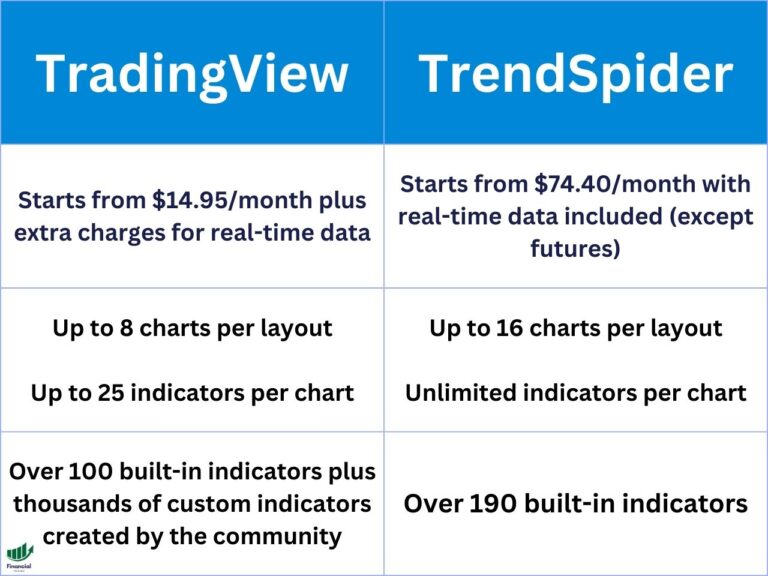
TradingView is what most of the books on this list assume you have access to: a charting platform with real-time data, drawing tools, indicators, and backtesting. TradingView supports stocks, forex, futures, cryptocurrencies, and more. The free tier covers everything in Murphy and Pring; the paid tiers add intraday data, advanced indicators, and faster refresh. If you want to test the premium features, sign up with this link for a free trial and a discount on a paid plan.
TrendSpider layers automated pattern detection and multi-timeframe analysis on top of the same charting layer, which is useful once you are working through Bulkowski’s pattern library and want to screen for setups rather than scan charts manually. The best charting software for stocks guide breaks down the full comparison.
The Financial Tech Wiz Trading Journal closes the loop between the reading and the results: it auto-imports trades from 25+ brokers, tracks your equity curve and P&L by symbol and hold duration, and surfaces AI insights on your trading patterns so you can see whether the setups you are studying are actually working.
For a broader look at where to find the best trading books across all categories, including strategy, options, and mindset, that guide covers the full landscape.
Disclosure: This post contains affiliate links from Amazon and TradingView. As an Amazon Associate, I earn from qualifying purchases. This means that if you click on these links and make a purchase, I will receive a small commission at no extra cost to you.
Frequently Asked Questions
What is the single best book on technical analysis?
If you can read only one, read Technical Analysis of the Financial Markets by John J. Murphy. It covers chart construction, trend analysis, classic patterns, indicators, oscillators, and intermarket relationships in plain English, and the CMT Association uses it as a primary text. Every other book on this list builds on or complements what Murphy lays out.
What books should a beginner start with?
Start with Murphy first, then add Technical Analysis For Dummies by Barbara Rockefeller if Murphy feels too dense in the first few chapters. After that, move to Japanese Candlestick Charting Techniques by Steve Nison and Getting Started in Technical Analysis by Jack Schwager. Those four together cover the entire foundational vocabulary you need before you start studying setups.
Are old technical analysis books still relevant in 2026?
Yes. Markets are faster and more algorithmic than they were in 1948 when Edwards and Magee published Technical Analysis of Stock Trends, but the patterns chart price action draws are still painted by fear and greed, and human emotions have not changed. The technology evolves; the chart-pattern psychology does not. The classics hold up better than most 2020s books on the subject.
What is the best technical analysis book for psychology and discipline?
Trading in the Zone by Mark Douglas is the canonical answer. Market Wizards by Jack Schwager is the close second because it shows you how legendary traders actually think about discipline and risk. Investment Psychology Explained by Martin Pring is also worth reading if you want a third angle.
What is the best book on price action specifically?
Trading Price Action Trends by Al Brooks. It is dense and demands real screen time to absorb, but no other published author has done more granular bar-by-bar work. Read Murphy and Mark Douglas first. If you try Brooks without that foundation, you will bounce off it.
Get Your Free Trading Resources
Grab the free trading journal template plus the same tools we use to stay organized, consistent, and objective.
- Free trading journal template
- Custom indicators, watchlists, and scanners
- Access our free trading community
Enter your email below to get instant access.
No spam. Unsubscribe anytime.