Best Time Frame for Intraday Trading (2026): 1m, 5m, 15m, and 30m Charts Compared

The best time frame for intraday trading depends on how fast you trade and how long you hold a position. Scalpers live on the 1-minute chart. Most discretionary day traders settle on the 5-minute or 15-minute. Trend day traders and the swing-into-day crowd lean on the 30-minute and 1-hour. The right answer for you is the one that matches your strategy, your platform speed, and your tolerance for noise, and the only way to know which one is actually working is to track each trade and review the results.
Key Takeaways
- Scalpers use the 1-minute chart; most discretionary day traders use 5-minute or 15-minute; trend day traders use 30-minute or 1-hour
- The first 30 minutes (9:30 to 10:00 ET) and the last hour (3:00 to 4:00 ET) are the two highest-volatility windows on US equities; the lunch hour (11:30 to 1:30 ET) is the chop window most traders skip
- A multi-time-frame approach (60m for trend, 15m for structure, 5m for entry) outperforms a single time frame for most discretionary day traders
Recommended Tool
Financial Tech Wiz Trading Journal
Tag every intraday trade by time frame, time of day, and symbol. See your win rate and expectancy on the 1-minute, 5-minute, 15-minute, and 30-minute side by side. Starting at $9.91/month billed annually.
Try It Free1-Minute Time Frame: Scalping and Tape Reading
The 1-minute chart is the domain of scalpers, prop-firm traders, and futures tape readers. Every candle represents 60 seconds of price action, which means the chart responds to every tick, every Level 2 print, and every micro support or resistance level in real time. The granularity is useful if your strategy calls for sub-5-minute holds, tight stops at the nearest bid or ask cluster, and a high trade count across the session.
VWAP is the most-watched 1-minute anchor for opening-range scalpers, and most setups built on the 1-minute chart key off price reclaiming or rejecting it.
The trade-off is noise. At 1-minute resolution, false signals outnumber clean ones, and the chart whipsaws between support and resistance levels that would never register on a 5-minute candle. A fast, low-latency data feed and a direct-access platform are baseline requirements. If your broker routes orders through a clearing firm with a 2-to-3-second execution lag, the 1-minute chart will cost you on entries and exits.
5-Minute Time Frame: The Day Trader Default
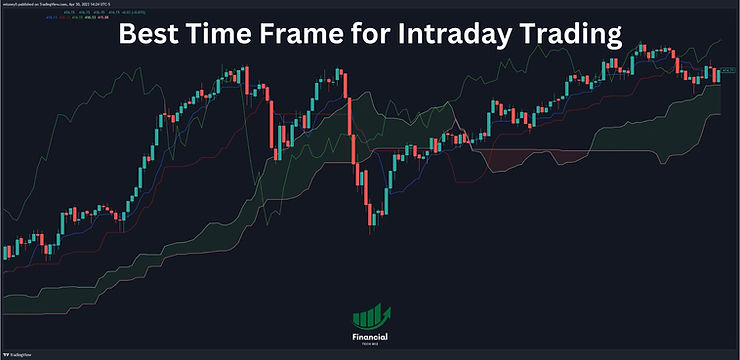
The 5-minute chart is the most popular intraday time frame for discretionary equity day traders. Each candle gives you five minutes of price discovery, enough detail to see opening-range breakouts, VWAP reclaims, and pullback entries without drowning in the sub-minute noise that hurts scalpers on thin days.
Most opening-range-breakout setups are built on the 5-minute chart: the first candle (9:30 to 9:35 ET) sets the range, and traders wait for a clean break with volume before entering. Pair the 5-minute chart with the indicators most discretionary day traders pair with the 5-minute, namely the 9-EMA, the 20-EMA, and VWAP, and you have a readable, scalable entry framework that works on equities, futures, and ETFs.
Platforms like TradingView give you the 5-minute view out of the box. Set the chart to 5 minutes, add VWAP and the 9-EMA, and you have the setup most retail day traders run.
15-Minute Time Frame: Structure and Pullback Trading
The 15-minute chart is a gap in most beginner trading content, and it is a meaningful one. Where the 5-minute chart shows entry-level granularity, the 15-minute shows structure: trendlines are more reliable, support and resistance zones are cleaner, and the false breakouts that torment 5-minute scalpers mostly disappear at the 15-minute level.
Pullback traders and mean-reversion traders lean on the 15-minute for this reason. A 5-minute breakout that looks clean might just be a spike into a 15-minute resistance; the higher chart gives you the context to filter the trade. RSI on the 15-minute is a common pullback signal: a dip into the 30-to-40 zone in an established uptrend is the textbook re-entry trigger.
The trade-off is fewer trade opportunities per session. If you are used to taking 10 trades a day on the 5-minute chart, the 15-minute will cut that number in half. Slower entries are the cost of cleaner signals.
30-Minute Time Frame: Volume Profile and Market Profile
Market Profile Trading pioneer James Dalton recommends the 30-minute time frame for traders using Volume Profile or Market Profile analysis, and the logic holds up. Each 30-minute candle represents a full intraday auction rotation, which means you can see whether the market is balancing (overlapping candles, tight range) or imbalancing (directional push, one-way flow) across the full session on a single chart.
TradingView Volume Profile tools work best anchored to the session open when trading the 30-minute frame. The Point of Control and the Value Area High and Low become your primary reference levels.
The trade-off is trade count. A 30-minute day trader might take 2 to 4 trades across the full session, compared to the 5-to-10 a 5-minute trader executes on the same day. If you need a high trade count to stay focused, the 30-minute will feel slow. If you are disciplined enough to wait for structure, it rewards patience.
1-Hour Time Frame: Trend Anchor and Multi-Time-Frame Top
Most intraday traders do not trade off the 1-hour chart directly; they use it as the top of a multi-time-frame stack. The 1-hour shows you whether the larger intraday trend is up, down, or sideways before you zoom in to find an entry. A bullish 1-hour chart does not guarantee a profitable long, but it tells you which side of the market institutional money is on during the current session.
Day traders who ignore the 1-hour and only trade the 5-minute or 15-minute chart are essentially reading a sentence without knowing the paragraph it belongs to. The 1-hour time frame provides that paragraph.
Multi-Time-Frame Analysis: 60m, 15m, 5m Stack
The most widely cited intraday workflow among discretionary day traders is the three-time-frame stack: 60-minute for trend, 15-minute for structure, 5-minute for entry. Each layer filters the layer below it.
Step one: pull up the 60-minute chart. Determine whether the stock or future is in an uptrend, downtrend, or range. Note the major support and resistance levels at this time frame.
Step two: switch to the 15-minute. Find the most recent swing high or low, the current pullback or consolidation zone, and the closest key level (prior day high, VWAP, moving average) that the market is testing.
Step three: drop to the 5-minute for the entry trigger. Wait for a specific candle pattern, a volume spike, or a reclaim of VWAP to pull the trigger in the direction the 60-minute and 15-minute both agree on.
The cleanest multi-time-frame setup uses an EMA stack across time frames: 200-EMA on the 60-minute for trend, 20-EMA on the 15-minute for structure, 9-EMA on the 5-minute for entry. A trade that aligns all three is the highest-probability setup in the stack.
Best Time of Day to Day Trade (US Eastern Time)
The clock matters as much as the chart. US equities have four distinct volatility windows each session, and treating them all the same will cost you edge.
9:30 to 10:00 ET (the open): highest volatility of the day. Institutional orders, overnight news reactions, and gap fills all land in this window. Moves are the biggest here, but so is slippage. Beginners should wait until 9:45 or 10:00 ET before placing live orders; the first 15 minutes is the worst slippage window of the entire session and produces the most fake breakouts.
10:00 to 11:30 ET (mid-morning): the cleanest trend hour for most discretionary day traders. Opening-range breakouts that held at 10:00 ET often continue into 11:30. Volume is still elevated, spread is tight, and the dominant intraday direction is usually clear.
11:30 to 1:30 ET (lunch): volume drops, bid-ask spreads widen, and price chops in a tight range. Most professional day traders cut their position size or step away entirely during this window. Mean-reversion scalpers may find some edge here, but momentum and trend strategies typically stop working.
3:00 to 4:00 ET (power hour): the second volume spike of the day arrives as institutional desks execute end-of-day rebalancing, MOC orders queue up, and index funds settle positions. Moves in the final 30 minutes can be large and fast.
Tick Charts and Renko: Time-Frame Alternatives
Time-based charts are not the only option. Two alternatives are worth understanding.
Tick charts build a candle for every N trades executed, regardless of how long that takes. A 200-tick chart draws a candle every 200 transactions, which compresses dead periods and expands volatile ones. Scalpers who find time-based 1-minute charts too noisy during slow periods often prefer tick charts because the chart only moves when something is actually happening.
Renko charts are price-based, not time-based. A new brick forms only when price moves a fixed number of points, filtering out all chop below the brick size. Trend traders who want a clean directional read without time noise use Renko as a complement to their time-based charts.
How to Find the Time Frame That Works for You
Every article on this topic gives you a recommendation. Most of the time, the recommendation is: it depends on your strategy. What that advice leaves out is the instruction to actually measure which time frame your specific trades perform on.
Here is a 30-day protocol that removes the guesswork. Pick two time frames you are genuinely considering, for example 5-minute and 15-minute. Take at least 30 trades on each, tagged by time frame, time of day, and symbol. Log entry, exit, reason, and result. After 30 trades on each, compare the win rate and expectancy side by side. The time frame with the better expectancy is your default. The other one is optional context.
You can compare trading journal options for time-frame attribution before you commit; not every journal lets you tag trades by time frame and aggregate the breakdown. The Financial Tech Wiz Trading Journal automates this breakdown by tagging trades when you import via SnapTrade and lets you filter the equity curve by tag across any date range.
Most traders are surprised by the result. The time frame they think is working often is not, and the one they avoid often outperforms. Data eliminates the guesswork.
Get Your Free Trading Resources
Grab the free trading journal template plus the same tools we use to stay organized, consistent, and objective.
- Free trading journal template
- Custom indicators, watchlists, and scanners
- Access our free trading community
Enter your email below to get instant access.
No spam. Unsubscribe anytime.
Track Your Trades
Find the Time Frame That Actually Works for You
Most traders pick a time frame and stick with it because that is what their broker showed them on day one. The Financial Tech Wiz Trading Journal can tag every trade and show you the win rate, expectancy, and your most profitable times to trade, so the data picks the chart speed for you.
Try It FreeFrequently Asked Questions
What is the best time frame for intraday trading for beginners?
Most beginners do best on the 5-minute or 15-minute chart. The 1-minute chart is too fast and too noisy: it generates whipsaws and rewards reaction speed over judgment. The 5-minute and 15-minute give you time to read price action, check the higher time frame, and pull the trigger without panic. Once your routine is automatic, you can decide whether to drop down to 1-minute or step up to 30-minute based on the strategy that matches your edge.
What is the best time of day to day trade?
For US equities, the two strongest windows are 9:30 to 11:00 ET (the open and mid-morning trend hour) and 3:00 to 4:00 ET (power hour). The 11:30 to 1:30 ET lunch window is the chop period most professional day traders avoid. Beginners should wait until 9:45 or 10:00 ET before taking a real trade because the first 15 minutes is the worst slippage window of the day.
Should I use a 1-minute or 5-minute chart for day trading?
Use the 1-minute if you scalp (sub-5-minute holds, tight stops, high-frequency entries) and your platform plus your data feed are fast enough to keep up. Use the 5-minute if you take 1 to 6 trades a day with 5-to-30-minute hold times, which is most discretionary day traders. Most retail day traders pick 5-minute and add a 15-minute or 60-minute as a higher-time-frame reference.
What time frame do scalpers use?
Scalpers default to the 1-minute chart. Some scalpers go even faster by switching from a time-based chart to a tick chart (every 200 ticks, every 500 ticks, etc.), which collapses chop and expands volatile periods. Either way the holding window is seconds to a few minutes and the trade count is high.
How do I know which time frame is working for me?
Track every trade in a journal, tag each one with the time frame, and review the win rate and expectancy by time frame after at least 30 trades on each. Most traders are surprised: the time frame they think is working often is not, and the one they avoid often outperforms. The Financial Tech Wiz Trading Journal automates this breakdown by tagging trades automatically when you import them via SnapTrade or CSV.
Get Your Free Trading Resources
Grab the free trading journal template plus the same tools we use to stay organized, consistent, and objective.
- Free trading journal template
- Custom indicators, watchlists, and scanners
- Access our free trading community
Enter your email below to get instant access.
No spam. Unsubscribe anytime.