Interactive Brokers vs thinkorswim (2026): Side-by-Side Breakdown

Interactive Brokers (IBKR) and thinkorswim get compared because both can support serious trading workflows, but the real choice is about platform philosophy. thinkorswim is owned by Charles Schwab and the Schwab vs. thinkorswim comparison covers the broader brokerage angle. This guide focuses on IBKR vs thinkorswim head-to-head: cost, asset access, platform depth, and which trader fits each side.
IBKR is a professional-grade brokerage with multiple trading interfaces built around routing control, advanced order types, and automation-friendly tooling. thinkorswim is the flagship trading platform inside Schwab’s ecosystem, built for charting, options analysis, paper trading, and a smooth all-in-one trading workspace.
Key takeaways
- IBKR wins on cost when you carry margin or trade futures. Margin rates run roughly 4 to 5 percentage points below Schwab’s, and futures commissions are roughly a third of thinkorswim’s.
- thinkorswim wins on options analysis, charting, and paper trading. The Analyze tab, thinkScript, OnDemand replay, and paperMoney are unmatched in retail.
- Asset breadth is a hard split. IBKR trades global equities, forex, fixed income, and spot crypto. thinkorswim is U.S. equities, options, and futures only.
Recommended Tool
Financial Tech Wiz Trading Journal
Whichever broker wins this comparison for you, neither IBKR nor thinkorswim ships with a structured performance review layer. Pull your full trade history into a journal that breaks down win rate and P&L by symbol, time of day, asset type, and hold duration. Starting at $9.91/month billed annually.
Try It FreeInteractive Brokers platform overview
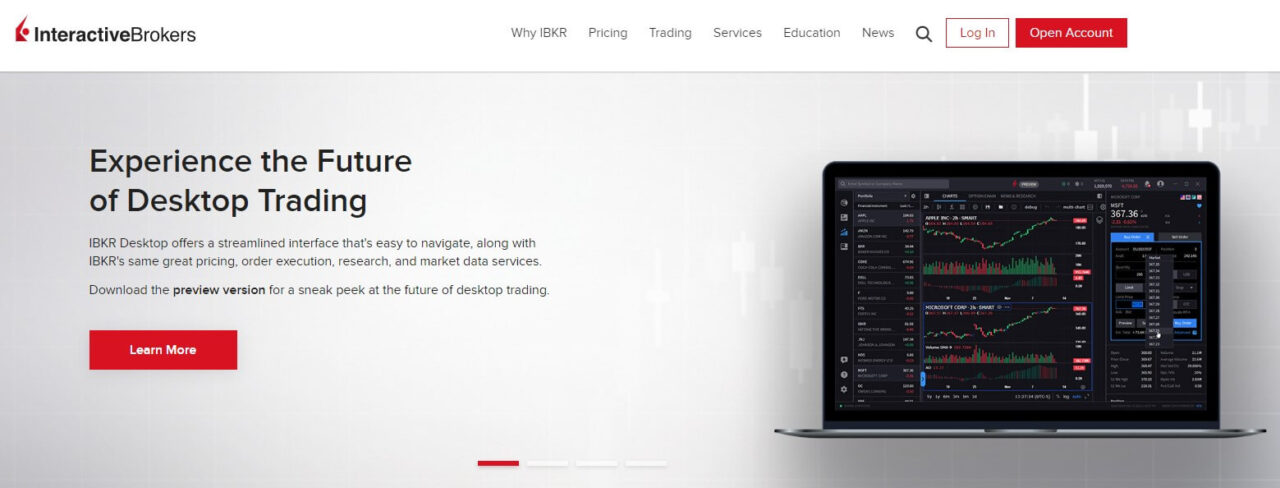
Interactive Brokers is a long-established brokerage (founded in 1978) known for professional trading infrastructure. The “platform” experience with IBKR is really a suite: desktop, web, and mobile interfaces designed to serve active traders, institutions, and systematic strategies.
IBKR shines when you care about execution precision, order control, and tooling that fits a more technical workflow. The trade-off is usability. Many traders find the IBKR interface less beginner-friendly and the charting experience less streamlined than chart-first platforms.
What stands out on IBKR
- Broad order control and advanced order types
- Strong fit for automation-oriented traders
- Competitive options pricing
Who IBKR is best for
IBKR fits experienced traders who want more control over execution and are comfortable with complex platforms. If you want a modern, simple investing experience first, IBKR is typically not the easiest on-ramp.
thinkorswim platform overview (Schwab)
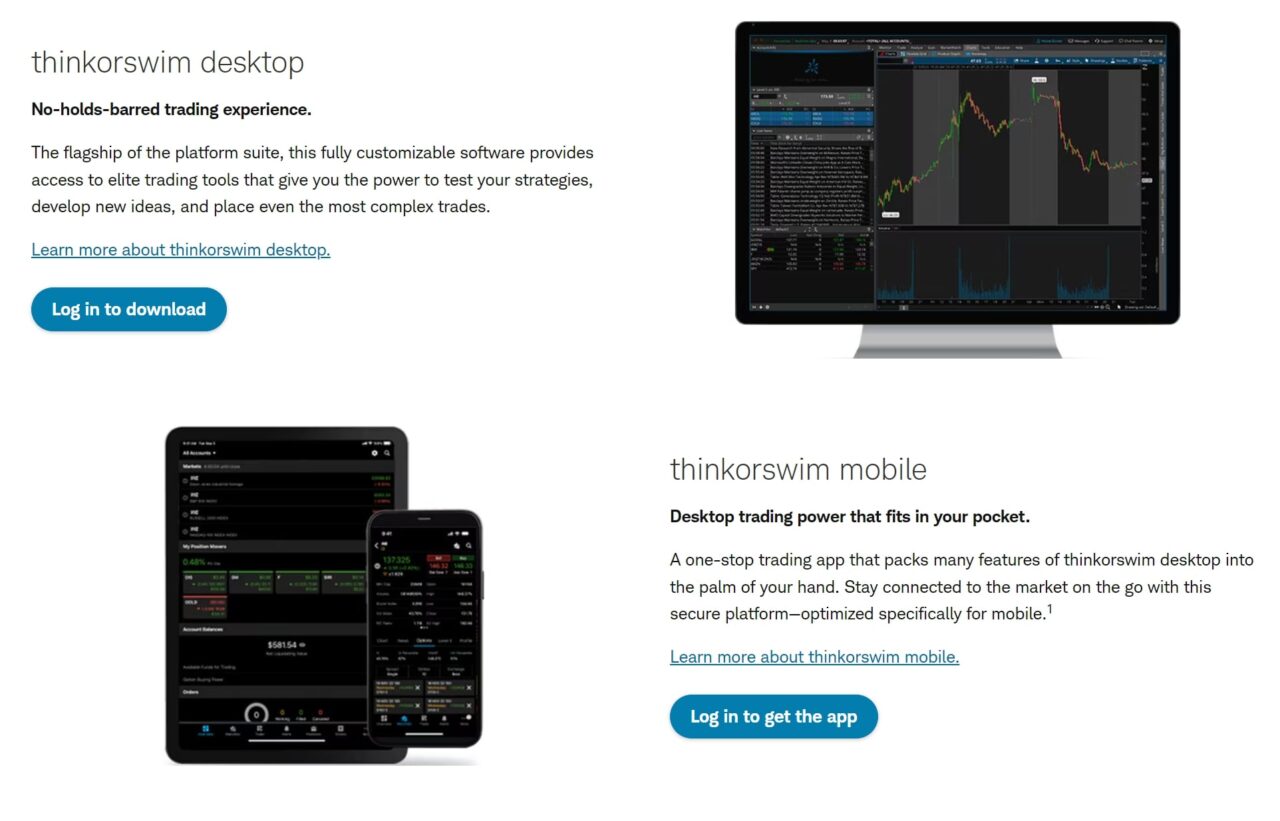
thinkorswim is Schwab’s trading platform. It is where Schwab clients go when they want an active trading workstation rather than a basic brokerage interface. It is popular for its charting, options tools, screeners, and paper trading feature for practicing without risking capital.
In practice, thinkorswim is less about raw execution customization and more about giving you a complete environment: charts, options chain analysis, trade management, and research tools in one place.
What stands out on thinkorswim
- Highly customizable charting and workspaces
- Paper trading for practice and testing
- Included with Schwab brokerage accounts
Who thinkorswim is best for
thinkorswim fits Schwab clients who want a powerful platform for technical analysis, options trading, and paper trading. It is a strong fit if you prefer a workstation experience that feels cohesive and chart-forward.
Key characteristics
| Platform | Platform Type | Tradeable Assets | Charting & Platforms | Data | Premium Pricing |
|---|---|---|---|---|---|
| Interactive Brokers | Brokerage + platform suite | Stocks, ETFs, mutual funds, options, futures, futures options, crypto, bonds, forex | Desktop, web, mobile | Often requires paid real-time data | No premium features |
| thinkorswim (Schwab) | Trading platform inside Schwab | Stocks, ETFs, mutual funds, options, index options, futures, futures options, bonds | Desktop, web, mobile | Real-time data with funded account | No premium features |
Trading features and tools
| Feature | Interactive Brokers | thinkorswim |
|---|---|---|
| DRIP | Yes, but with fees | Yes, no fees |
| Margin Trading | Yes | Yes |
| Insurance | SIPC insured | Not a broker (Schwab is) |
| Mobile App | Yes | Yes |
Trading costs and commissions
| Fee Type | Interactive Brokers | thinkorswim |
|---|---|---|
| Equity Commission | Free | Free |
| Options Commission | $0.65 per contract | $0.65 per contract |
| Futures Commission | $0.85 per contract, $0.25 micro | $2.25 per contract |
| Futures Options Commission | $0.85 per contract, $0.25 micro | $2.25 per contract |
| Option Exercise Fee | None | None |
Margin rates and account costs
If you carry margin balances, this is the section that actually decides the comparison.
Interactive Brokers runs a tiered margin model. IBKR Pro charges a benchmark rate plus a small spread, which works out to roughly 5.33% to 6.83% in 2026 depending on balance tier (lower spreads for larger balances). IBKR Lite charges a flat rate, currently around 6.14%, with no tier discounts. There is no minimum to open either account.
thinkorswim sits inside Charles Schwab’s brokerage, so its margin rate is Schwab’s. Schwab’s published 2026 schedule starts at roughly 12.075% on smaller balances and steps down to about 10.075% only at balances above $250,000. There is no published rate below the 10% floor at retail tiers.
The math on a $100,000 margin balance carried for a year:
- IBKR Pro at 6.83%: $6,830 in interest
- thinkorswim through Schwab at 11.075%: $11,075 in interest
- Annual difference: roughly $4,200 in IBKR’s favor
At $250,000 balance, the gap widens to roughly $11,000 per year. At $25,000 balance, the gap is roughly $1,000 per year.
If you do not use margin (cash account, fully paid securities only), this differential does not apply and the platform decision becomes about features, not cost. If you swing trade with leverage or run portfolio margin, IBKR’s rate alone is usually the deciding factor.
Tradable assets and global market access
Interactive Brokers is built for the trader who wants every asset class on one login. The platform supports U.S. equities and ETFs, options, futures and futures options, forex (over 100 currency pairs), bonds and fixed income, mutual funds, precious metals (physical-backed), and cryptocurrencies. Market access spans more than 150 exchanges across 34 countries, with native trading in local currencies for non-U.S. tickers.
The thinkorswim tradable universe is narrower and U.S. centric. Through Schwab you can trade U.S. equities and ETFs, options, futures, futures options, and Schwab’s mutual fund lineup. There is no spot crypto inside thinkorswim (Schwab offers Bitcoin and Ether futures only), no native forex desk, no direct international stock trading on most non-U.S. exchanges, and no fixed income on the thinkorswim platform itself (bonds are placed through the Schwab website).
If your strategy involves trading European or Asian equities directly, holding cash or balances in non-USD, taking spot crypto positions, or running a forex book alongside equities, IBKR is the only one of the two that supports that workflow.
If you trade U.S. equities, options, and futures only, both platforms cover the asset classes you need. The decision then moves to platform tools, not market access.
Desktop platforms: Trader Workstation vs thinkorswim Desktop
Both brokers reserve their power-user features for the downloadable desktop applications. The web and mobile versions are stripped down by comparison.
Interactive Brokers Trader Workstation (TWS)
TWS is built around execution control. The order ticket exposes 90+ order types and algo families: VWAP, TWAP, Adaptive, Iceberg, ScaleTrader, BookTrader for direct exchange interaction. Smart Routing splits orders across exchanges to chase price improvement and rebate-eligible liquidity. The platform supports custom algos through its IBKR API (Python, Java, C++, .NET) and includes a paper trading account that mirrors live account permissions. Charting is competent but not the headline feature: roughly 100 technical studies plus standard drawing tools. The trade-off is a steep learning curve. The default workspace can intimidate a trader who only wants to send a market order.
thinkorswim Desktop
thinkorswim is built around analysis. The Analyze tab models options strategies before you execute (theoretical P&L, greeks, probability cones, what-if scenarios on price/time/volatility shifts). thinkScript is a proprietary scripting language for custom indicators, scans, and conditional alerts. OnDemand replays any market session tick by tick for after-the-fact study or backtesting discretionary setups. Charting carries 400+ technical studies plus the heaviest drawing tool palette in retail trading. paperMoney is the simulator and runs alongside live trading in the same workspace. The trade-off is execution depth: thinkorswim has standard order types and conditional orders, but no Smart Routing equivalent and no native algo order suite.
Short version: TWS for execution and automation, thinkorswim for analysis and options modeling. Both desktop platforms can also feed charts through TradingView, see Interactive Brokers vs TradingView for the IBKR-specific integration.
Get Your Free Trading Resources
Grab the free trading journal template plus the same tools we use to stay organized, consistent, and objective.
- Free trading journal template
- Custom indicators, watchlists, and scanners
- Access our free trading community
Enter your email below to get instant access.
No spam. Unsubscribe anytime.
Day trading and active trader features
Both platforms support active trading. The differences sit in the data tier and the routing controls.
Level II quotes: thinkorswim includes Level II at no cost on equities and options. IBKR charges for real-time market data subscriptions, and Level II depth is a paid add-on (typically $5 to $15 per month per exchange).
Extended hours: both platforms support pre-market and post-market sessions on U.S. equities. IBKR additionally runs an overnight session (8 PM to 4 AM ET) on roughly 10,000 symbols, which thinkorswim does not.
Direct-access routing: TWS exposes individual exchange destinations (NYSE, NASDAQ, ARCA, BATS, IEX, plus dark pools and rebate venues). thinkorswim routes through the Schwab order management layer with limited venue selection.
Hard-to-borrow shorts: IBKR publishes a daily HTB list with borrow rates per ticker and lets you reserve shares pre-market. thinkorswim borrows through Schwab inventory and surfaces availability at the order ticket without a public rate sheet.
Pattern day trader rule: applies on both. Schwab does not offer enhanced PDT relief; the IBKR portfolio margin program (above $110K equity) does.
Bottom line: which platform should you pick?
Choose Interactive Brokers if you fall into any of these:
- You carry margin balances above $25,000 (the rate gap pays for itself)
- You trade global equities, forex, bonds, or spot crypto
- You run automated or systematic strategies through the IBKR API
- You want direct-access order routing and rebate-tier liquidity venues
- You trade overnight or in non-U.S. session hours
Choose thinkorswim if you fall into any of these:
- Your edge is in options structure (the Analyze tab is unmatched in retail)
- You rely on advanced charting, custom indicators (thinkScript), or session replay (OnDemand)
- You run a Schwab brokerage relationship for cash, retirement, or other holdings
- You want a smoother all-in-one workstation without the TWS learning curve
- You trade U.S. equities, options, and futures only and care more about analysis quality than cost
If your thinkorswim access comes through a Schwab account, it is also worth seeing how Schwab compares to other mainstream brokers in the Charles Schwab vs E*TRADE breakdown.
If you go with IBKR, the Interactive Brokers Trading Journal walkthrough shows the SnapTrade import process step by step. If you go with thinkorswim, the thinkorswim Trading Journal walkthrough covers the same import flow on the Schwab side.
If you trade both and have not committed to one yet, run thinkorswim paperMoney alongside an IBKR Pro live account. Two weeks of side-by-side use will surface which platform fits your workflow before you commit cash to either.
Frequently asked questions
Is thinkorswim a broker?
No. thinkorswim is a trading platform owned by Charles Schwab. The brokerage account that holds your cash and positions is the Schwab account itself. thinkorswim is the application layer you trade through. Interactive Brokers, by contrast, is both the broker and the platform (Trader Workstation runs against the IBKR brokerage account directly).
Can I link Interactive Brokers to thinkorswim?
No. The two platforms cannot be wired together for execution. thinkorswim only routes to Schwab. Interactive Brokers only routes through IBKR. If you want to use thinkorswim charting and analysis without holding a Schwab account, the closest workaround is to run the free thinkorswim chart-only mode (without funded trading) and execute through your IBKR account separately, but the platforms will not communicate.
Which has better paper trading, IBKR or thinkorswim?
thinkorswim paperMoney is widely considered the best simulated trading environment in retail. It mirrors the live platform in full, runs alongside live trading in the same workspace, and supports the same complex options strategies you can place live. The IBKR paper account is functional but feels like a sandbox rather than a parallel environment. For options-strategy practice, thinkorswim wins. For execution-style practice (algos, custom order types), the IBKR paper trader is closer to the live experience because it runs the same order management code path.
Does Interactive Brokers have an Analyze tab equivalent?
Not directly. IBKR has a Strategy Builder and a Probability Lab for options modeling, plus IB Risk Navigator for portfolio-level Greeks and scenario analysis, but the experience is fragmented across separate tools rather than a single tab. If options strategy modeling is the center of your workflow, the thinkorswim Analyze tab is the more integrated experience.
Is IBKR cheaper than thinkorswim?
On equity and ETF commissions, both are zero on standard online trades. Options are equal at $0.65 per contract. The real cost difference is margin interest (IBKR is roughly 4 to 5 percentage points lower than Schwab for retail tiers) and futures commissions (IBKR around $0.85 per contract on standard, $0.25 on micros, versus thinkorswim around $2.25 per contract). For a fully cash, U.S. equities-only trader, the cost difference is negligible. For an active futures trader or a margin trader, IBKR is meaningfully cheaper.
Can I use the Financial Tech Wiz Trading Journal with both brokers?
Yes. Both Interactive Brokers and thinkorswim (through your Schwab account) connect to the Financial Tech Wiz Trading Journal via SnapTrade for one-time bulk import of full trade history, plus CSV import for traders who want to load older trades. The journal handles win rate and P&L by symbol, time of day, asset type, and hold duration, plus equity-curve tracking against benchmarks. See the full supported brokers list for connection method per broker.
Related Comparisons
Get Your Free Trading Resources
Grab the free trading journal template plus the same tools we use to stay organized, consistent, and objective.
- Free trading journal template
- Custom indicators, watchlists, and scanners
- Access our free trading community
Enter your email below to get instant access.
No spam. Unsubscribe anytime.