Barchart vs. TradingView (2026): Which Is Better?

Barchart and TradingView are both popular among active traders, but they solve different problems. Barchart is a data and research machine: deep options chains, futures data, fundamentals, screeners. TradingView is a charting and community machine: 400-plus indicators, Pine Script, native broker integration, social feeds. Most serious traders end up with at least a free account on both, and pay for the one that matches their trading style. Here is how they stack up across pricing, features, data depth, and integration in 2026.
Key Takeaways
- Barchart wins for options data depth, futures and commodities coverage, and fundamental research (best for options traders, futures traders, and swing traders who screen on fundamentals).
- TradingView wins for charting depth, Pine Script customization, the indicator library, and native broker integration (best for technical chartists, multi-asset traders, and anyone who wants to trade from the chart).
- Pricing in 2026: TradingView ranges from $14.95 to $59.95/month across Essential, Plus, and Premium; Barchart Premier is $29.95/month or $199.95/year (Barchart Trader is a separate pro tier).
Whether you decide on Barchart, TradingView, or both, your edge comes from reviewing what worked and what did not. The Financial Tech Wiz Trading Journal imports trades from 25+ brokers, gives you AI insights on your performance, and breaks down win rate and P&L across your positions by symbol and hold duration.
Start tracking your tradesTradingView
- Pricing: Free–$59.95/month
- Community made custom indicators
- User-friendly charting tools
Barchart
- Pricing: Free–$29.95/month
- Customizable charts and indicators
- Great for fundamental analysis
Barchart vs. TradingView at a Glance
The table below captures the headline differences. Detailed breakdowns for each category follow.
| Feature | Barchart | TradingView |
|---|---|---|
| Primary use case | Market data, research, screening | Charting, community, execution |
| Best for | Options traders, futures traders, fundamental analysts | Technical chartists, multi-asset traders, beginners |
| Free tier | Yes (delayed quotes, basic screening) | Yes (limited layouts and alerts) |
| Cheapest paid tier (2026) | Premier $29.95/month or $199.95/year | Essential $14.95/month or ~$12.95/month annual |
| Top paid tier (2026) | Barchart Trader (pro, exchange data) | Premium $59.95/month or ~$49.95/month annual |
| Native charting | Yes (competent, no scripting layer) | Yes (industry-leading, Pine Script) |
| Indicator library | Standard set (RSI, MACD, MAs, Bollinger) | 400+ built-in plus community scripts |
| Options data depth | Strong (Greeks, IV rank, screener) | Limited (chains on Premium, no screener) |
| Futures and commodities | Deep (global exchanges) | Retail-focused contracts |
| Pine Script | No | Yes |
| Broker integration | No | Yes (IBKR, TradeStation, Tradovate, others) |
| Community | No peer-to-peer layer | Large (public ideas, scripts, live chat) |
Pricing in 2026: How Much Does Each Cost?
TradingView pricing (2026)
TradingView has a free tier that is genuinely usable for beginner and intermediate traders. Paid tiers as of 2026 (after the April price increase across all plans):
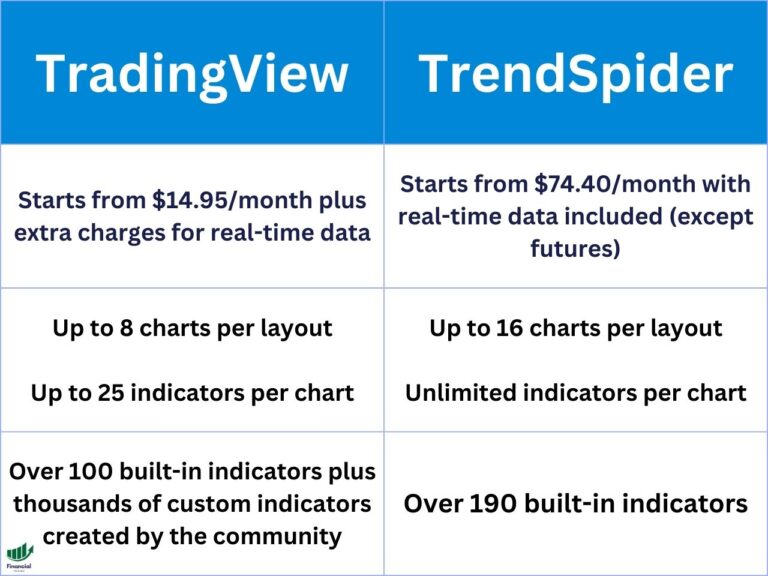
- Essential: $14.95/month, or roughly $12.95/month billed annually ($155.40/year). Adds more chart layouts, more indicators per chart, and no ads.
- Plus: available at an intermediate monthly and annual price between Essential and Premium. Adds more alerts, more simultaneous charts, and additional data exports.
- Premium: $59.95/month, or roughly $49.95/month billed annually. Full indicator and alert limits, volume profile, Bar Replay on all timeframes, and priority customer support.
All paid tiers come with a 30-day free trial. For the full tier-by-tier breakdown including the Ultimate plan, see the TradingView pricing guide.
Barchart pricing (2026)
Barchart also has a usable free tier. The main paid option for individual traders is Barchart Premier at $29.95/month, $199.95/year, or $368.00 for a two-year auto-renewing plan. Premier unlocks real-time data (vs. delayed on the free plan), advanced screeners, full options analytics including end-of-day Greeks across futures options, and complete historical data access. Barchart Trader is a separate, higher-priced tier aimed at active futures and options professionals who need real-time exchange data across global markets.
TradingView Limited Time Offer!
Exclusive Deal: 30-Day FREE Premium Access + Bonus Credit
Don’t Miss Out — Sign up for TradingView Now!
- Advanced Charts
- Real-Time Data
- Track all Markets
Charting and Technical Analysis
TradingView charting
TradingView is one of the strongest charting platforms on the market for retail traders. The built-in library covers 400-plus indicators, drawing tools, Heikin Ashi candles, Renko, volume profile, and a customizable multi-layout workspace. Pine Script lets you write custom indicators and strategy backtests in a lightweight scripting language with an active community of published scripts to pull from. Bar Replay on Premium lets you step through historical price action candle by candle, which is a practical training tool for technical traders. Native broker integration (Interactive Brokers, TradeStation, Tradovate, Webull, and others) means you can build a chart, set an alert, and place a trade in the same interface.
For a deeper look at what makes TradingView useful for chart-focused traders, see the best TradingView indicators roundup and the full TradingView review.
Barchart charting
Barchart’s charting is competent and covers the indicators most active traders use (RSI, MACD, moving averages, Bollinger Bands, volume, and more). Layouts are customizable and the interface is clean. What Barchart lacks relative to TradingView is a scripting layer: you cannot write custom Pine Script-style indicators or automated strategy tests. Barchart’s edge is in the underlying data, not in the chart annotation depth. If you are primarily a chart-driven trader who relies on custom indicators, TradingView is the stronger pick. If you use the chart to complement fundamental or options research, Barchart’s charting is more than sufficient.
Data Coverage and Research
Options data and Greeks
This is Barchart’s clearest competitive edge. The options screener lets you filter on volume, open interest, IV rank, days to expiration, and Greeks across the full chain. For futures options, Barchart provides end-of-day Greeks across most major underlying contracts, a data set that retail traders typically cannot get for free elsewhere. If your trading involves selling premium, identifying unusual options activity, or screening for high-IV setups, Barchart’s options tools are genuinely useful. TradingView surfaces options chains on Premium tiers, but without the screener depth or the futures-options coverage that Barchart provides.
Futures and commodities
Barchart pulls market data from most major global futures exchanges, including energy, grains, metals, livestock, and financial futures. Historical price data is available for analysis and informal backtesting. TradingView covers the futures contracts most retail traders care about (ES, NQ, CL, GC, and similar), with strong charting overlays, but the underlying exchange data depth is lighter than Barchart’s. For traders who follow multiple commodities markets or who want granular historical data on less-traded contracts, Barchart is the better tool.
Fundamental data
Barchart provides financial statements (income statement, balance sheet, cash flow), earnings history, dividend records, analyst ratings, and proprietary research reports. This makes it genuinely useful for swing traders and investors who want to screen on fundamentals before entering a position. TradingView surfaces fundamentals on individual equity pages and in the screener, but positions itself as a technical platform first. Fundamental data on TradingView is a secondary feature rather than a core product.
Broker Integration and Trade Execution
TradingView partners with a growing list of brokers including Interactive Brokers, TradeStation, Tradovate, Webull, Alpaca, and others, so a chart and a trade ticket live in the same interface. This chart-to-trade workflow is a genuine time-saver for active traders who want to act on setups quickly without switching platforms. Barchart does not offer broker integration; it is a research and screening tool, not an execution platform.
For traders who keep analysis and execution in separate tools, Barchart’s research depth can be the bigger value. For traders who want their chart to be the trading terminal, TradingView is the clear pick. For more detail on how native execution works, see can you trade on TradingView.
Community and Social Trading
TradingView has one of the largest trader communities online: public chart sharing, a published ideas feed, live chat rooms by asset class, and a library of open-source Pine Script indicators that anyone can publish or import. For newer traders, the social layer is a learning resource; for experienced traders, it is a way to share setups or find unusual custom indicators. Barchart is built around personal research and proprietary content. There is no peer-to-peer community layer on Barchart. If community and shared analysis matter to your workflow, TradingView is the only real option between the two.
Which Platform Is Best For You?
Best for options traders
Barchart. The options screener, end-of-day Greeks on futures options, and IV rank data make it the stronger research tool for options strategies. Pair it with the Financial Tech Wiz Trading Journal for post-trade options analytics: win rate and P&L across your positions broken down by symbol and hold duration.
Best for swing traders and fundamentals-driven traders
Barchart, for the depth of financial data and screener flexibility. The ability to filter stocks on earnings, analyst ratings, and fundamental metrics alongside technical signals is a differentiator most retail screeners do not match. Traders new to structured journaling can start with the free trading journal template in Google Sheets as a starting point.
Best for technical chartists and multi-asset traders
TradingView. The indicator library, Pine Script, and multi-layout workspace are the strongest available to retail traders at these price points. If you trade equities, crypto, forex, and futures across the same session and want a single charting interface, TradingView handles the multi-asset workflow better than Barchart.
Best for beginners
TradingView. Lower cost of entry on the paid tiers, a cleaner onboarding experience, the social learning layer, and easy access to a clean chart on day one. The free tier is genuinely usable, which lowers the barrier significantly.
Best for traders who want both
Many active traders use Barchart Free for screening and research, then chart and execute on TradingView. The two platforms are complementary more than competitive. The workflow is: screen on Barchart (options activity, fundamental filters, futures data), then chart the setup and execute in TradingView. Running both free tiers costs nothing.
Get Your Free Trading Resources
Grab the free trading journal template plus the same tools we use to stay organized, consistent, and objective.
- Free trading journal template
- Custom indicators, watchlists, and scanners
- Access our free trading community
Enter your email below to get instant access.
No spam. Unsubscribe anytime.
Final Verdict: Barchart or TradingView?
Barchart is the data machine. If your trading starts with a screen (options chains, fundamentals, futures markets, IV rank), Barchart is the better research environment. The options screener alone justifies a Premier subscription for active options traders who are not getting that depth from their broker.
TradingView is the charting machine. If your trading starts with a chart (patterns, indicators, custom scripts, or chart-to-trade execution), TradingView is the stronger platform at every price tier it occupies. The community and Pine Script ecosystem are differentiators no other platform at this price point matches.
The real answer for many serious traders is both: Barchart Free for research and screening, TradingView paid for charting and execution. The two tools do not overlap enough to make one redundant.
FAQ
Is Barchart better than TradingView?
It depends on what you trade and how you trade. Barchart is better if you focus on options chains, futures, commodities, or fundamental screening. TradingView is better if you live on the chart, want a deep indicator library, or want to trade directly from the chart through a connected broker.
Is Barchart free?
Yes. Barchart has a free Site Membership with delayed quotes, basic screening, and limited features. Barchart Premier ($29.95/month or $199.95/year) unlocks real-time data, advanced screeners, options analytics, and full Greeks. Barchart Trader is a separate higher-tier product aimed at active futures and options traders.
How much does TradingView cost?
TradingView’s free tier is genuinely usable for beginners. Paid tiers in 2026 are Essential at $14.95/month, Plus at an intermediate price, and Premium at $59.95/month, with roughly 15% to 20% savings on annual billing. All paid tiers come with a 30-day free trial. For the full breakdown, see the TradingView pricing guide.
Can you trade directly from Barchart or TradingView?
TradingView offers native broker integration with Interactive Brokers, TradeStation, Tradovate, and others, so you can execute trades from the chart. Barchart is a research and analysis platform without broker integration; you analyze in Barchart and execute in your broker’s platform.
Which platform is better for options trading?
Barchart, by a clear margin. The options screener, full end-of-day Greeks across futures options, and deep historical options data make it the more useful research tool for options strategies. Pair it with a structured options journal to track results across your positions.
Related Reading
Explore the full ecosystem of comparison and review content:
- TradingView Review
- TradingView vs. Finviz
- TrendSpider vs. TradingView
- Barchart vs. StockCharts
- TradingView Pricing Guide
- Free Trading Journal Template
Get Your Free Trading Resources
Grab the free trading journal template plus the same tools we use to stay organized, consistent, and objective.
- Free trading journal template
- Custom indicators, watchlists, and scanners
- Access our free trading community
Enter your email below to get instant access.
No spam. Unsubscribe anytime.