E*TRADE vs Fidelity (2026): Fees, Platforms, Verdict

Both E*TRADE and Fidelity charge $0 commissions on U.S. stocks and ETFs, so in 2026 the real decision comes down to fractional shares, platform depth for active traders, retirement account variety, and the ownership change at E*TRADE after Morgan Stanley acquired it in October 2020. This comparison covers fees, platforms, tradeable assets, research, and who each broker is actually built for this year.
Key Takeaways
- Fidelity wins for most long-term investors: fractional shares from $1, zero-expense-ratio index funds, the top-ranked research desk in StockBrokers.com’s 2026 review, and 200+ physical branches.
- E*TRADE wins for futures traders and for active options traders who hit 30 or more contracts per quarter, where options drop to $0.50 per contract versus Fidelity’s flat $0.65.
- Neither broker provides serious post-trade analytics out of the box, so active traders typically pair either with a dedicated trading journal like the Financial Tech Wiz Trading Journal, which connects to both via SnapTrade for automated trade import.
Recommended Tool
Financial Tech Wiz Trading Journal
Connect your E*TRADE or Fidelity account via SnapTrade and pull your full trade history into one dashboard. Win rate, equity curve, S&P 500 benchmark, and AI insights across both brokers if you run an account at each. Starting at $9.91/month billed annually.
Try It FreeAre E*TRADE and Fidelity the Same Company?
No. E*TRADE has been owned by Morgan Stanley since October 2020, when Morgan Stanley completed its $13 billion all-stock acquisition and folded E*TRADE into its wealth management division. Fidelity Investments is a private company, still majority-owned by the Johnson family and Fidelity employees, with no public parent. The two firms are completely separate and compete directly for self-directed retail accounts.
For the retail self-directed trading product, E*TRADE still operates under the E*TRADE brand, the Power E*TRADE platform is still live, and account holders still log in at etrade.com. What changed is the back office: E*TRADE accounts now sit inside Morgan Stanley’s broader ecosystem, including wealth-management advisor relationships and an expanded research pipeline from Morgan Stanley’s institutional desk.
E*TRADE at a Glance
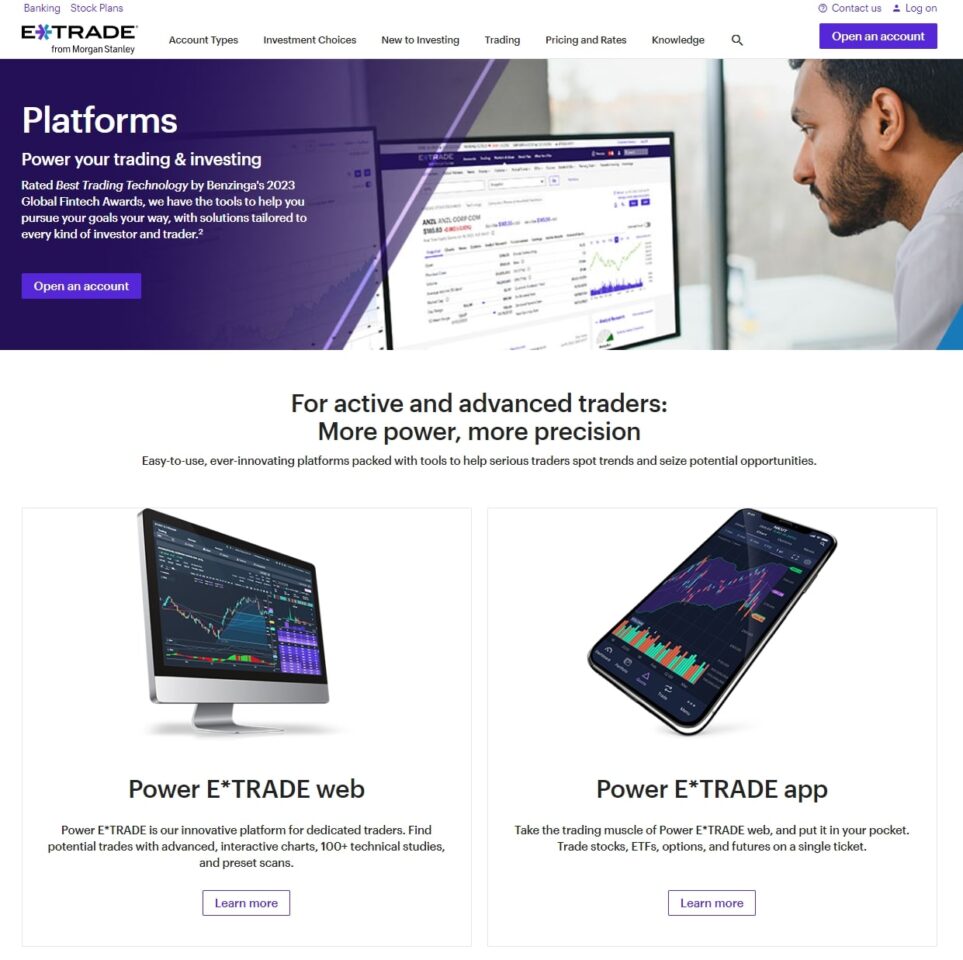
Founded in 1982, E*TRADE was one of the first firms to offer electronic trading to retail investors. Today it operates as a Morgan Stanley subsidiary, runs the Power E*TRADE platform for active traders alongside the standard web and mobile experience, and supports stocks, ETFs, options, futures, futures options, mutual funds, bonds, crypto futures, and crypto ETFs. It does not currently offer direct spot crypto trading, and it does not offer fractional shares for general stock purchases outside of dividend reinvestment.
Active options traders get a pricing tier drop to $0.50 per contract after hitting 30 or more options trades per quarter, which is the single biggest fee advantage E*TRADE has over Fidelity. E*TRADE also offers paper trading inside Power E*TRADE, which is useful for options strategy testing before live deployment.
Fidelity at a Glance
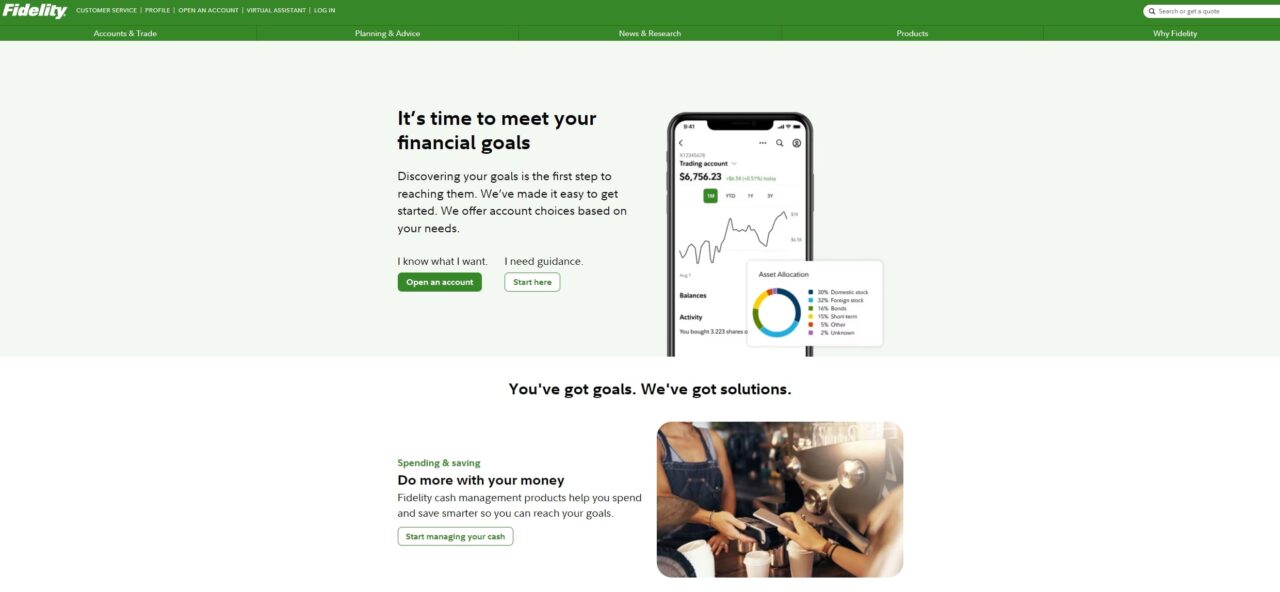
Fidelity Investments was founded in 1946 and remains one of the largest privately held financial services firms in the world. Its retail self-directed platform covers stocks, ETFs, options, mutual funds, bonds, and direct spot crypto on Bitcoin, Ethereum, and Litecoin through Fidelity Crypto. Fractional shares start at $1 across essentially any U.S.-listed stock or ETF, which is a significant advantage for newer investors and dollar-cost averaging strategies.
Fidelity runs Active Trader Pro as its desktop platform for active traders and pairs it with a web platform and a widely regarded mobile app. It also operates more than 200 physical branches across the U.S., publishes a deep proprietary research library, and offers several zero-expense-ratio mutual funds. StockBrokers.com ranked Fidelity #1 for research across the 14 online brokers it reviewed in its 2026 annual report.
E*TRADE vs. Fidelity: Side-by-Side Comparison
| Category | E*TRADE | Fidelity |
|---|---|---|
| Parent company | Morgan Stanley (since 2020) | Private, Johnson family and employees |
| Year founded | 1982 | 1946 |
| Stock and ETF commissions | $0 | $0 |
| Options commissions | $0.65/contract ($0.50 at 30+ trades/quarter) | $0.65/contract |
| Futures | Yes, $1.50/contract plus exchange fees | No |
| Crypto | Crypto futures and crypto ETFs only | Direct spot: BTC, ETH, LTC |
| Mutual fund selection | 4,400+ no-load, no-transaction-fee funds | 3,400+ NTF funds, including zero-expense-ratio Fidelity ZERO funds |
| Fractional shares | DRIP only | Yes, from $1 on any U.S. stock or ETF |
| Account minimum | $0 | $0 |
| Margin rates (approximate base) | ~13.45% on balances under $10K | ~12.575% on balances under $25K |
| Desktop platform | Power E*TRADE | Active Trader Pro |
| Paper trading | Yes | No |
| Physical branches | ~30 E*TRADE branches plus Morgan Stanley wealth locations | 200+ investor centers nationwide |
| Journal integration (SnapTrade) | Yes | Yes |
Trading Platforms Compared
Power E*TRADE vs. Active Trader Pro (Desktop)
Power E*TRADE is the more chart-forward of the two. It carries a cleaner options chain layout, strategy tools like Strategy Optimizer for comparing multi-leg setups before entry, a risk-and-reward visualization on every options order ticket, and paper trading. It is the stronger choice for traders whose primary activity is options strategy testing and execution.
Active Trader Pro leans more toward stock and ETF execution, with deeper level 2 data, customizable multi-monitor layouts, and directed routing controls. It is the stronger choice for equity day traders and swing traders who care about order routing precision and real-time market depth. It does not include paper trading, which is a real limitation if you want to test a strategy before deploying capital.
Web Platforms
Both brokers run competent browser-based platforms for investors who do not want to install desktop software. Fidelity’s web platform is the cleaner experience for standard buy-and-hold investing, portfolio review, mutual fund research, and retirement-account management. E*TRADE’s web platform exposes more direct-trade affordances (options chains, futures ticker lookups, conditional orders) without forcing the user into the desktop install.
Mobile Apps
Fidelity’s mobile app consistently scores at the top of broker app reviews for breadth: full research access, mutual fund transactions, options chains, multi-account management, bill pay, and Fidelity Crypto access all in one app. E*TRADE splits the experience across two apps: the standard E*TRADE app for general investing and the separate Power E*TRADE app, which is the one to use for active options and futures trading on mobile. Casual investors generally prefer Fidelity’s unified app; active options traders prefer Power E*TRADE mobile.
Fees and Commissions in Detail
| Fee Type | E*TRADE | Fidelity |
|---|---|---|
| Stocks and ETFs | $0 | $0 |
| Options base | $0.65/contract | $0.65/contract |
| Options active-trader tier | $0.50/contract at 30+ trades per quarter | No active-trader tier |
| Futures | $1.50/contract plus exchange fees | Not offered |
| Mutual fund (non-NTF) | $19.99 per transaction | $49.95 on buys ($0 on sells) |
| Option exercise/assignment | $0 | $0 |
| Outgoing ACAT | $75 | $0 (as of 2026) |
| Margin rate (base, under $10K) | ~13.45% | ~12.575% |
For the typical investor placing a handful of stock or ETF trades per month, fees are effectively identical. Where the difference bites is at the edges: high-volume options traders save meaningful money at E*TRADE, while Fidelity’s $0 outgoing ACAT and lower margin base rate matter for anyone holding leveraged positions or planning to move assets later.
Margin costs are the other place the two brokers separate for traders who borrow. Fidelity’s published base rate sits a touch lower than E*TRADE’s across comparable balance tiers (Fidelity near 12.575% versus E*TRADE’s higher base as of 2026), and both scale the rate down as your balance grows. If you carry margin regularly, even a fraction of a percent compounds, so price the tier you would actually borrow at rather than the headline number.
Investment Options and Asset Classes
Both brokers cover the standard retail asset mix of stocks, ETFs, options, mutual funds, and fixed income. The differences show up on the edges: futures, crypto, and fractional shares.
Where E*TRADE pulls ahead: Futures (including the full CME suite) and futures options are available, which Fidelity does not offer at all. Active options traders also benefit from Power E*TRADE’s strategy-modeling tools, the $0.50 active-trader tier, and paper trading for testing multi-leg structures before deployment.
Where Fidelity pulls ahead: Fractional shares from $1 on any U.S.-listed stock or ETF, a meaningful edge for newer investors and anyone running dollar-cost-averaging into high-priced names. Direct spot crypto on Bitcoin, Ethereum, and Litecoin through Fidelity Crypto, compared to E*TRADE’s indirect exposure via futures and ETFs. Zero-expense-ratio index funds in the Fidelity ZERO family, which cannot be matched on cost by any fund at E*TRADE. A broader IRA menu including solo 401(k) support for self-employed traders.
Research and Education
Fidelity’s research desk is the single strongest reason long-term investors pick Fidelity over E*TRADE. The broker ranked #1 for research across all 14 online brokers in StockBrokers.com’s 2026 annual review, pairing its own in-house equity and fixed-income research with third-party reports from providers like Zacks, Argus, Morningstar, and Thomson Reuters. Fundamental data goes deep on every equity screener, and the mutual fund and ETF screeners are industry-leading.
E*TRADE’s research picked up a meaningful boost after the Morgan Stanley acquisition, with Morgan Stanley’s institutional research now feeding into the self-directed experience. It is stronger than it was pre-2020, but it still sits a step below Fidelity on the depth and independence of available reports. Where E*TRADE holds its own is in active-trader education: Power E*TRADE’s in-platform strategy library, options learning center, and paper-trading integration give active traders a tighter feedback loop than Fidelity’s education suite.
Customer Support, Branches, and Cash Management
Both brokers offer 24/7 phone support, secure message center access inside the logged-in experience, and in-app chat. Fidelity’s support wins on in-person access: the broker operates more than 200 investor centers across the U.S. for account review, financial planning, and cash management support. E*TRADE’s physical footprint is smaller (roughly 30 branded E*TRADE branches), though account holders can also access the broader Morgan Stanley wealth-management branch network for advisor-led services.
Cash management is close. Both brokers offer a linked cash management account with a debit card, bill pay, and ATM fee rebates. Fidelity’s Cash Management Account reimburses ATM fees worldwide with no balance requirement, which is a real edge for travelers.
Who Should Choose E*TRADE
- Active options traders hitting 30+ contracts per quarter. The $0.50 per contract tier meaningfully lowers cost on high-frequency options strategies and is not matched at Fidelity.
- Traders who want futures under one roof. Fidelity does not offer futures at all. E*TRADE covers the CME suite plus futures options.
- Options strategy testers. Paper trading inside Power E*TRADE is a distinct advantage over Fidelity for structure-testing before going live. See our E*TRADE vs. thinkorswim comparison for how Power E*TRADE stacks up against the other major active-trader platform.
The trade-offs: E*TRADE has no direct international-exchange access and pays a lower default rate on uninvested cash than some competitors, so global stock traders and anyone optimizing idle cash will feel those gaps.
Who Should Choose Fidelity
- Long-term investors and beginners. Fractional shares from $1, zero-expense-ratio funds, and the top-ranked research desk make Fidelity the default choice for buy-and-hold portfolios.
- Retirement-focused savers. Broader IRA and solo 401(k) support, plus 200+ branches where you can sit down with a representative for planning questions.
- Investors who want direct spot crypto alongside stocks. Fidelity Crypto supports BTC, ETH, and LTC inside the same login as the brokerage account. If you are also cross-shopping Schwab, see our E*TRADE vs. Schwab breakdown for how E*TRADE’s feature set compares against the other major Morgan-Stanley-adjacent option.
The trade-offs: Fidelity offers no futures and no forex, and its direct crypto support is limited to Bitcoin, Ethereum, and Litecoin, so dedicated derivatives traders and broad-altcoin buyers will look elsewhere.
How to Track Your Trades at E*TRADE or Fidelity
Neither E*TRADE nor Fidelity provides a serious post-trade analytics layer out of the box. You get order history, realized and unrealized P&L, and basic gain-loss reports. What you do not get is win rate by setup, equity curve vs. a benchmark, hold-duration analysis, or the ability to see performance side-by-side if you run accounts at both brokers. That is where a dedicated trading journal fills the gap.
The Financial Tech Wiz Trading Journal connects to both E*TRADE and Fidelity through SnapTrade, the broker-aggregation backbone that is live across 36 supported brokers. You log in once, SnapTrade pulls your full trade history (you choose the date range on import), and every closed trade shows up with win rate, P&L by symbol, performance by time of day, portfolio vs. SPY, QQQ, or IWM benchmark comparison, and drawdown tracking. If you run accounts at both brokers, you can see combined performance in a single dashboard or segment by account. Specific broker-import walkthroughs are available for both: track your E*TRADE trades with the Financial Tech Wiz Trading Journal and track your Fidelity trades with the Financial Tech Wiz Trading Journal.
If you want a free starting point before subscribing, grab the free Google Sheets trading journal template. It handles manual entry, benchmarks against the S&P 500, and includes the core performance breakdowns. For a broader roundup of the options for active traders, see best trading journals for active traders.
Get Your Free Trading Resources
Grab the free trading journal template plus the same tools we use to stay organized, consistent, and objective.
- Free trading journal template
- Custom indicators, watchlists, and scanners
- Access our free trading community
Enter your email below to get instant access.
No spam. Unsubscribe anytime.
Frequently Asked Questions
Is Fidelity or E*TRADE better for beginners?
Fidelity is the stronger choice for most beginners. Fractional shares from $1, no account minimum, 200+ physical branches, and the top-ranked research and education library across major brokers make it the lower-friction starting point. E*TRADE is still a reasonable option if the beginner plans to trade options and wants Power E*TRADE’s paper trading to practice before deploying capital.
Is E*TRADE part of Fidelity?
No. Morgan Stanley acquired E*TRADE in October 2020 and now runs it as a subsidiary of its wealth-management business. Fidelity Investments is a separate private company owned by the Johnson family and Fidelity employees. The two brokers are unaffiliated and compete directly for retail accounts.
Do E*TRADE and Fidelity charge stock trading commissions?
No. Both brokers charge $0 for U.S. stocks and ETFs. Options cost $0.65 per contract at both, with E*TRADE dropping to $0.50 per contract once you hit 30 or more options trades in a quarter. Fidelity does not offer an active-trader options tier.
Does E*TRADE or Fidelity offer fractional shares?
Fidelity does, starting at $1 on any U.S.-listed stock or ETF. E*TRADE does not offer fractional shares for general stock purchases outside of dividend reinvestment, where partial-share accrual happens automatically. If fractional investing matters to you, Fidelity is the clear choice.
Does E*TRADE or Fidelity offer futures trading?
E*TRADE does. Fidelity does not. Futures commissions at E*TRADE are $1.50 per contract plus exchange fees, covering the CME equity index, metals, energy, and agricultural suites. E*TRADE also supports futures options, which require a quick phone activation.
Can I trade crypto at E*TRADE or Fidelity?
Fidelity offers direct spot crypto trading on Bitcoin, Ethereum, and Litecoin through Fidelity Crypto, accessible inside the same login as the brokerage account. E*TRADE does not currently offer direct spot crypto. It does offer crypto futures (contracts on Bitcoin and Ether) and crypto-related ETFs for indirect exposure.
Is Fidelity or E*TRADE better for options trading?
For casual options traders, the two are even at $0.65 per contract. For active options traders placing 30 or more contracts per quarter, E*TRADE is cheaper at $0.50 per contract. On platform depth, Power E*TRADE carries stronger strategy-modeling tools and includes paper trading for pre-live testing, which Fidelity does not offer. For straightforward execution inside a long-term account, Fidelity is cleaner.
Can I transfer my account from E*TRADE to Fidelity or vice versa?
Yes. Both brokers support ACAT transfers, which move positions in-kind without forcing you to liquidate. Fidelity does not currently charge an outgoing ACAT fee. E*TRADE charges roughly $75 for a full outgoing transfer. The receiving broker in either direction typically reimburses ACAT fees for larger transfers on request.
What are the disadvantages of E*TRADE?
E*TRADE’s main gaps are no access to international stock exchanges or forex, a relatively low default interest rate on uninvested cash, and no direct spot-crypto trading. For most U.S. stock, ETF, and options traders these rarely bite, but international and forex traders will feel the first limitation immediately.
Should I switch from E*TRADE to Fidelity?
There is no wrong answer between the two, so switch only if a specific feature pulls you: Fidelity for fractional shares from $1, zero-expense-ratio index funds, lower margin rates, and physical branches, or E*TRADE if you prefer the Power E*TRADE options interface and its futures access. An ACATS transfer moves your positions in kind without selling, so you keep your cost basis.
Related Trading Platform Comparisons
- E*TRADE vs. Schwab
- E*TRADE vs. thinkorswim
- Schwab vs. thinkorswim
- Schwab vs. tastytrade
- Interactive Brokers vs. thinkorswim
- Webull vs. thinkorswim
- Best Trading Journals in 2026
Get Your Free Trading Resources
Grab the free trading journal template plus the same tools we use to stay organized, consistent, and objective.
- Free trading journal template
- Custom indicators, watchlists, and scanners
- Access our free trading community
Enter your email below to get instant access.
No spam. Unsubscribe anytime.