Morning Star Pattern: How to Spot and Trade It
This page may contain affiliate links. We may earn a commission if you make a purchase through these links. Nothing on this website should be construed as financial advice. Learn more.

A Morning Star pattern is a three-candle setup traders watch for a possible shift from a downtrend to a recovery. The shape is easy to recognize; the harder work is deciding whether the candles formed in a useful place, waiting for confirmation, and defining risk before acting.
This guide explains the candle sequence, a repeatable way to check it, an example with prices, and the limits that matter when you review the setup.
Log this setup and see your win rate and P&L by symbol, hold time and time of day.
Create a free accountFree account, no card. Financial Tech Wiz makes this journal.
Key Takeaways
- A Morning Star is a potential bullish reversal pattern: it is most relevant after a visible decline and near an area where buyers may respond.
- The third candle should close firmly into the first candle’s body; many traders use a close above its midpoint as a simple confirmation rule.
- The pattern is a clue, not a forecast. Set an invalidation level and size the trade before entry.
What Is a Morning Star Pattern?
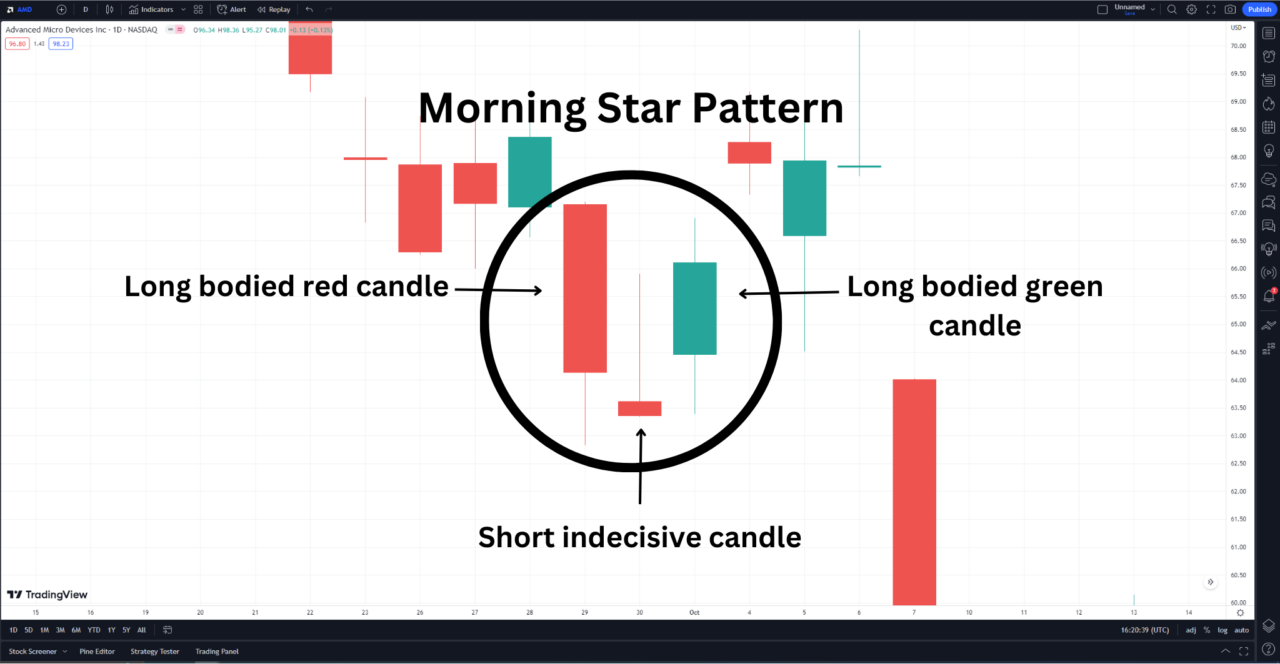
The Morning Star is a three-candle formation that can appear after a sustained decline. It suggests that selling pressure may be easing and buyers are beginning to respond. A pattern name does not confirm a trend change by itself: location and the next price action matter.
- First candle: a relatively long bearish real body that continues the preceding decline.
- Second candle: a smaller real body showing hesitation. It can be bullish or bearish, and it may look like a doji or spinning top.
- Third candle: a bullish real body that closes well into the first candle’s body. A close above the first candle’s midpoint is a common confirmation threshold.
Classic diagrams often show gaps between the candles. Gaps are not required for every market or chart interval, especially where trading continues for extended hours. Focus on the bodies, the preceding trend, and where the third candle closes rather than requiring a gap that may be uncommon in the instrument you follow.
The pattern also has a bearish counterpart. An Evening Doji Star forms after an advance and can warn that buyers are losing control. Both names describe a possible shift in pressure; neither guarantees a reversal.
How to Identify a Morning Star on a Chart
Start with context instead of scanning for three candle shapes in isolation. The chart patterns guide covers other formations and the role of trend, support, and confirmation. Use this sequence for the Morning Star:
- Check for a decline. Look for lower swing highs, lower swing lows, or another clear reason to describe the recent movement as a downtrend. A three-candle cluster inside a sideways range has less reversal context.
- Mark the first candle’s body. Note its open, close, and midpoint. The body is the distance between open and close; the wicks show the full high and low for that period.
- Look for hesitation. The middle candle should have a smaller body than the first. Its small size signals indecision, but it does not prove that sellers are finished.
- Wait for the third candle to close. Check whether it is bullish and closes well into the first body. If your written rule requires a close above the midpoint, do not count a touch of that level as confirmation.
- Review the location. A pattern near prior support, a well-defined base, or another level you already track may be more useful than the same shape in the middle of an unstructured decline. Treat those areas as context, not guarantees.
Morning Star Pattern Example
Consider an illustrative daily chart after a stock has been making lower lows. The first candle opens at $104 and closes at $98, creating a $6 real body. Its midpoint is $101. The next candle has a much smaller body near the low, showing that the decline has paused.
If the third candle opens at $97 and closes at $100.50, it is bullish, but it has not closed above the first candle’s $101 midpoint. A trader whose rule requires that midpoint would keep the setup unconfirmed. If the candle instead closes at $102, the close clears that rule. This example explains a chart rule; it is not a prediction about any security.
Some traders use a less strict confirmation level, while others want a close above the first candle’s midpoint or above a nearby swing level. Decide which rule you will use before reviewing results. Changing the threshold after seeing the outcome makes a journal less useful.
How Traders Plan Around the Pattern
The pattern does not choose an entry, stop, or position size for you. A repeatable plan separates those decisions:
- Entry: decide whether your plan enters after the third candle closes, after price moves above its high, or after a later pullback. Each approach gives a different entry price and should be evaluated consistently.
- Invalidation: choose the price that would show your setup thesis is no longer valid. Some traders use a level below the pattern’s low; others use a nearby structure level. A stop order cannot guarantee an exit at the stop price if the market gaps.
- Risk per share: subtract the planned stop price from the entry price for a long setup. For example, an entry at $50 and an invalidation level at $48 creates $2 of planned price risk per share before fees and slippage.
- Position size: divide the dollar amount you are willing to risk by the planned risk per share. If the planned risk budget is $100 and the example risk is $2 per share, the arithmetic gives 50 shares before costs. This is only a sizing illustration; choose risk limits that fit your own circumstances.
A stronger third candle or higher volume may support a trader’s read, but neither guarantees follow-through. Some traders also compare the move with support or with indicators. If you use an indicator, define what it must show before the setup qualifies. The guide to TradingView indicators covers common tools, but a second signal does not remove market risk.
Common Morning Star Trading Mistakes
- Ignoring the prior trend. The same three candles can appear anywhere. Without a decline beforehand, the reversal interpretation is weaker.
- Calling the pattern before the third candle closes. A developing candle can change shape before the period ends. Evaluate the completed bar against your rule.
- Treating a doji as proof. A small middle candle shows a pause, not a confirmed change in control.
- Entering only because the name sounds bullish. A bullish label does not make the setup suitable for every account, timeframe, or market condition.
- Moving the stop farther away after entry. If the invalidation level changes, record why and recalculate the risk rather than treating the original amount as unchanged.
- Assuming volume or an indicator makes the setup certain. These can be part of a checklist, but they do not eliminate false signals, gaps, or losses.
- Changing definitions between examples. If one review requires a close above the midpoint and another accepts any close into the body, the results are not directly comparable.
How to Review Morning Star Setups
Record what you could know at the time of the decision: the prior trend, the three candle values, the confirmation rule, the entry and invalidation levels, and any reason you passed on the setup. Add the result only after the trade closes. This makes it easier to separate a sound process from a lucky outcome.
Save a chart image or note the candle values when you review the setup, before later price action changes the picture. Include examples you passed on as well as trades you took. Reviewing only completed entries can hide how often the same rules produced no trade, which makes the pattern look more consistent than it was.
After you have a set of comparable examples, group them by the conditions you actually recorded, such as timeframe, location, or whether you waited for the confirmation close. Small samples can be noisy, so do not treat a handful of trades as proof that a pattern has a fixed success rate. The Financial Tech Wiz Trading Journal has a free account, so you have a place to organize trades and review performance from your first logged setup. The bearish engulfing pattern guide covers a different reversal structure you can study alongside it.
For a charting example, you can mark the three candles and the first candle’s midpoint in TradingView or another charting platform. Use the same candle interval and confirmation rule when you compare examples.
Disclosure: I may earn a commission if you open a TradingView account through this link.
When a Morning Star May Be Less Useful
A visually clean pattern can still be a poor fit for a particular plan. Be cautious when the candles appear in a flat range, when the decline is only one brief move, or when the third candle closes weakly near its low. In each case, the reversal story may be less convincing than the three-candle label suggests.
Timeframe changes the meaning of each candle. A daily candle summarizes a full session; a five-minute candle captures a much shorter period and can be affected by opening volatility, news, or a temporary liquidity gap. Apply the same definition to each timeframe and do not compare results from different intervals as if they were identical setups.
Also check whether the expected entry is still practical after confirmation. If price has already moved far above the pattern, the distance to a reasonable invalidation point may make the planned risk too large for your rules. Passing on a late setup is a valid decision. The goal is to follow a consistent process, not to take every pattern that looks familiar.
Morning Star Pattern FAQ
Is a Morning Star pattern bullish?
It is generally interpreted as a potential bullish reversal because it follows a decline and ends with a stronger bullish candle. It is still a pattern interpretation, not a promise. Check the prior trend, your confirmation rule, and the risk at the planned entry.
Which stocks have a Morning Star pattern?
The pattern can appear on many stocks and other actively traded instruments; the list changes as new candles form. Use a chart or screener to review current candidates, then check the trend and candle sequence yourself. A scan result is a starting point, not a trade instruction.
What is the most successful chart pattern?
There is no single pattern that is most successful for every market, timeframe, and trading plan. Results depend on how a trader defines the setup, manages risk, and measures outcomes. Compare consistent examples from your own process instead of relying on a universal success claim.
What does the Morning Star pattern mean in the stock market?
It describes a three-candle sequence that may show selling pressure easing after a decline. Traders often look for a bullish third candle that closes into the first candle’s body. The pattern means buyers may be responding; price can still fall or continue sideways.
Financial Tech Wiz / Free resources
Build a clearer picture of your trading.
Start with a free journal account. Keep your trades organized, review your results, and build a consistent review routine.
Your free journal account includes the template and tools by email:
- Free Google Sheets and Excel trading journal template
- Indicators, watchlists, and scanners
- Access to the free trading community
Ready for automatic trade tracking? Explore the Financial Tech Wiz Trading Journal.
Free journal. No card needed.